
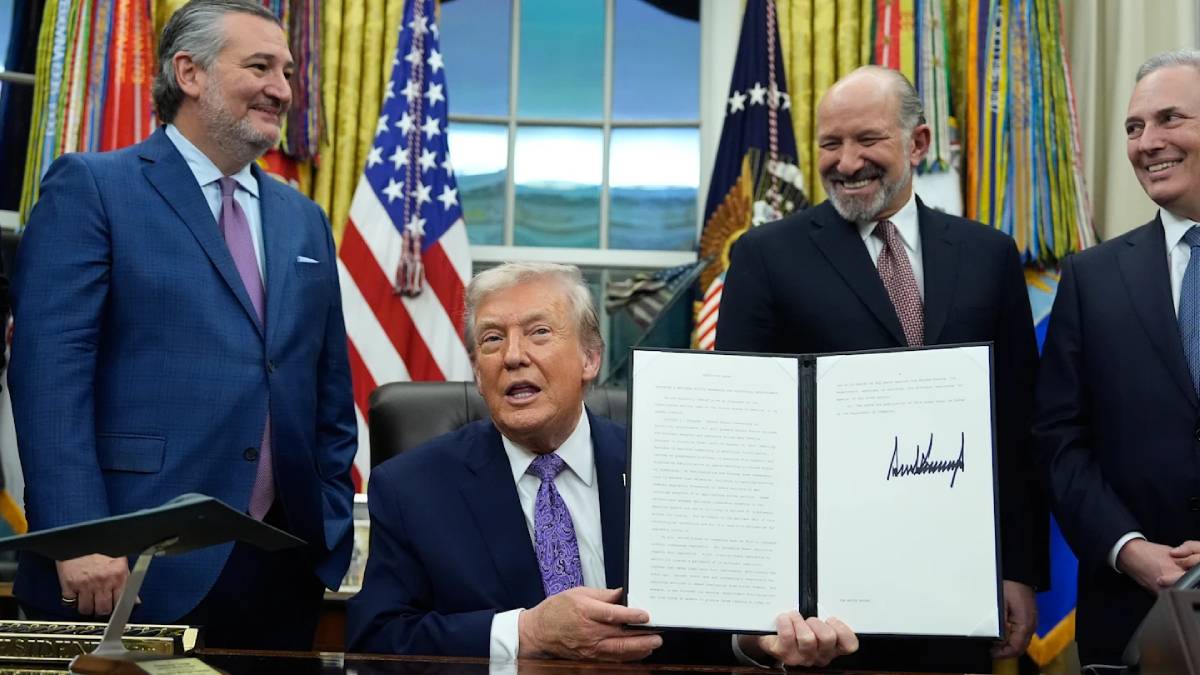
Trump AI Agenda Triggers Republican Rift Before Midterms

Trump’s policy push emphasizes accelerating domestic AI development, strengthening US competitiveness against China, and expanding federal support for AI infrastructure and innovation.

February 24, 2026
|

A political fault line is emerging within the Republican Party as Donald Trump advances an aggressive artificial intelligence agenda, prompting backlash from segments of his MAGA base. The dispute carries implications for US technology policy, electoral strategy, and investor sentiment ahead of the midterm elections.

Trump’s policy push emphasizes accelerating domestic AI development, strengthening US competitiveness against China, and expanding federal support for AI infrastructure and innovation.

However, factions within the MAGA movement have expressed concern over government collaboration with major technology firms and potential surveillance risks tied to advanced AI systems.

The internal friction surfaces as Republicans position themselves for upcoming midterm contests, where turnout and ideological cohesion will be critical.

The debate intersects with broader economic themes, including industrial policy, technology sovereignty, and national security. For markets, political uncertainty around AI regulation and funding priorities introduces fresh variables into an already volatile technology landscape.

The development aligns with a broader global race to dominate artificial intelligence capabilities. The US and China remain locked in strategic competition over semiconductors, advanced computing, and AI governance frameworks.

Historically, bipartisan support has underpinned US technology leadership initiatives. However, AI’s societal implications including automation, misinformation, and surveillance have intensified ideological divides.

Trump’s positioning reflects a nationalistic approach focused on reshoring manufacturing, tightening export controls, and boosting domestic innovation. Yet skepticism within populist circles about Big Tech influence complicates coalition-building.

As AI becomes central to economic and defense policy, internal party divisions could affect legislative momentum. For global investors, clarity in US AI policy direction remains a key determinant of capital allocation decisions in the technology sector.

Political analysts suggest the tension reflects a broader recalibration within conservative politics, balancing pro-innovation economic messaging with grassroots distrust of large technology platforms.

Policy experts argue that advancing AI leadership requires coordination between government and private industry an approach that may clash with anti-corporate rhetoric prevalent in parts of the MAGA base.

Market strategists note that regulatory stability is essential for sustaining AI investment cycles. If political fragmentation delays funding approvals or introduces abrupt policy shifts, enterprise planning could face uncertainty.

Observers also point out that AI policy debates are increasingly intertwined with national security narratives, making bipartisan compromise both urgent and politically sensitive. For technology firms, internal Republican divisions could complicate expectations around federal incentives, procurement contracts, and export controls. Companies reliant on AI infrastructure funding may face delays if legislative consensus weakens.

Investors may respond cautiously to political volatility, particularly in sectors tied to defense, semiconductors, and cloud computing.

From a policy standpoint, the episode underscores the fragility of consensus around emerging technologies. Regulatory clarity, funding continuity, and public trust will be essential to maintain US leadership in AI.

For C-suite executives, scenario planning around political outcomes is becoming increasingly critical. The trajectory of Trump’s AI agenda will depend on electoral dynamics and the party’s ability to reconcile internal divisions. Observers will watch legislative proposals, campaign messaging, and polling trends closely.

As midterms approach, AI policy may evolve from a technology issue into a defining political battleground shaping America’s innovation strategy.

Source: Australian Financial Review
Date: February 23, 2026

  • Featured tools
Upscayl AI
Free

Upscayl AI is a free, open-source AI-powered tool that enhances and upscales images to higher resolutions. It transforms blurry or low-quality visuals into sharp, detailed versions with ease.

#
Productivity
Learn more
Symphony Ayasdi AI
Free

SymphonyAI Sensa is an AI-powered surveillance and financial crime detection platform that surfaces hidden risk behavior through explainable, AI-driven analytics.

#
Finance
Learn more

Learn more about future of AI

Join 80,000+ Ai enthusiast getting weekly updates on exciting AI tools.
Thank you! Your submission has been received!
Oops! Something went wrong while submitting the form.

Trump AI Agenda Triggers Republican Rift Before Midterms

February 24, 2026

Trump’s policy push emphasizes accelerating domestic AI development, strengthening US competitiveness against China, and expanding federal support for AI infrastructure and innovation.

A political fault line is emerging within the Republican Party as Donald Trump advances an aggressive artificial intelligence agenda, prompting backlash from segments of his MAGA base. The dispute carries implications for US technology policy, electoral strategy, and investor sentiment ahead of the midterm elections.

Trump’s policy push emphasizes accelerating domestic AI development, strengthening US competitiveness against China, and expanding federal support for AI infrastructure and innovation.

However, factions within the MAGA movement have expressed concern over government collaboration with major technology firms and potential surveillance risks tied to advanced AI systems.

The internal friction surfaces as Republicans position themselves for upcoming midterm contests, where turnout and ideological cohesion will be critical.

The debate intersects with broader economic themes, including industrial policy, technology sovereignty, and national security. For markets, political uncertainty around AI regulation and funding priorities introduces fresh variables into an already volatile technology landscape.

The development aligns with a broader global race to dominate artificial intelligence capabilities. The US and China remain locked in strategic competition over semiconductors, advanced computing, and AI governance frameworks.

Historically, bipartisan support has underpinned US technology leadership initiatives. However, AI’s societal implications including automation, misinformation, and surveillance have intensified ideological divides.

Trump’s positioning reflects a nationalistic approach focused on reshoring manufacturing, tightening export controls, and boosting domestic innovation. Yet skepticism within populist circles about Big Tech influence complicates coalition-building.

As AI becomes central to economic and defense policy, internal party divisions could affect legislative momentum. For global investors, clarity in US AI policy direction remains a key determinant of capital allocation decisions in the technology sector.

Political analysts suggest the tension reflects a broader recalibration within conservative politics, balancing pro-innovation economic messaging with grassroots distrust of large technology platforms.

Policy experts argue that advancing AI leadership requires coordination between government and private industry an approach that may clash with anti-corporate rhetoric prevalent in parts of the MAGA base.

Market strategists note that regulatory stability is essential for sustaining AI investment cycles. If political fragmentation delays funding approvals or introduces abrupt policy shifts, enterprise planning could face uncertainty.

Observers also point out that AI policy debates are increasingly intertwined with national security narratives, making bipartisan compromise both urgent and politically sensitive. For technology firms, internal Republican divisions could complicate expectations around federal incentives, procurement contracts, and export controls. Companies reliant on AI infrastructure funding may face delays if legislative consensus weakens.

Investors may respond cautiously to political volatility, particularly in sectors tied to defense, semiconductors, and cloud computing.

From a policy standpoint, the episode underscores the fragility of consensus around emerging technologies. Regulatory clarity, funding continuity, and public trust will be essential to maintain US leadership in AI.

For C-suite executives, scenario planning around political outcomes is becoming increasingly critical. The trajectory of Trump’s AI agenda will depend on electoral dynamics and the party’s ability to reconcile internal divisions. Observers will watch legislative proposals, campaign messaging, and polling trends closely.

As midterms approach, AI policy may evolve from a technology issue into a defining political battleground shaping America’s innovation strategy.

Source: Australian Financial Review
Date: February 23, 2026

Promote Your Tool

Copy Embed Code

Similar Blogs

February 24, 2026
|

Jamie Dimon Calms Markets, Downplays AI Disruption Risks

Dimon addressed concerns at a corporate briefing, emphasizing JPMorgan’s proactive adoption of AI for efficiency, compliance, and customer services.
Read more
February 24, 2026
|

Asian Markets Steady After Wall Street Rout in AI Exposed Stocks

Markets across Asia traded unevenly following a sharp US selloff in technology and legacy IT stocks exposed to AI disruption. Wall Street investors rotated out of companies perceived as vulnerable to automation.
Read more
February 24, 2026
|

Crypto Markets Slide as AI Jitters Trigger Sharp IBM Selloff

Cryptocurrency markets recorded deeper declines amid a broader tech-led selloff, reflecting risk-off sentiment among global investors. IBM shares plunged 11%, highlighting heightened sensitivity to earnings expectations.
Read more
February 24, 2026
|

Indian IT Stocks Extend Losses as AI Fears Trigger Global Repricing

Shares of major Indian IT services firms extended losses following global volatility in AI-linked equities.
Read more
February 24, 2026
|

AI Coding Platforms Threaten Freemium App Model Economics

Advances in generative AI coding assistants now allow users to create simple, task-specific applications through natural language prompts, reducing reliance on standalone freemium utilities.
Read more
February 24, 2026
|

AI Powered Body Scans Expand Across Health and Retail

AI-driven body scanning platforms are increasingly being deployed in gyms, wellness centers, medical clinics, and retail environments.
Read more