



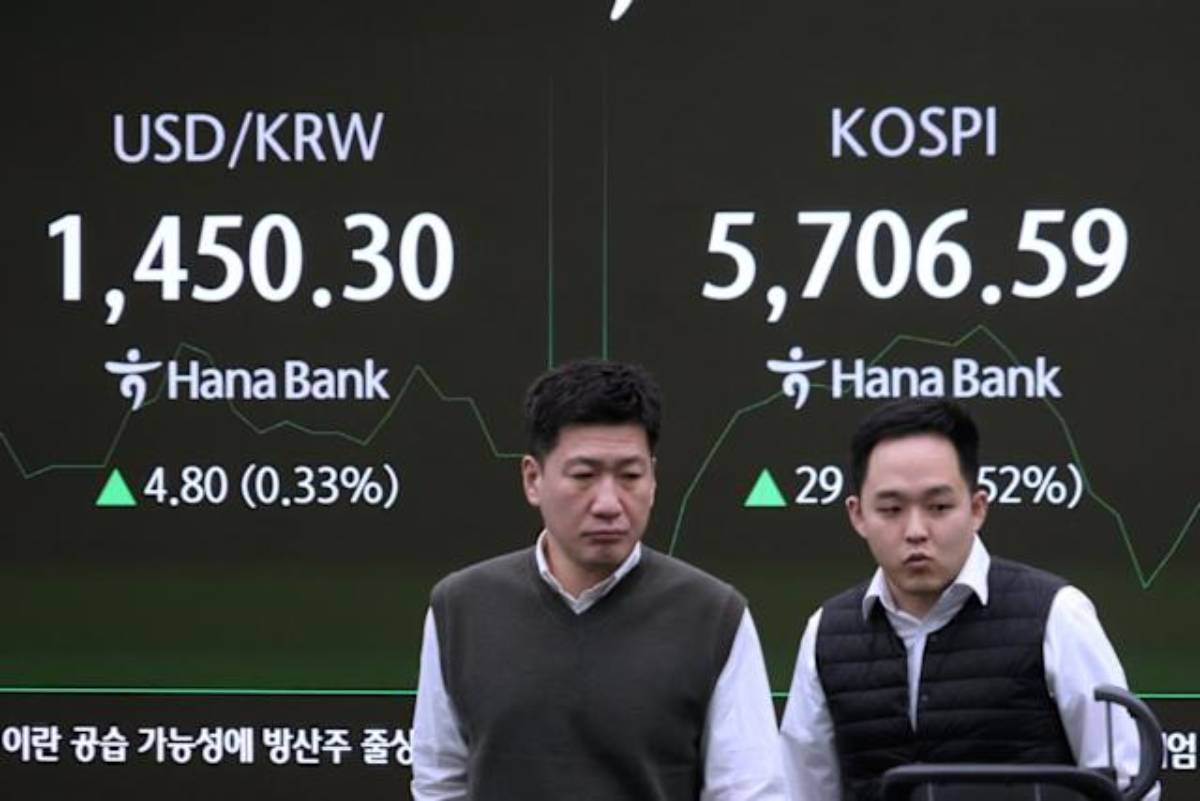
Asian equities delivered a mixed performance after heavy selling on Wall Street targeted companies viewed as potential losers in the accelerating AI shift. The volatility reflects growing investor scrutiny over which business models will thrive or falter as artificial intelligence reshapes global markets.
Markets across Asia traded unevenly following a sharp US selloff in technology and legacy IT stocks exposed to AI disruption. Wall Street investors rotated out of companies perceived as vulnerable to automation or generative AI displacement, triggering broader risk aversion.
Major US indices closed lower, setting a cautious tone for Asia-Pacific trading sessions. Technology suppliers, outsourcing firms, and legacy enterprise service providers were among the hardest hit in the US downturn.
Asian investors responded selectively, with some markets stabilizing while others tracked US declines, highlighting differentiated regional exposure to AI-driven structural change. The development aligns with a broader global trend where AI adoption is prompting rapid reassessment of corporate valuations. Investors are increasingly distinguishing between AI beneficiaries such as semiconductor manufacturers and cloud infrastructure providers and firms that may face margin compression due to automation.
Recent volatility has been amplified by concentrated capital flows into AI-linked mega-cap stocks, leaving markets sensitive to narrative shifts. Asian economies, deeply integrated into global supply chains and technology exports, are particularly exposed to US market sentiment.
At the same time, governments across the region are investing heavily in domestic AI capabilities, seeking to position themselves competitively in a strategic technology race. For executives, the mixed performance underscores uneven exposure to AI-led disruption across sectors and geographies.
Market analysts suggest the rotation reflects a maturing AI trade, where investors move beyond broad enthusiasm toward selective positioning. Strategists note that companies with limited AI integration strategies or heavy dependence on labor-based service models may face valuation pressure.
Regional economists emphasize that Asia’s export-oriented economies remain sensitive to US demand cycles and capital market movements. Portfolio managers argue that volatility may persist as markets attempt to price both the productivity gains and displacement risks associated with AI.
Experts broadly agree that the AI narrative is evolving from a singular growth story into a complex redistribution of corporate advantage. For global executives, the shift could redefine strategic investment priorities, particularly in technology transformation and workforce planning.
Companies may accelerate AI integration efforts to avoid being categorized as structural laggards. Investors are likely to demand clearer AI roadmaps and measurable performance indicators tied to automation efficiency.
Policymakers across Asia may intensify support for AI innovation ecosystems to maintain competitiveness amid shifting global capital flows. Boards and risk committees should prepare for continued valuation swings driven by AI positioning narratives.
Markets will monitor upcoming US earnings reports and macroeconomic data for clues on whether the AI-driven selloff stabilizes or deepens. Decision-makers should watch capital rotation trends and sector-specific performance gaps.
As AI reshapes competitive hierarchies, market volatility may remain elevated rewarding firms that demonstrate credible, scalable AI execution strategies.
Source: Yahoo Finance
Date: February 24, 2026


