



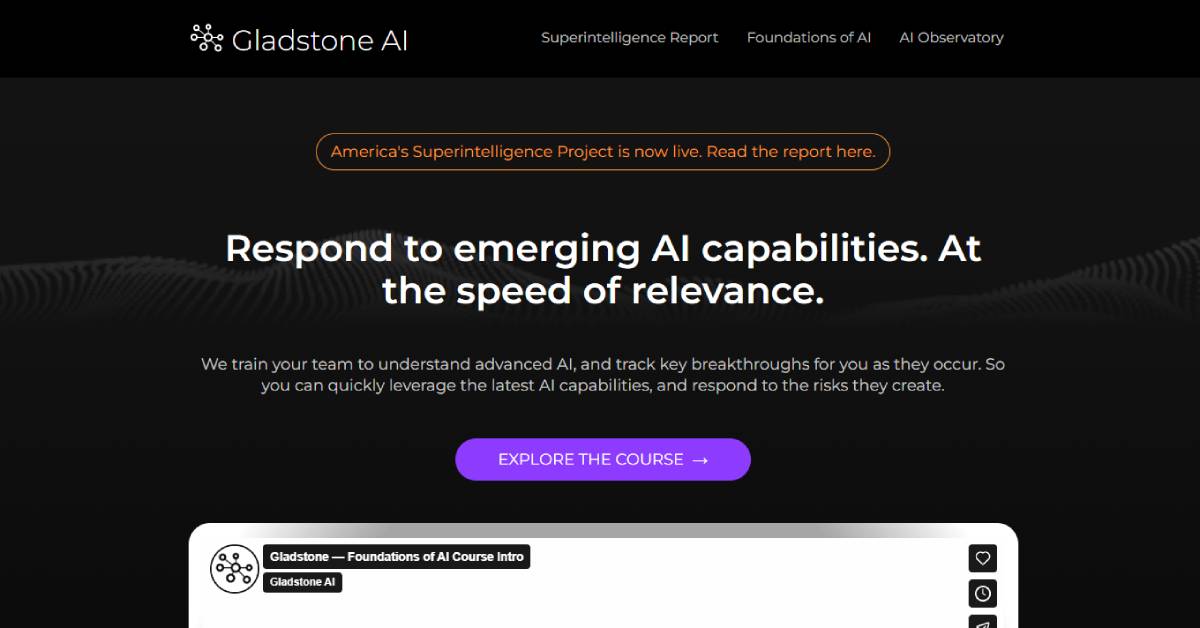
A major development unfolded as Gladstone AI presented itself as a focused artificial intelligence platform operating in the applied AI space. The initiative reflects growing momentum in domain-specific AI systems designed for enterprise and strategic use cases, with implications for decision intelligence, automation, and institutional adoption of AI-driven workflows.
Gladstone AI operates as an AI-focused entity positioning its technology around applied intelligence solutions rather than general-purpose consumer tools. The platform emphasizes structured AI applications that can be deployed in enterprise or mission-critical environments.
Its positioning reflects a broader shift in the AI sector toward specialized systems tailored for specific operational contexts, including decision support and data interpretation. While detailed public disclosures on product architecture and deployment scale remain limited, the company presents itself within the rapidly expanding ecosystem of applied AI vendors targeting high-value institutional workflows. The development aligns with increasing demand for configurable AI systems that extend beyond generic chatbot functionality.
The artificial intelligence landscape has increasingly fragmented into three broad categories: general-purpose foundation models, enterprise-integrated AI tools, and highly specialized domain-specific systems. Gladstone AI appears to align with the third category, where AI is engineered for targeted operational environments rather than broad consumer usage.
This trend has accelerated as organizations seek greater control over AI outputs, data governance, and system reliability. Rather than relying solely on large, generalized models, enterprises are investing in layered AI architectures that integrate reasoning, automation, and domain constraints.
The emergence of companies like Gladstone AI reflects a broader industry transition toward applied intelligence where value is derived not only from model scale, but from contextual precision, workflow integration, and security alignment within institutional systems.
Industry analysts note that the rise of applied AI platforms signals a maturation phase in the artificial intelligence market. As foundational models become more widely accessible, differentiation is shifting toward deployment specificity, reliability, and integration depth.
Technology strategists suggest that companies operating in this space must demonstrate clear value beyond model access particularly in regulated or high-stakes environments where accuracy and traceability are critical.
Experts also highlight that enterprise buyers are increasingly prioritizing AI systems that can operate within defined operational boundaries rather than open-ended generative models. This trend is expected to drive growth in vertically specialized AI vendors, while intensifying competition among firms offering tailored intelligence solutions.
For businesses, the rise of applied AI platforms like Gladstone AI signals a shift toward more modular and controllable AI deployment strategies. Organizations may increasingly adopt hybrid stacks combining foundation models with specialized decision systems.
For investors, this reflects a diversification of the AI market beyond large model providers into application-layer intelligence firms focused on enterprise value creation.
For policymakers and regulators, the expansion of specialized AI systems raises new considerations around accountability, auditability, and domain-specific risk management, particularly in sectors where AI outputs influence critical decisions.
Applied AI platforms are expected to expand as enterprises move beyond experimentation toward structured deployment. Future competition will likely center on reliability, integration depth, and regulatory compliance rather than model size alone. Gladstone AI and similar entities will be evaluated on their ability to deliver measurable operational impact within defined enterprise environments.
Source: Gladstone AI
Date: April 16, 2026


