



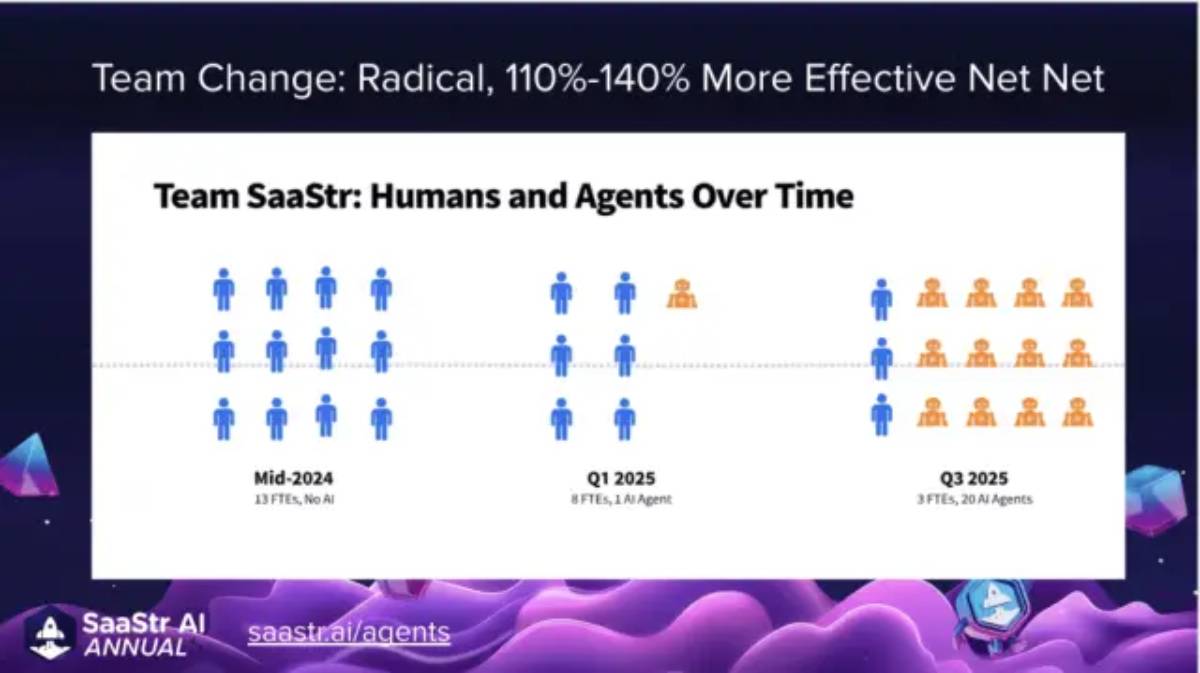
A major shift in enterprise sales strategy is emerging as AI-augmented teams demonstrate the ability to outperform traditional human-only models. New data shows a hybrid workforce of humans and AI agents achieving significantly higher sales output, signaling transformative implications for productivity, workforce design, and revenue operations.
Insights shared via SaaStr reveal that a sales operation combining roughly one full-time human resource with 20 AI agents achieved 140% of the output of a previous all-human team.
The AI agents handled tasks such as lead qualification, outreach, follow-ups, and data analysis, enabling the human operator to focus on high-value closing activities. The model highlights the scalability of AI-driven sales processes and the ability to significantly increase productivity with minimal human intervention.
The findings underscore a growing trend in enterprise adoption of AI agents to automate repetitive workflows while augmenting human decision-making in revenue-generating functions.
The development aligns with a broader trend across global markets where AI is reshaping knowledge work and operational structures. Sales, traditionally reliant on human interaction and relationship-building, is increasingly being augmented by automation and data-driven tools.
Advances in generative AI and autonomous agents have enabled systems to perform complex tasks such as personalized communication, pipeline management, and predictive analytics. This shift is part of a larger movement toward “agentic AI,” where software systems can act independently to achieve defined objectives.
Historically, productivity gains in sales have been incremental, driven by CRM systems and analytics tools. The introduction of AI agents represents a step change, offering exponential scalability. This evolution reflects a rethinking of workforce composition, where humans and AI collaborate to maximize efficiency and outcomes.
Industry analysts suggest that AI-augmented sales models could redefine productivity benchmarks across sectors. Experts note that the ability to scale outreach and engagement through AI agents allows organizations to operate with leaner teams while maintaining or increasing output.
However, some commentators caution that raw performance metrics may not capture the full picture. Factors such as customer relationships, deal quality, and long-term retention remain critical and may still depend heavily on human involvement.
Technology experts emphasize that successful implementation requires careful orchestration between human and AI roles, ensuring that automation enhances rather than replaces strategic thinking. The broader consensus is that AI will not eliminate sales roles but will fundamentally transform how they are executed.
For global executives, the findings highlight the potential to redesign sales organizations around AI-driven efficiency. Companies may need to invest in AI tools, retrain staff, and rethink performance metrics to align with hybrid models.
Investors are likely to favor businesses that demonstrate scalable, AI-enabled revenue generation. At the same time, workforce implications could drive discussions around job displacement, reskilling, and the future of work.
From a policy perspective, the rise of AI agents in customer-facing roles may raise questions about transparency, accountability, and ethical use of automation in business interactions.
Looking ahead, AI-augmented sales teams are expected to become increasingly common as organizations seek competitive advantage through efficiency and scalability. Decision-makers should monitor how these models impact customer experience and long-term business outcomes.
The balance between automation and human engagement will define the next phase of sales transformation, shaping how enterprises generate and sustain revenue in an AI-driven economy.
Source: SaaStr
Date: April 2026


