



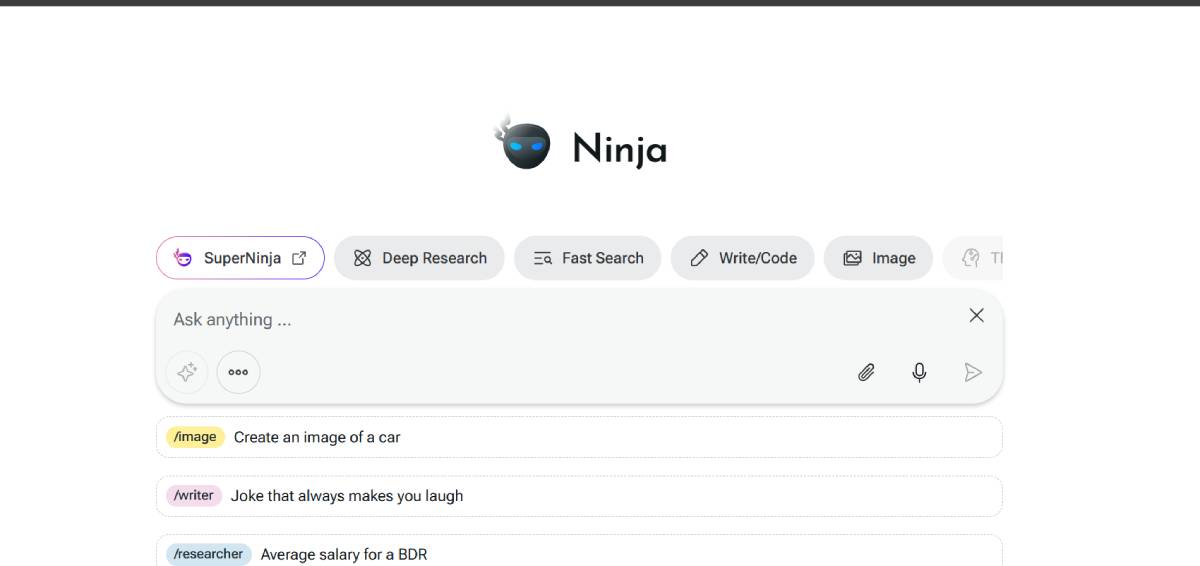
A new productivity-focused AI platform is entering the enterprise arena as Ninja AI positions itself as an all-in-one intelligent agent for business users. The development reflects intensifying competition in AI workplace automation, with implications for enterprises, startups, and digital workforce strategies worldwide.
Ninja AI offers a consolidated AI agent designed to manage tasks across writing, research, coding, data analysis, and workflow automation. The platform integrates multiple AI capabilities into a single interface, aiming to reduce fragmentation across enterprise tool stacks.
Target users include startups, remote teams, and corporate departments seeking operational efficiency. The company promotes real-time task execution, context retention, and multi-functional support features increasingly demanded in enterprise AI deployments.
By bundling productivity functions under one system, Ninja AI aligns with SaaS-driven subscription models that emphasize scalability and centralized management. Its launch reflects growing demand for AI agents capable of operating beyond simple chatbot interactions into workflow-level execution.
The development aligns with a broader shift toward AI agents as digital coworkers rather than standalone tools. Over the past two years, enterprises have experimented with generative AI for content creation and data synthesis. The next phase focuses on agentic systems capable of executing multi-step tasks autonomously.
Global technology leaders are investing heavily in AI copilots and workflow automation to enhance productivity while containing labor costs. Fragmentation across enterprise SaaS platforms has also created inefficiencies, driving demand for unified AI orchestration layers.
In parallel, regulatory scrutiny around AI governance and enterprise data security continues to evolve, particularly in regions tightening compliance standards. Ninja AI enters a competitive field shaped by rapid innovation, capital investment, and executive demand for measurable productivity gains.
Industry analysts suggest unified AI agent platforms could significantly streamline enterprise digital operations. Productivity consultants argue that organizations adopting centralized AI systems may reduce software redundancy and improve cross-team collaboration. However, cybersecurity experts warn that consolidating AI capabilities into one system increases the importance of strong data governance, encryption, and access controls.
Venture capital observers note rising investor interest in agentic AI startups, viewing them as the next evolution beyond generative text tools. Enterprise transformation leaders emphasize that success will depend not only on technological capability but also on employee training and change management frameworks. Ninja AI’s positioning reflects the broader industry ambition to transition AI from assistive feature to autonomous operational partner.
For businesses, integrated AI agents could reduce operational costs and accelerate project timelines. Executives may reassess software procurement strategies, favoring consolidated AI platforms over fragmented point solutions.
Investors tracking enterprise SaaS markets may view agentic AI as a high-growth vertical reshaping digital workplace economics. Regulators, meanwhile, may intensify focus on AI accountability, especially where automated agents execute decisions affecting compliance, financial reporting, or customer interactions. Corporate boards will likely demand clear governance frameworks to ensure transparency, auditability, and risk mitigation in AI-powered workflows.
Decision-makers should monitor adoption metrics, integration capabilities, and enterprise security certifications. Future competition will hinge on reliability, interoperability, and regulatory alignment.
Ninja AI’s emergence underscores a broader inflection point: AI agents are evolving from experimental assistants into core infrastructure shaping the productivity architecture of modern enterprises.
Source: Ninja AI Official Website
Date: March 2, 2026


