



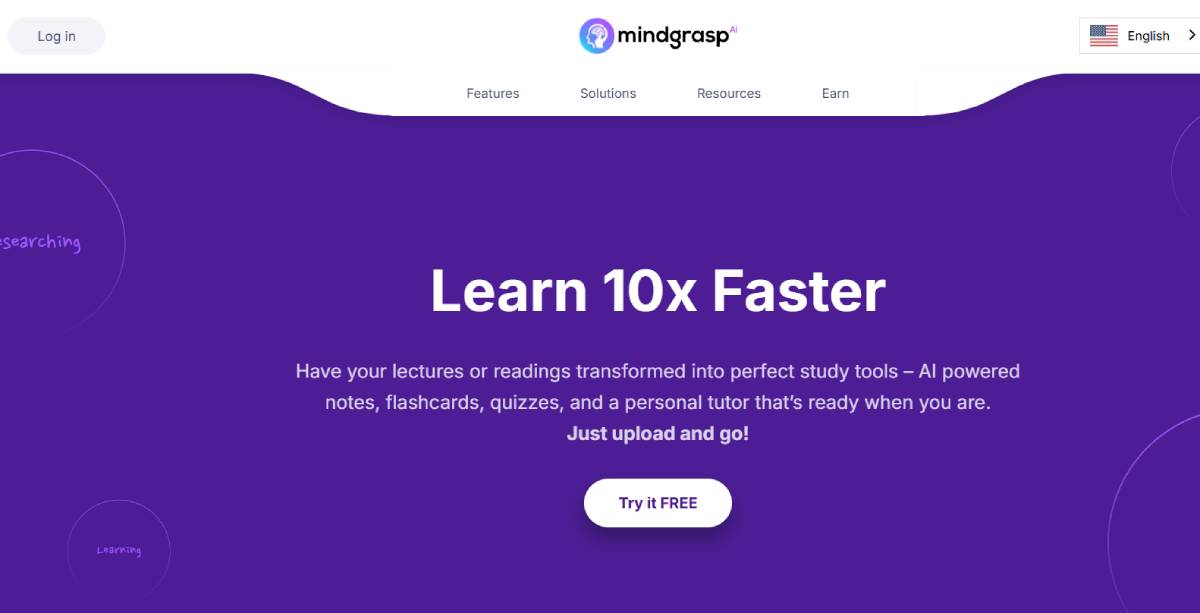
A major shift is underway in the global education technology sector as Mindgrasp AI expands its AI-powered learning platform aimed at students worldwide. The development signals a broader transformation in how knowledge is consumed, summarised, and retained reshaping academic productivity, institutional strategies, and the economics of digital education.
Mindgrasp AI has introduced an AI-driven study assistant that converts lectures, PDFs, videos, and textbooks into summaries, notes, flashcards, and quizzes within seconds. The platform is designed to support high school and university students, competitive exam candidates, and lifelong learners.
The company positions itself at the intersection of generative AI and academic performance enhancement, offering automated comprehension tools aimed at reducing study time and improving retention. As AI integration accelerates across classrooms globally, Mindgrasp AI enters a competitive market alongside established digital learning providers and emerging AI-native education platforms.
Its growth reflects rising venture capital interest in AI-led productivity tools within the global education market.
The emergence of platforms like Mindgrasp AI aligns with a broader global shift toward AI-personalised education. Since the rapid mainstream adoption of generative AI tools in 2023, institutions have grappled with balancing academic integrity concerns against productivity gains.
The global edtech market already valued in the hundreds of billions of dollars is undergoing structural change as AI transforms content delivery, assessment models, and student engagement metrics. Universities across North America, Europe, and Asia have begun formalising AI usage policies, while private tutoring and test-prep sectors increasingly deploy AI-driven automation to scale services.
Historically, digital learning platforms focused on content distribution. The new frontier centres on intelligent transformation of raw information into structured, adaptive learning outputs. This shift carries economic consequences for publishers, institutions, and credentialing bodies navigating a rapidly digitising knowledge economy.
Industry analysts suggest AI-native learning assistants represent the next productivity wave in knowledge industries. Education strategists argue that platforms like Mindgrasp AI could significantly compress study cycles, altering competitive dynamics in exam-based systems globally.
EdTech investors note that automation of summarisation and testing functions addresses a universal pain point time scarcity among students. However, policy experts caution that widespread AI adoption in education may accelerate regulatory scrutiny, particularly concerning data privacy, bias mitigation, and academic misuse.
Technology consultants further observe that institutions embracing AI augmentation rather than prohibition may gain performance advantages. The broader debate continues to centre on whether AI tools enhance cognitive engagement or risk over-automation of critical thinking processes an issue likely to shape institutional governance frameworks in the coming years.
For global executives, the rise of AI-powered study platforms signals monetisation opportunities in subscription-based academic productivity services. Education providers may need to reassess curriculum design, evaluation frameworks, and competitive positioning as AI tools become embedded in student workflows.
Investors are closely monitoring scalable AI learning platforms as potential high-growth assets within the digital economy. Meanwhile, regulators face mounting pressure to define ethical guardrails without stifling innovation.
For universities and certification bodies, the challenge lies in preserving assessment credibility while integrating AI efficiencies. The long-term impact could redefine institutional cost structures, talent pipelines, and global access to quality education.
As AI integration deepens across global education systems, platforms like Mindgrasp AI are poised to test the boundaries between augmentation and automation. Decision-makers should watch regulatory developments, institutional partnerships, and user adoption metrics.
The next phase of AI in education will likely determine whether such tools become supplemental aids or foundational infrastructure in the global knowledge economy.
Source: Mindgrasp AI Official Website
Date: March 4, 2026


