
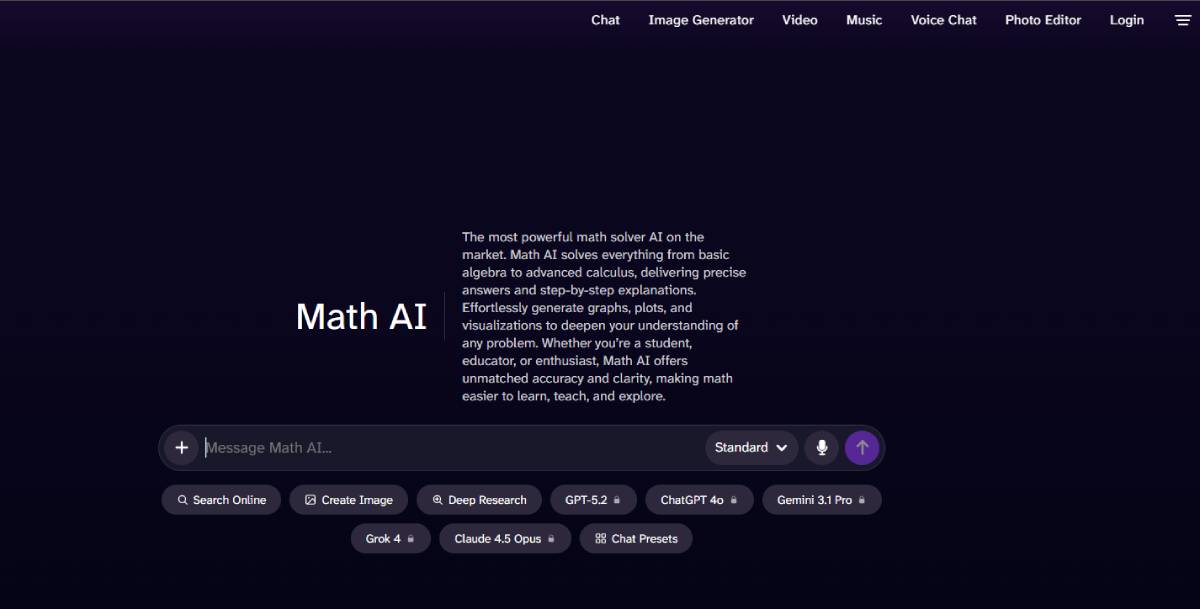
Math AI Platforms Disrupt Traditional Learning

AI-driven math assistants, such as those offered by platforms like DeepAI, now provide step-by-step solutions across a wide spectrum of mathematical disciplines.

April 13, 2026
|

AI-powered mathematics platforms are rapidly transforming how individuals and institutions approach problem-solving, offering real-time solutions from basic algebra to advanced calculus. This shift signals a broader disruption in education technology, impacting students, educators, and enterprises while raising questions about learning integrity, skill development, and long-term workforce readiness.

AI-driven math assistants, such as those offered by platforms like DeepAI, now provide step-by-step solutions across a wide spectrum of mathematical disciplines. These tools leverage large language models and symbolic computation to deliver near-instant answers, often accompanied by explanations.

Adoption is rising among students globally, particularly in digital-first education markets. The tools are accessible via web interfaces, often free or low-cost, lowering barriers to entry.

EdTech companies, academic institutions, and AI developers are key stakeholders. The expansion aligns with growing demand for personalized, on-demand learning support, while also raising concerns around academic misuse and over-reliance on automated systems in formal education environments.

The emergence of AI-powered academic tools reflects a broader transformation within the global education sector, where generative AI is reshaping knowledge acquisition and delivery. Over the past two years, platforms integrating AI tutors, homework assistants, and automated grading systems have gained traction, particularly following the rise of large language models.

This development aligns with a broader trend across global markets where automation is extending beyond repetitive tasks into cognitive domains traditionally reserved for human expertise. Mathematics, once seen as a discipline requiring deep conceptual understanding, is increasingly being augmented or in some cases replaced by AI-driven assistance.

Historically, technological disruptions in education from calculators to online learning have faced similar scrutiny. However, the scale, accessibility, and sophistication of AI tools represent a step-change, prompting educators and policymakers to reassess frameworks around assessment, academic integrity, and skill validation.

Industry analysts suggest that AI math tools could redefine the role of educators, shifting focus from instruction to mentorship and critical thinking development. Experts argue that while such platforms enhance accessibility and efficiency, they risk undermining foundational learning if used without oversight.

EdTech leaders emphasize the potential for AI to democratize education, particularly in underserved regions where access to qualified teachers remains limited. However, academic institutions have voiced concerns about plagiarism, reduced student engagement, and the erosion of problem-solving skills.

Policy experts are increasingly calling for clear guidelines on AI usage in education, including disclosure requirements and assessment redesign. Corporate stakeholders, meanwhile, view these tools as part of a larger productivity ecosystem, integrating AI into learning, training, and workforce development pipelines.

For businesses, the rise of AI-driven math platforms opens new opportunities in the EdTech sector, particularly in subscription-based learning tools, enterprise training solutions, and AI-powered tutoring services. Investors are closely monitoring companies that can scale responsibly while maintaining credibility in education outcomes.

For policymakers, the challenge lies in balancing innovation with academic integrity. Governments and regulators may need to introduce standards governing AI-assisted learning, particularly in examination systems and certification processes.

Educational institutions must rethink curricula, assessment models, and digital literacy frameworks to ensure students develop both conceptual understanding and the ability to critically evaluate AI-generated outputs.

AI-powered math tools are expected to become increasingly sophisticated, integrating multimodal capabilities and deeper personalization. Decision-makers should watch for regulatory developments, institutional responses, and evolving user behavior. The key uncertainty remains whether these platforms will complement human learning or fundamentally reshape it. The trajectory will define the future balance between automation and human expertise in education.

Source: DeepAI
Date: April 2026

  • Featured tools
Hostinger Horizons
Freemium

Hostinger Horizons is an AI-powered platform that allows users to build and deploy custom web applications without writing code. It packs hosting, domain management and backend integration into a unified tool for rapid app creation.

#
Startup Tools
#
Coding
#
Project Management
Learn more
Murf Ai
Free

Murf AI Review – Advanced AI Voice Generator for Realistic Voiceovers

#
Text to Speech
Learn more

Learn more about future of AI

Join 80,000+ Ai enthusiast getting weekly updates on exciting AI tools.
Thank you! Your submission has been received!
Oops! Something went wrong while submitting the form.

Math AI Platforms Disrupt Traditional Learning

April 13, 2026

AI-driven math assistants, such as those offered by platforms like DeepAI, now provide step-by-step solutions across a wide spectrum of mathematical disciplines.

AI-powered mathematics platforms are rapidly transforming how individuals and institutions approach problem-solving, offering real-time solutions from basic algebra to advanced calculus. This shift signals a broader disruption in education technology, impacting students, educators, and enterprises while raising questions about learning integrity, skill development, and long-term workforce readiness.

AI-driven math assistants, such as those offered by platforms like DeepAI, now provide step-by-step solutions across a wide spectrum of mathematical disciplines. These tools leverage large language models and symbolic computation to deliver near-instant answers, often accompanied by explanations.

Adoption is rising among students globally, particularly in digital-first education markets. The tools are accessible via web interfaces, often free or low-cost, lowering barriers to entry.

EdTech companies, academic institutions, and AI developers are key stakeholders. The expansion aligns with growing demand for personalized, on-demand learning support, while also raising concerns around academic misuse and over-reliance on automated systems in formal education environments.

The emergence of AI-powered academic tools reflects a broader transformation within the global education sector, where generative AI is reshaping knowledge acquisition and delivery. Over the past two years, platforms integrating AI tutors, homework assistants, and automated grading systems have gained traction, particularly following the rise of large language models.

This development aligns with a broader trend across global markets where automation is extending beyond repetitive tasks into cognitive domains traditionally reserved for human expertise. Mathematics, once seen as a discipline requiring deep conceptual understanding, is increasingly being augmented or in some cases replaced by AI-driven assistance.

Historically, technological disruptions in education from calculators to online learning have faced similar scrutiny. However, the scale, accessibility, and sophistication of AI tools represent a step-change, prompting educators and policymakers to reassess frameworks around assessment, academic integrity, and skill validation.

Industry analysts suggest that AI math tools could redefine the role of educators, shifting focus from instruction to mentorship and critical thinking development. Experts argue that while such platforms enhance accessibility and efficiency, they risk undermining foundational learning if used without oversight.

EdTech leaders emphasize the potential for AI to democratize education, particularly in underserved regions where access to qualified teachers remains limited. However, academic institutions have voiced concerns about plagiarism, reduced student engagement, and the erosion of problem-solving skills.

Policy experts are increasingly calling for clear guidelines on AI usage in education, including disclosure requirements and assessment redesign. Corporate stakeholders, meanwhile, view these tools as part of a larger productivity ecosystem, integrating AI into learning, training, and workforce development pipelines.

For businesses, the rise of AI-driven math platforms opens new opportunities in the EdTech sector, particularly in subscription-based learning tools, enterprise training solutions, and AI-powered tutoring services. Investors are closely monitoring companies that can scale responsibly while maintaining credibility in education outcomes.

For policymakers, the challenge lies in balancing innovation with academic integrity. Governments and regulators may need to introduce standards governing AI-assisted learning, particularly in examination systems and certification processes.

Educational institutions must rethink curricula, assessment models, and digital literacy frameworks to ensure students develop both conceptual understanding and the ability to critically evaluate AI-generated outputs.

AI-powered math tools are expected to become increasingly sophisticated, integrating multimodal capabilities and deeper personalization. Decision-makers should watch for regulatory developments, institutional responses, and evolving user behavior. The key uncertainty remains whether these platforms will complement human learning or fundamentally reshape it. The trajectory will define the future balance between automation and human expertise in education.

Source: DeepAI
Date: April 2026

Promote Your Tool

Copy Embed Code

Similar Blogs

April 17, 2026
|

Cybertruck-Style E-Bike Targets Urban Mobility

The newly introduced e-bike, often described as the “Cybertruck of e-bikes,” is designed with a rugged, futuristic aesthetic and enhanced performance capabilities aimed at replacing short car commutes.
Read more
April 17, 2026
|

Casely Reissues Power Bank Recall Over Safety

Casely has officially reannounced a recall of its portable power bank products originally flagged in 2025, following confirmation of a fatality associated with battery malfunction.
Read more
April 17, 2026
|

Telegram Scrutiny Over $21B Crypto Scam

Investigations highlight that Telegram has remained a hosting channel for a sprawling crypto scam ecosystem despite prior sanctions and enforcement actions targeting related entities.
Read more
April 17, 2026
|

Europe Launches Online Age Verification App

European regulators have rolled out a new age verification app designed to help online platforms confirm user eligibility for age-restricted content and services.
Read more
April 17, 2026
|

Meta Raises Quest 3 Prices on Supply Strain

Meta has officially raised prices on its Quest 3 and Quest 3S VR headsets, citing increased memory (RAM) costs amid global supply constraints.
Read more
April 17, 2026
|

Ozlo Sleepbuds See 30% Price Cut

Ozlo Sleepbuds, designed for noise-masking and sleep optimization, are currently being offered at nearly 30% off their standard retail price in a limited-time promotional campaign aligned with Mother’s Day gifting demand.
Read more