
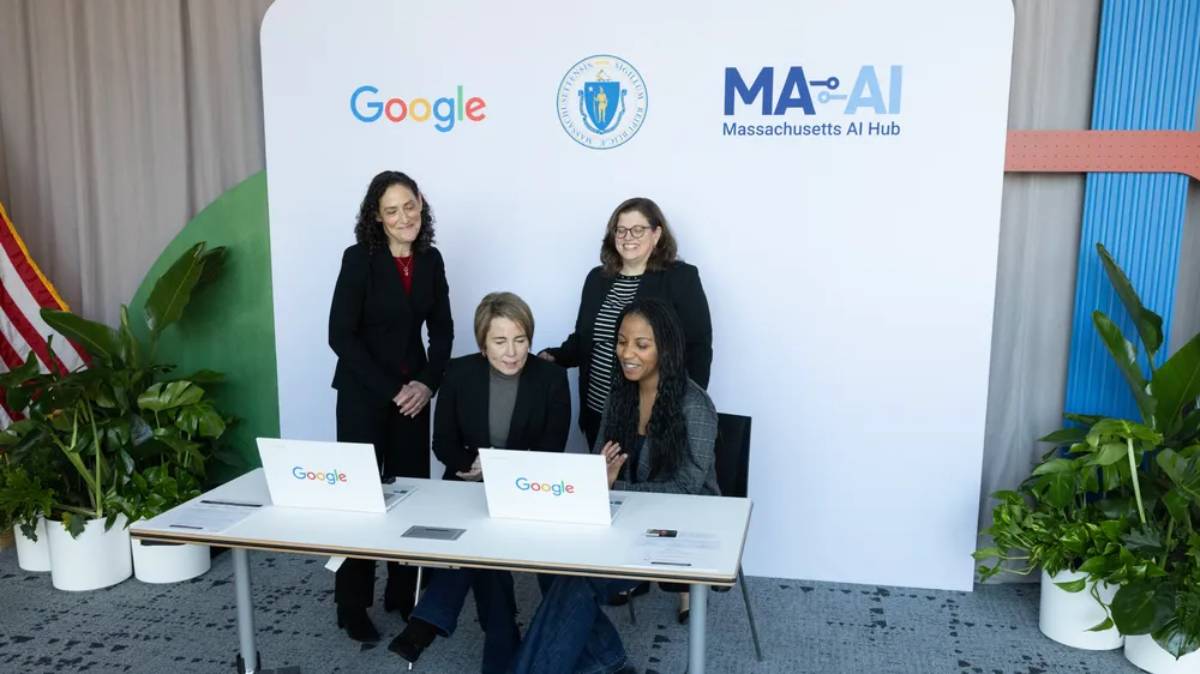
Google Partners Massachusetts to Scale AI Workforce Training Initiative

The initiative will deliver AI-focused training programs to students, job seekers, and small businesses across Massachusetts. Courses are expected to include foundational AI literacy, generative AI tools.

February 27, 2026
|

A major workforce development push was unveiled as Google joined forces with the Massachusetts AI Hub to launch a statewide AI training initiative. The program aims to equip residents across the Commonwealth with artificial intelligence skills, signaling a strategic alignment between Big Tech and regional economic policy.

The initiative will deliver AI-focused training programs to students, job seekers, and small businesses across Massachusetts. Courses are expected to include foundational AI literacy, generative AI tools, and applied business use cases. The collaboration forms part of Google’s broader workforce development strategy under its “Grow with Google” platform.

State officials and technology leaders aim to position Massachusetts as a competitive AI innovation cluster.The program will leverage partnerships with local educational institutions, workforce boards, and community organizations. By expanding access to AI education, stakeholders intend to close skills gaps while strengthening the region’s long-term economic resilience.

The development aligns with a broader trend across global markets where governments are racing to build AI-ready workforces. As automation and generative AI tools reshape industries, skill shortages have emerged as a major constraint on productivity growth. Technology hubs such as Boston and Cambridge already host world-class research institutions and AI startups, but scaling workforce participation remains critical.

Public-private partnerships are increasingly seen as essential to bridge digital divides and support inclusive economic growth. Historically, technology revolutions from the internet era to cloud computing have required coordinated training initiatives to ensure labor market adaptation.

For executives, the Massachusetts initiative represents a model in which corporate capital, academic research, and state policy converge to secure long-term competitive advantage in the AI economy.

Workforce development analysts view the partnership as a strategic move to future-proof regional talent pipelines. Technology policy experts argue that state-level AI hubs can act as accelerators for innovation ecosystems, particularly when anchored by major corporate players. Corporate leaders emphasize that AI adoption depends not only on advanced models but also on widespread workforce fluency.

Economic strategists note that regions investing early in AI training may attract venture capital, startups, and advanced manufacturing projects. Education advocates highlight the importance of equitable access to AI literacy programs, warning that failure to broaden participation could deepen socioeconomic divides. The collaboration reflects a growing recognition that AI competitiveness hinges as much on human capital as on computational power.

For business leaders, the initiative could expand the availability of AI-skilled talent, lowering hiring friction and accelerating digital transformation strategies. Investors may view coordinated workforce programs as signals of long-term regional stability and innovation readiness. Small and medium-sized enterprises stand to benefit from practical AI training that enhances productivity and operational efficiency.

Policymakers across other states may replicate the model, intensifying interstate competition for AI leadership. The move reinforces that AI policy is shifting beyond regulation toward capacity-building embedding skills development at the core of economic strategy. Decision-makers should monitor enrollment uptake, employer participation, and measurable workforce outcomes from the program.

If successful, the initiative could serve as a blueprint for national AI training frameworks. As global competition for AI leadership accelerates, regions that align corporate innovation with public workforce strategy are likely to shape the next chapter of economic growth.

Source: Google Official Blog
Date: February 27, 2026

  • Featured tools
Figstack AI
Free

Figstack AI is an intelligent assistant for developers that explains code, generates docstrings, converts code between languages, and analyzes time complexity helping you work smarter, not harder.

#
Coding
Learn more
Copy Ai
Free

Copy AI is one of the most popular AI writing tools designed to help professionals create high-quality content quickly. Whether you are a product manager drafting feature descriptions or a marketer creating ad copy, Copy AI can save hours of work while maintaining creativity and tone.

#
Copywriting
Learn more

Learn more about future of AI

Join 80,000+ Ai enthusiast getting weekly updates on exciting AI tools.
Thank you! Your submission has been received!
Oops! Something went wrong while submitting the form.

Google Partners Massachusetts to Scale AI Workforce Training Initiative

February 27, 2026

The initiative will deliver AI-focused training programs to students, job seekers, and small businesses across Massachusetts. Courses are expected to include foundational AI literacy, generative AI tools.

A major workforce development push was unveiled as Google joined forces with the Massachusetts AI Hub to launch a statewide AI training initiative. The program aims to equip residents across the Commonwealth with artificial intelligence skills, signaling a strategic alignment between Big Tech and regional economic policy.

The initiative will deliver AI-focused training programs to students, job seekers, and small businesses across Massachusetts. Courses are expected to include foundational AI literacy, generative AI tools, and applied business use cases. The collaboration forms part of Google’s broader workforce development strategy under its “Grow with Google” platform.

State officials and technology leaders aim to position Massachusetts as a competitive AI innovation cluster.The program will leverage partnerships with local educational institutions, workforce boards, and community organizations. By expanding access to AI education, stakeholders intend to close skills gaps while strengthening the region’s long-term economic resilience.

The development aligns with a broader trend across global markets where governments are racing to build AI-ready workforces. As automation and generative AI tools reshape industries, skill shortages have emerged as a major constraint on productivity growth. Technology hubs such as Boston and Cambridge already host world-class research institutions and AI startups, but scaling workforce participation remains critical.

Public-private partnerships are increasingly seen as essential to bridge digital divides and support inclusive economic growth. Historically, technology revolutions from the internet era to cloud computing have required coordinated training initiatives to ensure labor market adaptation.

For executives, the Massachusetts initiative represents a model in which corporate capital, academic research, and state policy converge to secure long-term competitive advantage in the AI economy.

Workforce development analysts view the partnership as a strategic move to future-proof regional talent pipelines. Technology policy experts argue that state-level AI hubs can act as accelerators for innovation ecosystems, particularly when anchored by major corporate players. Corporate leaders emphasize that AI adoption depends not only on advanced models but also on widespread workforce fluency.

Economic strategists note that regions investing early in AI training may attract venture capital, startups, and advanced manufacturing projects. Education advocates highlight the importance of equitable access to AI literacy programs, warning that failure to broaden participation could deepen socioeconomic divides. The collaboration reflects a growing recognition that AI competitiveness hinges as much on human capital as on computational power.

For business leaders, the initiative could expand the availability of AI-skilled talent, lowering hiring friction and accelerating digital transformation strategies. Investors may view coordinated workforce programs as signals of long-term regional stability and innovation readiness. Small and medium-sized enterprises stand to benefit from practical AI training that enhances productivity and operational efficiency.

Policymakers across other states may replicate the model, intensifying interstate competition for AI leadership. The move reinforces that AI policy is shifting beyond regulation toward capacity-building embedding skills development at the core of economic strategy. Decision-makers should monitor enrollment uptake, employer participation, and measurable workforce outcomes from the program.

If successful, the initiative could serve as a blueprint for national AI training frameworks. As global competition for AI leadership accelerates, regions that align corporate innovation with public workforce strategy are likely to shape the next chapter of economic growth.

Source: Google Official Blog
Date: February 27, 2026

Promote Your Tool

Copy Embed Code

Similar Blogs

February 27, 2026
|

Top AI Growth navigate startup tools Poised to Transform Startups

The list features tools spanning AI analytics, automated marketing, product management, and customer engagement. Each platform offers tailored capabilities for startups, including predictive insights.
Read more
February 27, 2026
|

Aicut Launches Automated AI Video Platform for Creators

AICut allows users to transform scripts or prompts into short-form video stories designed for platforms such as TikTok, Instagram, and YouTube Shorts.
Read more
February 27, 2026
|

Kira AI Taps Avatar Economy With 3D Stylized Photo Engine

Kira AI enables users to upload photos and convert them into 3D cartoon-style avatars optimized for profiles, stickers, and digital sharing. The platform leverages generative AI models trained to produce expressive.
Read more
February 27, 2026
|

Topview AI: Video Generation Battle Intensifies as Platforms

AI video platforms now enable businesses to generate presenter-led videos without traditional filming infrastructure. HeyGen and Synthesia offer avatar-based video generation, multilingual voiceovers.
Read more
February 27, 2026
|

Deep Realms Expands AI Storytelling Platform Amid Boom

Deep Realms offers an AI-driven platform focused on immersive storytelling, narrative design, and creative writing assistance.
Read more
February 27, 2026
|

Thumbly AI Targets Creator Economy With AI Viral Engine

Thumbly offers AI-powered tools that generate optimized YouTube thumbnails tailored for higher click-through rates. The platform analyzes visual patterns, color contrasts, text placement.
Read more