
Deep Realms Expands AI Storytelling Platform Amid Boom

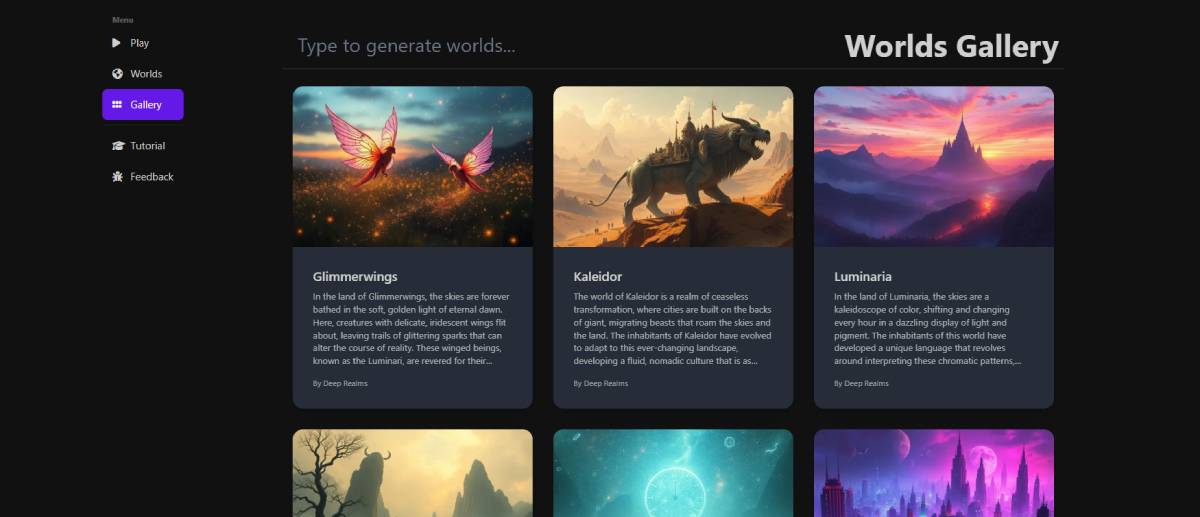
Deep Realms offers an AI-driven platform focused on immersive storytelling, narrative design, and creative writing assistance.

March 30, 2026
|
Deep Realms is an AI storytelling and writing platform. Create and explore characters, narratives and worlds, together with our AI writer.

The generative AI race is accelerating into long-form content creation as Deep Realms advances its AI-powered storytelling and writing platform. The move underscores intensifying competition in creative automation, with implications for authors, publishers, gaming studios, and digital media companies worldwide.

Deep Realms offers an AI-driven platform focused on immersive storytelling, narrative design, and creative writing assistance. The system enables users to generate structured plots, develop characters, and co-create fictional universes with AI support. Its target users include independent writers, game developers, content studios, and interactive media creators. The platform positions itself as a collaborative tool rather than a replacement for human authorship.

As demand for scalable content rises across streaming, gaming, and publishing sectors, AI storytelling tools are gaining strategic importance. Deep Realms enters a competitive market where differentiation hinges on narrative depth, customization, and user control.

The development aligns with a broader expansion of generative AI beyond short-form prompts into structured, long-form creativity. Entertainment and publishing industries are under pressure to produce high volumes of original content across multiple platforms. AI-assisted writing tools offer cost efficiencies and accelerated production cycles.

Simultaneously, gaming studios increasingly rely on dynamic narrative systems to enhance player immersion. AI storytelling platforms could enable adaptive plotlines and personalized user experiences.

However, the rapid integration of AI into creative industries has triggered debates over intellectual property, originality, and compensation for human creators.

Globally, policymakers are examining how AI-generated content should be classified and protected under copyright law. For executives, AI storytelling represents both a productivity opportunity and a governance challenge.

Creative technology analysts argue that AI storytelling tools can augment human creativity rather than replace it. Publishing strategists suggest that AI co-writing platforms may reduce development timelines for serialized fiction and transmedia projects. Gaming industry observers highlight potential applications in procedural narrative design, where AI adapts stories in real time.

At the same time, intellectual property experts caution that ownership frameworks for AI-assisted works remain legally complex across jurisdictions. Industry leaders emphasize that platforms capable of offering transparency in content generation processes will likely gain institutional trust. Deep Realms’ emergence reflects a shift toward structured, enterprise-ready creative AI solutions rather than casual prompt-based experimentation.

For media companies, AI storytelling platforms could significantly lower pre-production and content development costs. Studios may leverage such tools to prototype scripts, expand fictional universes, or localize narratives for global markets. Investors tracking generative AI see creative automation as a high-growth vertical within the broader AI economy.

Regulators, however, may intensify scrutiny around authorship disclosure and copyright attribution. For C-suite executives, integrating AI storytelling requires clear governance policies, contractual safeguards, and strategic positioning to maintain brand authenticity while capturing productivity gains.

Decision-makers should watch adoption rates within publishing and gaming, as well as evolving copyright regulations impacting AI-generated narratives. As AI systems grow more sophisticated in plot coherence and emotional nuance, competitive advantage will hinge on ethical integration and creative differentiation.

Deep Realms’ trajectory highlights how AI is not only optimizing workflows but redefining the architecture of storytelling itself.

Source: Deep Realms Official Website
Date: February 27, 2026

  • Featured tools
Symphony Ayasdi AI
Free

SymphonyAI Sensa is an AI-powered surveillance and financial crime detection platform that surfaces hidden risk behavior through explainable, AI-driven analytics.

#
Finance
Learn more
Beautiful AI
Free

Beautiful AI is an AI-powered presentation platform that automates slide design and formatting, enabling users to create polished, on-brand presentations quickly.

#
Presentation
Learn more

Learn more about future of AI

Join 80,000+ Ai enthusiast getting weekly updates on exciting AI tools.
Thank you! Your submission has been received!
Oops! Something went wrong while submitting the form.

Deep Realms Expands AI Storytelling Platform Amid Boom

March 30, 2026

Deep Realms offers an AI-driven platform focused on immersive storytelling, narrative design, and creative writing assistance.

Deep Realms is an AI storytelling and writing platform. Create and explore characters, narratives and worlds, together with our AI writer.

The generative AI race is accelerating into long-form content creation as Deep Realms advances its AI-powered storytelling and writing platform. The move underscores intensifying competition in creative automation, with implications for authors, publishers, gaming studios, and digital media companies worldwide.

Deep Realms offers an AI-driven platform focused on immersive storytelling, narrative design, and creative writing assistance. The system enables users to generate structured plots, develop characters, and co-create fictional universes with AI support. Its target users include independent writers, game developers, content studios, and interactive media creators. The platform positions itself as a collaborative tool rather than a replacement for human authorship.

As demand for scalable content rises across streaming, gaming, and publishing sectors, AI storytelling tools are gaining strategic importance. Deep Realms enters a competitive market where differentiation hinges on narrative depth, customization, and user control.

The development aligns with a broader expansion of generative AI beyond short-form prompts into structured, long-form creativity. Entertainment and publishing industries are under pressure to produce high volumes of original content across multiple platforms. AI-assisted writing tools offer cost efficiencies and accelerated production cycles.

Simultaneously, gaming studios increasingly rely on dynamic narrative systems to enhance player immersion. AI storytelling platforms could enable adaptive plotlines and personalized user experiences.

However, the rapid integration of AI into creative industries has triggered debates over intellectual property, originality, and compensation for human creators.

Globally, policymakers are examining how AI-generated content should be classified and protected under copyright law. For executives, AI storytelling represents both a productivity opportunity and a governance challenge.

Creative technology analysts argue that AI storytelling tools can augment human creativity rather than replace it. Publishing strategists suggest that AI co-writing platforms may reduce development timelines for serialized fiction and transmedia projects. Gaming industry observers highlight potential applications in procedural narrative design, where AI adapts stories in real time.

At the same time, intellectual property experts caution that ownership frameworks for AI-assisted works remain legally complex across jurisdictions. Industry leaders emphasize that platforms capable of offering transparency in content generation processes will likely gain institutional trust. Deep Realms’ emergence reflects a shift toward structured, enterprise-ready creative AI solutions rather than casual prompt-based experimentation.

For media companies, AI storytelling platforms could significantly lower pre-production and content development costs. Studios may leverage such tools to prototype scripts, expand fictional universes, or localize narratives for global markets. Investors tracking generative AI see creative automation as a high-growth vertical within the broader AI economy.

Regulators, however, may intensify scrutiny around authorship disclosure and copyright attribution. For C-suite executives, integrating AI storytelling requires clear governance policies, contractual safeguards, and strategic positioning to maintain brand authenticity while capturing productivity gains.

Decision-makers should watch adoption rates within publishing and gaming, as well as evolving copyright regulations impacting AI-generated narratives. As AI systems grow more sophisticated in plot coherence and emotional nuance, competitive advantage will hinge on ethical integration and creative differentiation.

Deep Realms’ trajectory highlights how AI is not only optimizing workflows but redefining the architecture of storytelling itself.

Source: Deep Realms Official Website
Date: February 27, 2026

Promote Your Tool

Copy Embed Code

Similar Blogs

March 30, 2026
|

Meta Court Setbacks Signal Stricter AI Scrutiny

Meta faced multiple legal losses related to its AI initiatives, particularly around training data usage, algorithmic transparency, and consumer protection obligations. Courts questioned the company’s safeguards, emphasizing risks of bias, privacy violations, and misinformation.
Read more
March 30, 2026
|

Anthropic Pushes Back Against Pentagon Pressure

Anthropic, a leading AI firm, resisted Pentagon pressure to weaken or remove safeguards designed to prevent misuse of its AI systems. The confrontation escalated after Hegseth urged faster deployment of AI capabilities without certain safety constraints.
Read more
March 30, 2026
|

Digital Twin Meets AI in Mining Transformation

MineScape 2026 introduces enhanced capabilities combining AI-powered analytics with digital twin simulations to optimize mine planning and operations.
Read more
March 30, 2026
|

AI Moves Beyond Earth With Space Data Centers

Nvidia has introduced a concept for deploying AI data center hardware in space, leveraging satellite platforms and orbital infrastructure to process data closer to its source. The initiative aligns with rising demand for real-time analytics from Earth observation, telecommunications, and defense sectors.
Read more
March 30, 2026
|

AI Becomes Frontline Defense Against Spam Calls

The development aligns with a broader trend across global markets where AI is being used both to enable and combat digital fraud. Spam calls have become a widespread issue, costing consumers and businesses billions annually.
Read more
March 30, 2026
|

Bluesky Unveils AI Driven Feed Customization

The integration of AI into feed customization represents a convergence of personalization and decentralization. Historically, social media has prioritized engagement metrics over user choice.
Read more