



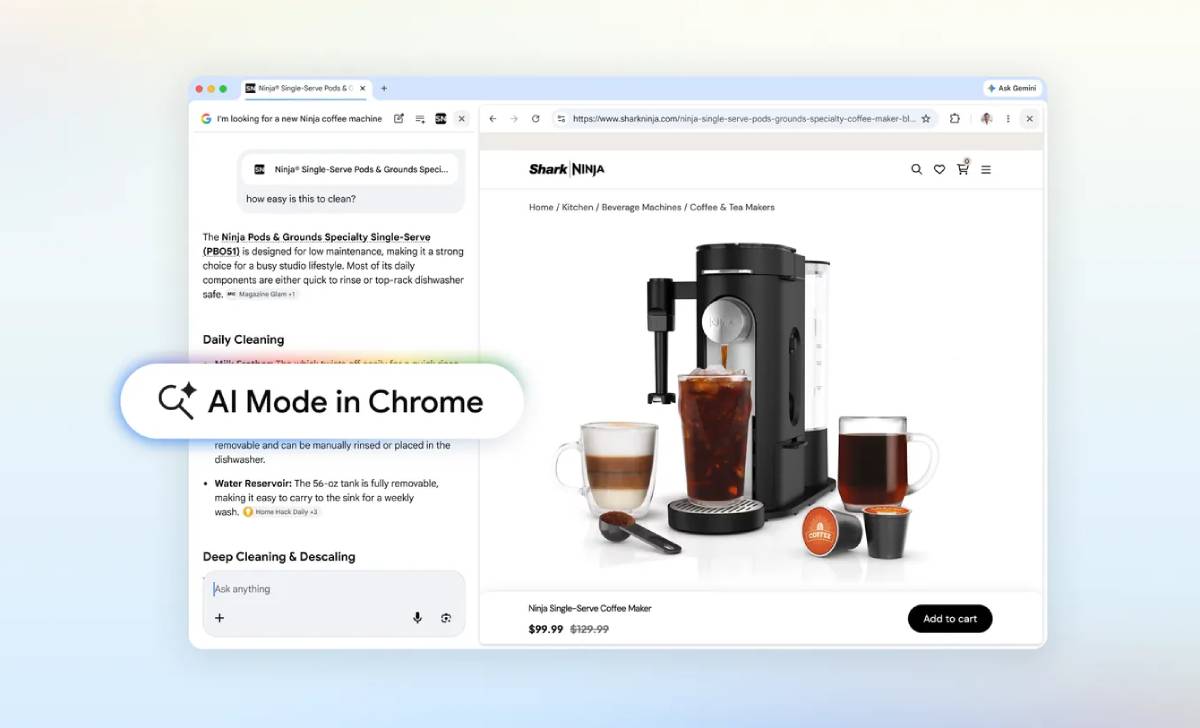
A major development unfolded as Google introduced “AI Mode” in Google Chrome, signalling a fundamental shift in how users explore the internet. The move integrates conversational AI directly into browsing, with far-reaching implications for search, digital advertising, publishers, and enterprise decision-making worldwide.
Google’s AI Mode transforms Chrome into an AI-assisted browsing environment, enabling users to interact with web content through conversational prompts rather than traditional keyword searches.
The feature allows summarization of webpages, contextual question-answering, and multi-step research assistance directly within the browser interface. It builds on Google’s broader push to integrate generative AI across its product ecosystem.
The rollout targets both consumer and enterprise users, positioning Chrome as a central hub for AI-powered productivity. This shift could significantly alter traffic flows across the web, as users rely less on clicking multiple links and more on AI-generated synthesis.
The move intensifies competition with AI-first platforms and search alternatives globally. The development aligns with a broader trend across global markets where web navigation is evolving from link-based discovery to AI-mediated interaction. Traditional search engines, long driven by keyword queries and ranked results, are increasingly being replaced or augmented by conversational interfaces.
This transition reflects the rapid rise of generative AI technologies capable of synthesizing information, reducing the need for users to manually navigate multiple sources. Major technology firms are racing to embed AI into core platforms, including browsers, operating systems, and productivity tools.
Chrome, as the world’s dominant browser, represents a critical battleground. By integrating AI Mode, Google is reinforcing its control over the discovery layer of the internet while defending its search and advertising dominance against emerging AI-native competitors.
The shift also raises structural questions about how information is accessed, monetized, and validated in the digital economy. Technology analysts view AI Mode as a pivotal step in redefining the browser’s role from a passive gateway to an active intelligence layer. Experts suggest this could fundamentally reshape user behavior, reducing friction in information retrieval while increasing reliance on AI-generated outputs.
Digital advertising specialists highlight potential disruptions to the current monetization model. If users consume summarized answers instead of visiting websites, publishers may experience reduced traffic, affecting revenue streams across the media ecosystem.
Enterprise leaders see opportunities in productivity gains, as AI-assisted browsing can streamline research, decision-making, and knowledge management workflows.
At the same time, experts caution about risks related to accuracy, bias, and transparency. Ensuring that AI-generated summaries remain reliable and properly attributed will be critical to maintaining trust in the system.
For businesses, AI Mode signals a shift in how digital presence is optimized. Search engine optimization strategies may need to evolve toward AI-readability and content structuring rather than traditional ranking tactics.
Investors are likely to monitor how this impacts Google’s advertising revenues, which depend heavily on user interaction with search results. A move toward AI summaries could reshape the economics of online advertising.
For policymakers, the development raises concerns around competition, data usage, and information control. As AI intermediates access to content, regulatory scrutiny may increase around fairness, transparency, and market dominance.
Publishers and content creators may face pressure to renegotiate their role in an AI-driven web ecosystem. The rollout of AI Mode marks the beginning of a new phase in internet evolution, where browsers act as intelligent agents rather than neutral tools. Key areas to watch include user adoption, impact on web traffic, and regulatory responses.
For global decision-makers, the question is no longer if AI will reshape the web but how quickly and who will control its future architecture.
Source: Google Blog
Date: April 2026


