



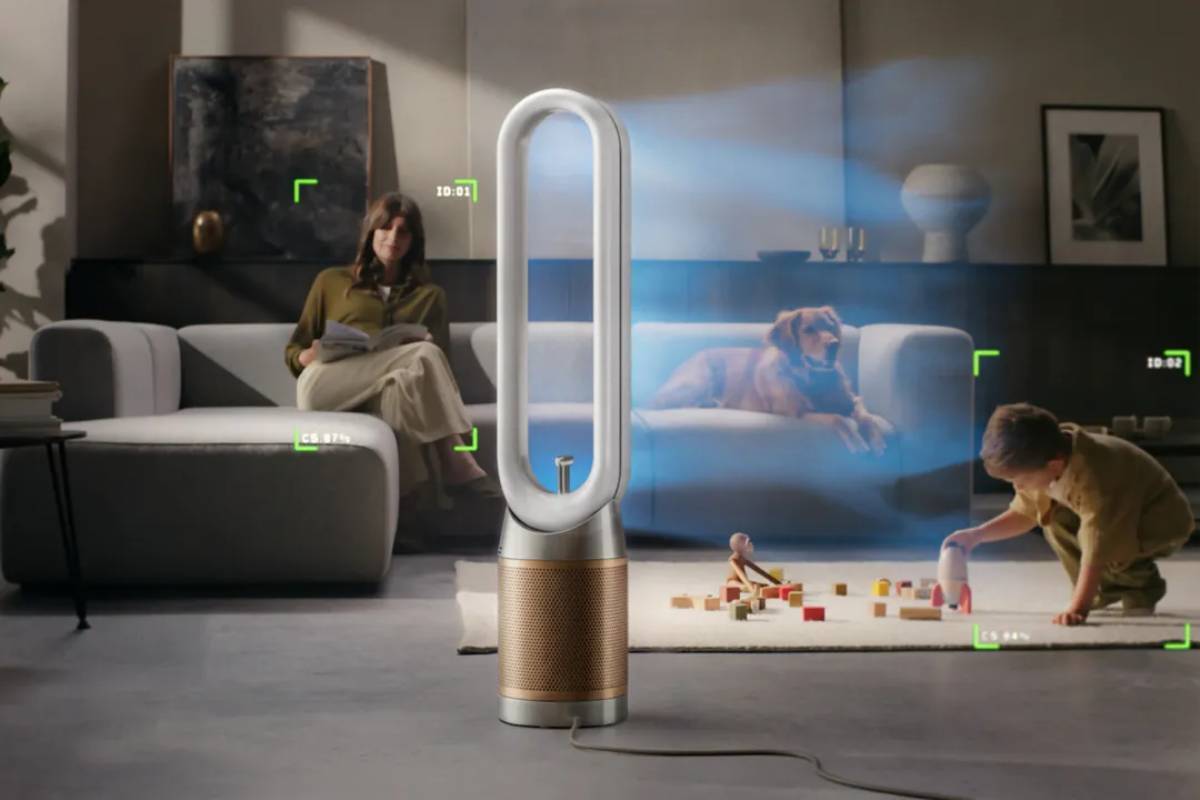
A new frontier in smart home technology is emerging as Dyson introduces an AI-enabled air purifier equipped with a camera system designed to track user movement and direct airflow accordingly. The innovation signals a convergence of environmental hardware and computer vision, raising implications for consumer privacy, smart home ecosystems, and AI-driven appliance design.
The latest Dyson purifier integrates camera-based tracking technology to identify user location within a room and dynamically adjust airflow direction. The system is designed to “follow” individuals, optimizing air purification efficiency based on real-time spatial positioning.
This marks a shift from static air filtration systems toward adaptive, AI-assisted environmental control devices. The product combines sensor fusion, computer vision, and airflow engineering to personalize indoor air quality management. It also represents an expansion of Dyson’s broader strategy of embedding intelligent systems into household appliances, positioning the company within the growing smart home and ambient computing ecosystem.
The development reflects a broader evolution in smart home technology, where traditional appliances are being transformed into connected, data-driven systems. Over the past decade, devices such as thermostats, speakers, and security cameras have increasingly adopted AI capabilities to improve automation and user personalization.
Dyson has consistently pursued innovation in consumer hardware, particularly in airflow and environmental control systems. The integration of camera-based tracking into an air purifier marks a significant step toward spatially aware home environments, where devices respond dynamically to human presence and behavior.
This trend aligns with the rise of ambient intelligence an ecosystem in which devices continuously monitor and adapt to environmental conditions. However, it also intensifies global debates around surveillance, data privacy, and the normalization of in-home sensing technologies.
Industry analysts suggest that AI-enabled environmental systems like Dyson’s latest purifier could redefine expectations for smart home efficiency and personalization. Experts argue that integrating real-time user tracking into appliances enables more precise energy and resource optimization, potentially improving both performance and user comfort.
While Dyson has framed the innovation as an engineering advancement in airflow precision, technology observers highlight the increasing role of computer vision in everyday consumer devices.
Privacy and cybersecurity commentators note that camera-equipped household appliances introduce new data governance challenges, particularly regarding how visual data is processed, stored, and secured. Analysts also point out that as smart home ecosystems become more autonomous, regulatory scrutiny over in-home data capture is likely to increase, especially in regions with strict privacy frameworks such as the European Union.
For consumer electronics manufacturers, the shift toward AI-driven environmental control systems signals a competitive pivot toward intelligent, adaptive appliances. Companies may need to invest more heavily in sensor integration, computer vision, and edge AI capabilities to remain competitive.
For consumers, the innovation offers improved comfort and efficiency but raises concerns over constant visual monitoring in private spaces. For policymakers, the expansion of camera-based smart home systems introduces regulatory questions around consent, data retention, and household surveillance boundaries. Analysts warn that as AI becomes embedded in domestic infrastructure, the distinction between convenience and surveillance will become increasingly difficult to define.
Looking ahead, Dyson’s AI-enabled purifier may represent an early step toward fully responsive home environments where appliances dynamically adapt to human behavior. Market adoption will depend on consumer trust, privacy safeguards, and regulatory clarity. Decision-makers will be watching how competitors respond and whether camera-based environmental intelligence becomes a standard feature in next-generation smart home ecosystems.
Source: The Verge Report
Date: May 17, 2026


