



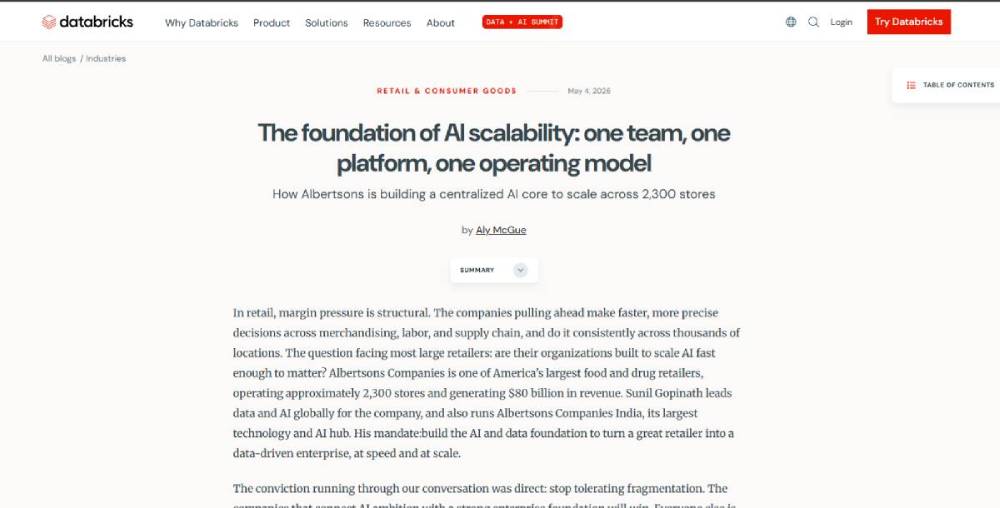
A major strategic framework has been outlined by Databricks as enterprises accelerate their transition toward large-scale artificial intelligence adoption. The company emphasizes a unified approach combining teams, platforms, and operating models to solve AI scalability challenges. The development signals a shift in how global organizations structure data and AI operations for production-level deployment.
Databricks has introduced a consolidated AI execution framework built on three pillars: one team, one platform, and one operating model. The approach is designed to eliminate fragmentation across data engineering, machine learning, and business analytics workflows.
The model advocates for unified governance and infrastructure to streamline AI deployment across enterprises. It highlights the need for organizations to reduce operational silos that slow down AI production scaling.
The framework is positioned as a response to rising enterprise demand for production-grade AI systems, particularly as companies move beyond experimentation into full-scale deployment of generative and predictive AI solutions.
The push for unified AI operating models comes at a critical stage in the evolution of enterprise artificial intelligence. Many organizations have already invested heavily in AI experimentation, but struggle to operationalize models at scale due to fragmented infrastructure, disconnected teams, and inconsistent governance frameworks.
Historically, data engineering, analytics, and machine learning functions have operated in isolation, creating inefficiencies and slowing down time-to-value for AI initiatives. As enterprises now attempt to deploy AI across core business operations, these structural limitations have become more visible.
The framework introduced by Databricks aligns with a broader industry trend toward platform consolidation. Companies are increasingly seeking integrated environments that unify data processing, model development, and deployment under a single operational layer. This reflects a shift from experimental AI adoption toward industrialized, production-ready AI ecosystems that can scale globally and consistently.
Industry observers note that unified AI operating models are becoming a defining requirement for enterprise AI maturity. Analysts suggest that fragmented AI stacks often lead to duplicated efforts, inconsistent model performance, and governance challenges that limit scalability.
From a platform strategy perspective, leaders at Databricks argue that enterprises must treat AI as a coordinated system rather than isolated projects. This includes aligning engineering, data science, and business teams under a shared operational framework.
Technology experts also highlight that such approaches are critical for ensuring regulatory compliance, model transparency, and operational reliability in enterprise AI deployments. As organizations expand AI usage across sensitive domains like finance, healthcare, and supply chains, governance and standardization are becoming central priorities. Analysts view this framework as part of a broader shift toward “AI industrialization,” where scalability depends on structural integration rather than isolated innovation.
For global enterprises, the unified AI operating model could significantly reduce friction in scaling AI systems from pilot stages to full production environments. Businesses may benefit from faster deployment cycles, improved governance, and reduced infrastructure duplication.
Investors are likely to view platform consolidation strategies as a long-term growth driver for enterprise AI ecosystems. Companies that successfully unify their AI stacks may gain competitive advantages in efficiency and innovation speed.
From a policy standpoint, standardized AI operating frameworks could simplify regulatory oversight by improving transparency and auditability. However, it may also raise concerns about vendor concentration and ecosystem dependency in enterprise AI infrastructure.
Looking ahead, enterprises are expected to increasingly adopt unified AI platforms as they scale generative and predictive AI workloads. The success of this model will depend on execution across industries with varying levels of digital maturity. Decision-makers will closely watch whether integrated AI operating systems can consistently deliver measurable gains in speed, compliance, and cost efficiency across global deployments.
Source: Databricks Blog
Date: May 2026


