



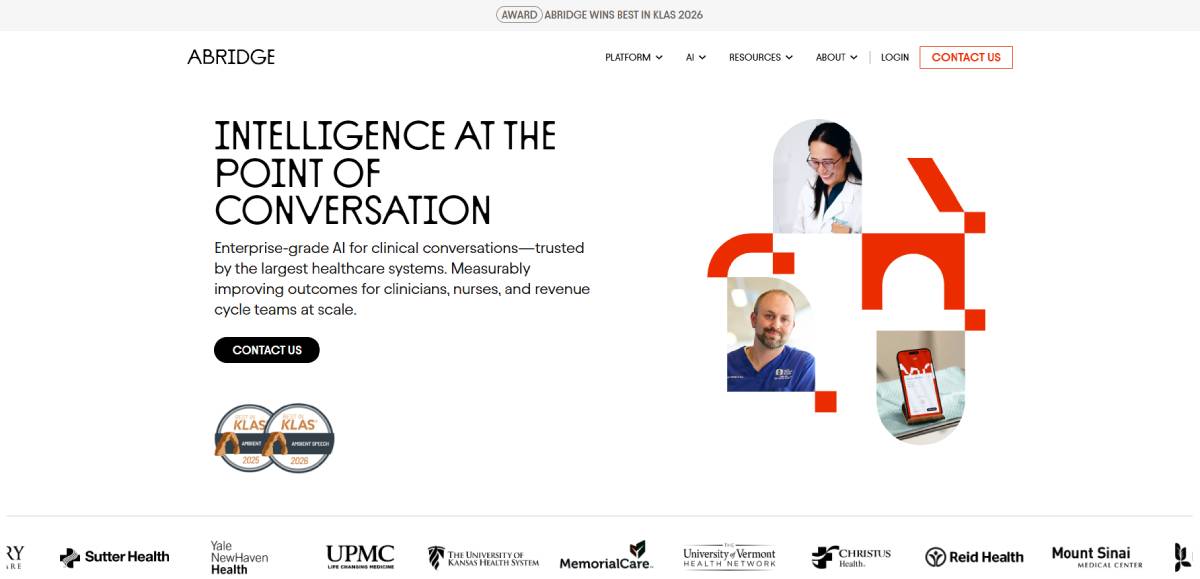
A major development is reshaping healthcare technology as Abridge accelerates deployment of its generative AI platform designed to document clinical conversations in real time. The move signals a structural shift in medical workflows, with implications for hospital efficiency, physician burnout, health data governance, and digital health investment worldwide.
Abridge has built an AI-powered system that converts doctor-patient conversations into structured clinical notes integrated directly into electronic health records (EHRs). The platform leverages generative AI to reduce administrative burden on clinicians while maintaining medical accuracy and compliance standards.
The company partners with major health systems and integrates with widely used EHR platforms, positioning itself within core hospital IT infrastructure. Its expansion comes amid mounting financial and staffing pressures across global healthcare systems.
Investors have shown strong interest in AI-driven clinical automation, viewing documentation tools as scalable, high-impact solutions in a sector where inefficiency costs billions annually in lost productivity.
The rise of companies like Abridge aligns with a broader global push toward AI-enabled healthcare transformation. Administrative overload remains one of the most persistent structural challenges in medicine, with physicians spending substantial hours on documentation rather than patient care.
The integration of generative AI into clinical workflows accelerated following breakthroughs in large language models in 2023. Since then, hospitals and insurers have explored automation to address clinician shortages and rising operational costs.
Healthcare systems in the United States, Europe, and parts of Asia-Pacific are under sustained fiscal strain, driven by ageing populations, regulatory complexity, and workforce burnout. Historically, digitisation efforts focused on record-keeping. The new wave prioritises intelligent summarisation and workflow optimisation effectively embedding AI as a clinical co-pilot rather than a back-office tool.
Health technology analysts suggest clinical documentation represents one of the most commercially viable applications of generative AI. Experts argue that platforms such as Abridge address a clear return-on-investment case: reducing physician burnout, improving billing accuracy, and increasing patient throughput.
Hospital executives have noted that documentation automation can free up hours per clinician each week—translating into measurable financial and operational gains. However, policy specialists caution that AI-generated clinical records must meet strict compliance standards, including patient privacy regulations and medical liability safeguards.
Industry observers also highlight data security as a critical risk vector. As AI becomes embedded in frontline care, governance frameworks will need to evolve rapidly to ensure transparency, auditability, and trust across stakeholders from providers to insurers and regulators.
For healthcare executives, AI-driven documentation tools could redefine cost structures and workforce planning. Hospitals may reallocate resources toward patient-facing services while reducing reliance on manual transcription and administrative support roles.
Investors see scalable clinical AI platforms as high-growth assets within the broader digital health market. At the same time, insurers and policymakers will scrutinise how AI documentation impacts billing accuracy, reimbursement integrity, and malpractice risk.
Governments may accelerate the development of AI compliance frameworks specific to healthcare. For technology providers, demonstrating clinical accuracy and regulatory alignment will be central to long-term market dominance.
As adoption widens, the next phase will test interoperability, international scalability, and regulatory durability. Decision-makers should monitor hospital partnerships, reimbursement integration, and emerging AI oversight rules.
The broader question remains whether generative AI will simply ease documentation burdens—or fundamentally redesign how clinical care is delivered and recorded in the global health economy.
Source: Abridge Official Website
Date: March 4, 2026


