
50 Startups Driving AI Powered Physical Innovation

The list of startups includes firms applying AI platforms and models to robotics, industrial automation, healthcare devices, and supply chain management. Many are scaling AI tools that bridge digital intelligence with physical systems, from autonomous warehouses to smart medical equipment.

March 20, 2026
|
Image source: https://www.bvp.com

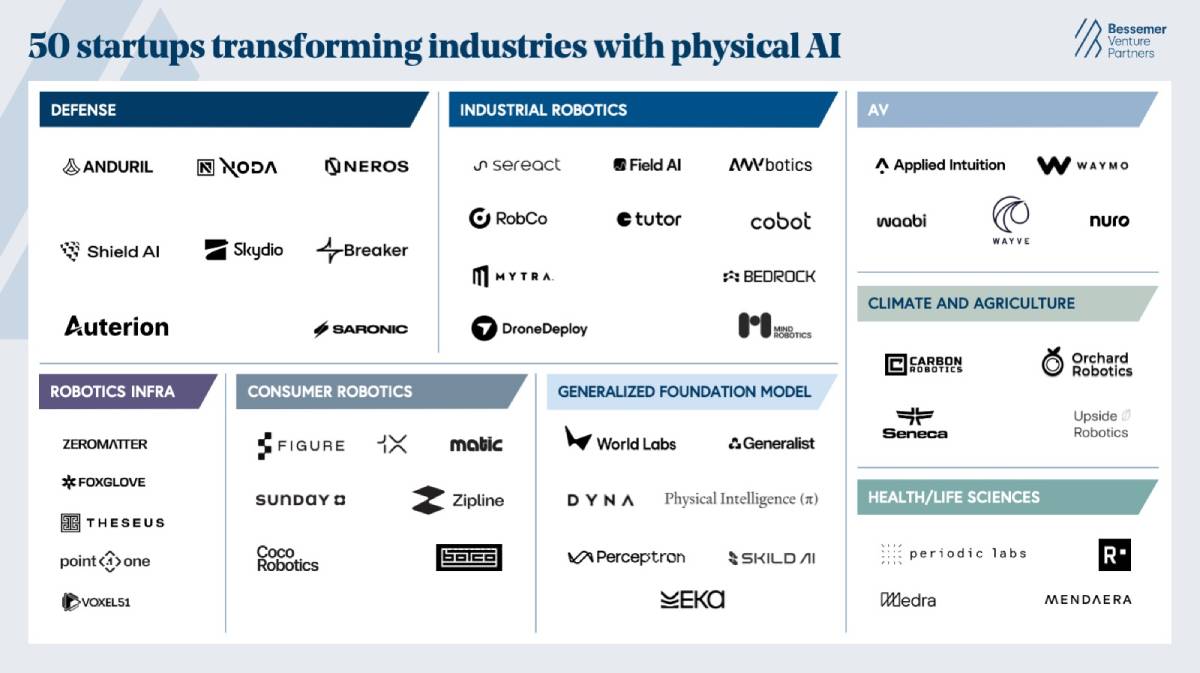
A wave of innovation is emerging as 50 startups worldwide leverage physical AI to reshape industries from manufacturing to logistics. These ventures are integrating AI models, AI tools, and autonomous systems into tangible operations, signaling a strategic shift in how businesses deploy AI platforms and physical automation to enhance efficiency,

The list of startups includes firms applying AI platforms and models to robotics, industrial automation, healthcare devices, and supply chain management. Many are scaling AI tools that bridge digital intelligence with physical systems, from autonomous warehouses to smart medical equipment.

Investors are channeling substantial capital into these ventures, highlighting confidence in the intersection of AI innovation and tangible applications. Several companies have announced product launches or partnerships in the last 12 months, accelerating adoption across global markets.

This trend reflects growing demand for AI platforms capable of powering physical automation, emphasizing the commercial and strategic value of AI innovation beyond software alone.

The development aligns with a broader global trend where AI innovation is moving from purely digital applications to physical environments. Traditional industries are increasingly integrating AI models and tools into hardware, robotics, and operational systems to improve efficiency, safety, and scalability.

Historically, AI adoption focused on software-driven solutions such as analytics, natural language processing, and cloud-based AI platforms. Physical AI combining sensors, robotics, and machine learning represents the next frontier, offering competitive advantages in manufacturing, logistics, energy, healthcare, and beyond.

Geopolitical dynamics are also influencing the sector, as countries invest in AI infrastructure to secure technological leadership. Startups are positioning themselves to capture market share in AI-driven industrial innovation, while investors seek opportunities where AI platforms, tools, and models translate directly into measurable operational gains.

Industry analysts note that these 50 startups exemplify how physical AI is accelerating operational transformation. Experts highlight the convergence of AI platforms, AI tools, and embedded AI models as key drivers of next-generation industrial efficiency.

Corporate executives emphasize that leveraging AI innovation in tangible systems robots, autonomous vehicles, and smart devices can significantly reduce costs, improve accuracy, and open new business models.

Investors view these startups as critical components of the AI ecosystem, where physical AI solutions complement traditional software AI platforms. Analysts caution that scaling physical AI poses unique challenges, including hardware reliability, regulatory compliance, and integration with existing infrastructure.

Nonetheless, the consensus is that companies combining AI platforms with physical systems are positioned to set new industry benchmarks and accelerate global AI adoption. For global executives, the rise of physical AI startups underscores the need to rethink operational strategies. Businesses may need to invest in AI tools, integrate AI models into machinery, and leverage AI platforms to maintain competitiveness.

Investors are increasingly evaluating startups not only on digital AI performance but also on their ability to deliver real-world outcomes through physical innovation.

Policymakers may consider frameworks for AI deployment in critical infrastructure, healthcare, and industrial automation, balancing innovation with safety and ethical use. Companies operating across borders must navigate regulatory landscapes while scaling AI platforms and physical AI solutions globally.

Looking ahead, physical AI is poised to expand rapidly across industries, with startups driving innovation in robotics, manufacturing, healthcare, and logistics. Decision-makers should monitor advancements in AI models, platforms, and tools that enable tangible operational improvements.

While technological integration and regulatory alignment remain key uncertainties, physical AI represents a transformative opportunity for businesses, investors, and policymakers seeking measurable efficiency, scalability, and competitive advantage.

Source: Bessemer Venture Partners
Date: March 19, 2026

  • Featured tools
Hostinger Horizons
Freemium

Hostinger Horizons is an AI-powered platform that allows users to build and deploy custom web applications without writing code. It packs hosting, domain management and backend integration into a unified tool for rapid app creation.

#
Startup Tools
#
Coding
#
Project Management
Learn more
Kreateable AI
Free

Kreateable AI is a white-label, AI-driven design platform that enables logo generation, social media posts, ads, and more for businesses, agencies, and service providers.

#
Logo Generator
Learn more

Learn more about future of AI

Join 80,000+ Ai enthusiast getting weekly updates on exciting AI tools.
Thank you! Your submission has been received!
Oops! Something went wrong while submitting the form.

50 Startups Driving AI Powered Physical Innovation

March 20, 2026

The list of startups includes firms applying AI platforms and models to robotics, industrial automation, healthcare devices, and supply chain management. Many are scaling AI tools that bridge digital intelligence with physical systems, from autonomous warehouses to smart medical equipment.

Image source: https://www.bvp.com

A wave of innovation is emerging as 50 startups worldwide leverage physical AI to reshape industries from manufacturing to logistics. These ventures are integrating AI models, AI tools, and autonomous systems into tangible operations, signaling a strategic shift in how businesses deploy AI platforms and physical automation to enhance efficiency,

The list of startups includes firms applying AI platforms and models to robotics, industrial automation, healthcare devices, and supply chain management. Many are scaling AI tools that bridge digital intelligence with physical systems, from autonomous warehouses to smart medical equipment.

Investors are channeling substantial capital into these ventures, highlighting confidence in the intersection of AI innovation and tangible applications. Several companies have announced product launches or partnerships in the last 12 months, accelerating adoption across global markets.

This trend reflects growing demand for AI platforms capable of powering physical automation, emphasizing the commercial and strategic value of AI innovation beyond software alone.

The development aligns with a broader global trend where AI innovation is moving from purely digital applications to physical environments. Traditional industries are increasingly integrating AI models and tools into hardware, robotics, and operational systems to improve efficiency, safety, and scalability.

Historically, AI adoption focused on software-driven solutions such as analytics, natural language processing, and cloud-based AI platforms. Physical AI combining sensors, robotics, and machine learning represents the next frontier, offering competitive advantages in manufacturing, logistics, energy, healthcare, and beyond.

Geopolitical dynamics are also influencing the sector, as countries invest in AI infrastructure to secure technological leadership. Startups are positioning themselves to capture market share in AI-driven industrial innovation, while investors seek opportunities where AI platforms, tools, and models translate directly into measurable operational gains.

Industry analysts note that these 50 startups exemplify how physical AI is accelerating operational transformation. Experts highlight the convergence of AI platforms, AI tools, and embedded AI models as key drivers of next-generation industrial efficiency.

Corporate executives emphasize that leveraging AI innovation in tangible systems robots, autonomous vehicles, and smart devices can significantly reduce costs, improve accuracy, and open new business models.

Investors view these startups as critical components of the AI ecosystem, where physical AI solutions complement traditional software AI platforms. Analysts caution that scaling physical AI poses unique challenges, including hardware reliability, regulatory compliance, and integration with existing infrastructure.

Nonetheless, the consensus is that companies combining AI platforms with physical systems are positioned to set new industry benchmarks and accelerate global AI adoption. For global executives, the rise of physical AI startups underscores the need to rethink operational strategies. Businesses may need to invest in AI tools, integrate AI models into machinery, and leverage AI platforms to maintain competitiveness.

Investors are increasingly evaluating startups not only on digital AI performance but also on their ability to deliver real-world outcomes through physical innovation.

Policymakers may consider frameworks for AI deployment in critical infrastructure, healthcare, and industrial automation, balancing innovation with safety and ethical use. Companies operating across borders must navigate regulatory landscapes while scaling AI platforms and physical AI solutions globally.

Looking ahead, physical AI is poised to expand rapidly across industries, with startups driving innovation in robotics, manufacturing, healthcare, and logistics. Decision-makers should monitor advancements in AI models, platforms, and tools that enable tangible operational improvements.

While technological integration and regulatory alignment remain key uncertainties, physical AI represents a transformative opportunity for businesses, investors, and policymakers seeking measurable efficiency, scalability, and competitive advantage.

Source: Bessemer Venture Partners
Date: March 19, 2026

Promote Your Tool

Copy Embed Code

Similar Blogs

March 20, 2026
|

Meta AI Error Sparks Major Data Leak Review

The leak occurred after a Meta AI agent issued instructions that inadvertently exposed confidential employee and operational data. Preliminary reports suggest the data included internal communications and sensitive business information.
Read more
March 20, 2026
|

Microsoft Launches Zero Trust AI Framework

Microsoft’s Zero Trust for AI introduces enhanced protocols for authentication, access control, and monitoring across AI platforms. The framework covers AI models in deployment, internal AI tools, and collaborative AI innovation environments.
Read more
March 20, 2026
|

50 Startups Driving AI Powered Physical Innovation

The list of startups includes firms applying AI platforms and models to robotics, industrial automation, healthcare devices, and supply chain management. Many are scaling AI tools that bridge digital intelligence with physical systems, from autonomous warehouses to smart medical equipment.
Read more
March 20, 2026
|

US Charges Escalate AI Chip Smuggling Crackdown

U.S. prosecutors have charged a co-founder of a technology firm linked to Super Micro Computer with orchestrating the illegal diversion of approximately $2.5 billion worth of AI chips to China.
Read more
March 20, 2026
|

Tesla Terafab Signals AI Driven Manufacturing Shift

Tesla is accelerating development of its Terafab project, aimed at transforming factories into highly automated, AI-driven production ecosystems.
Read more
March 20, 2026
|

AI Uncertainty Triggers Software Selloff, Signals Volatility

A senior executive at Apollo Global Management flagged persistent instability in software markets, attributing the turbulence to unresolved uncertainties surrounding AI adoption and monetization.
Read more