



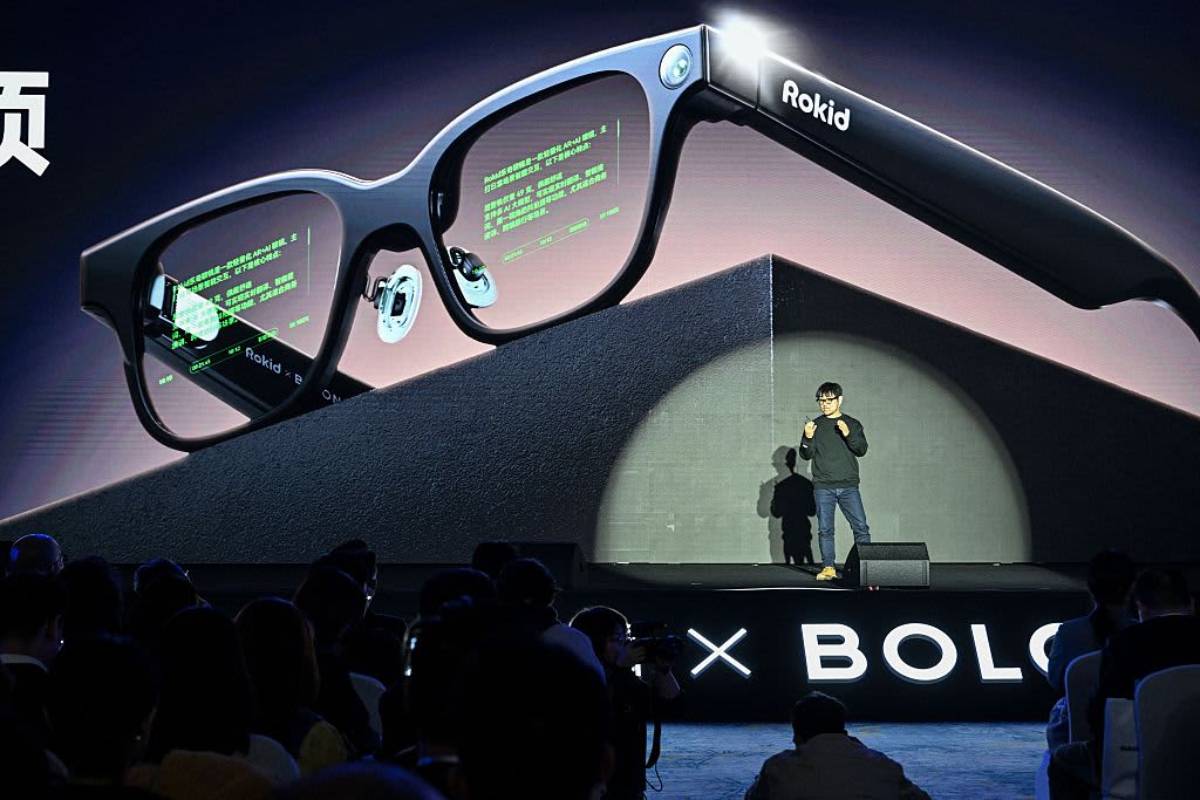
A major development unfolded as Chinese firm Rokid unveiled AI-powered smart glasses featuring built-in virtual displays an advancement not yet matched by Meta Platforms. The innovation signals intensifying global competition in wearable AI, with implications for consumer tech leadership, supply chains, and digital ecosystem dominance.
Rokid introduced AI smart glasses capable of projecting a virtual screen directly into the user’s field of vision, enabling functions such as messaging, navigation, and media consumption without external devices.
Unlike Meta’s Ray-Ban smart glasses, which focus on audio, cameras, and AI assistants, Rokid’s product integrates a visual interface marking a significant leap toward fully immersive wearable computing.
The product is already gaining attention in China’s fast-evolving tech market, with potential for global expansion. Key stakeholders include hardware manufacturers, AI developers, and consumers, as well as policymakers monitoring cross-border tech competition and innovation leadership.
The development aligns with a broader trend across global markets where AI-powered wearables are emerging as the next frontier in personal computing. Technology giants are racing to develop devices that move beyond smartphones toward always-on, context-aware interfaces.
Meta, in partnership with Ray-Ban, has pushed into smart glasses with camera-enabled devices, while companies like Apple are investing heavily in spatial computing through mixed reality headsets.
China, however, has been accelerating innovation in hardware-software integration, supported by strong domestic supply chains and government-backed tech ecosystems. Rokid’s advancement highlights China’s growing ability to compete at the cutting edge of consumer AI devices. The race for dominance in AI wearables is increasingly seen as strategic, with implications for data ecosystems, user interfaces, and the future of digital interaction.
Industry analysts view Rokid’s virtual display capability as a critical differentiator in the smart glasses market. Experts suggest that integrating a functional screen directly into eyewear could significantly enhance usability, making such devices viable alternatives to smartphones in certain contexts.
Technology strategists note that Meta’s approach has prioritized accessibility and style, while Chinese firms are pushing hardware innovation more aggressively. This divergence reflects different market strategies mass adoption versus technological leapfrogging.
Some experts caution that challenges remain, including battery life, user comfort, and privacy concerns associated with always-on visual interfaces. While official statements emphasize innovation and user experience, the broader industry sees this as a signal that competition in AI wearables is entering a more advanced and differentiated phase.
For global executives, this shift could redefine competitive dynamics in consumer technology and AI ecosystems. Companies may need to accelerate investment in hardware innovation to keep pace with rapidly evolving user expectations.
Investors are likely to view AI wearables as a high-growth segment, particularly as devices become more functional and integrated into daily life. Policymakers, meanwhile, may face new challenges around data privacy, surveillance, and cross-border technology competition. The development also underscores the strategic importance of supply chains and domestic innovation capabilities in shaping global tech leadership.
Looking ahead, the success of Rokid’s AI glasses will depend on user adoption, global market entry, and the ability to scale production. Competitors like Meta and Apple are expected to respond with more advanced features, intensifying the innovation cycle.
As the race for AI-powered wearables accelerates, decision-makers should watch for breakthroughs in display technology, battery efficiency, and ecosystem integration—key factors that will determine long-term market leadership.
Source: CNBC
Date: April 13, 2026


