
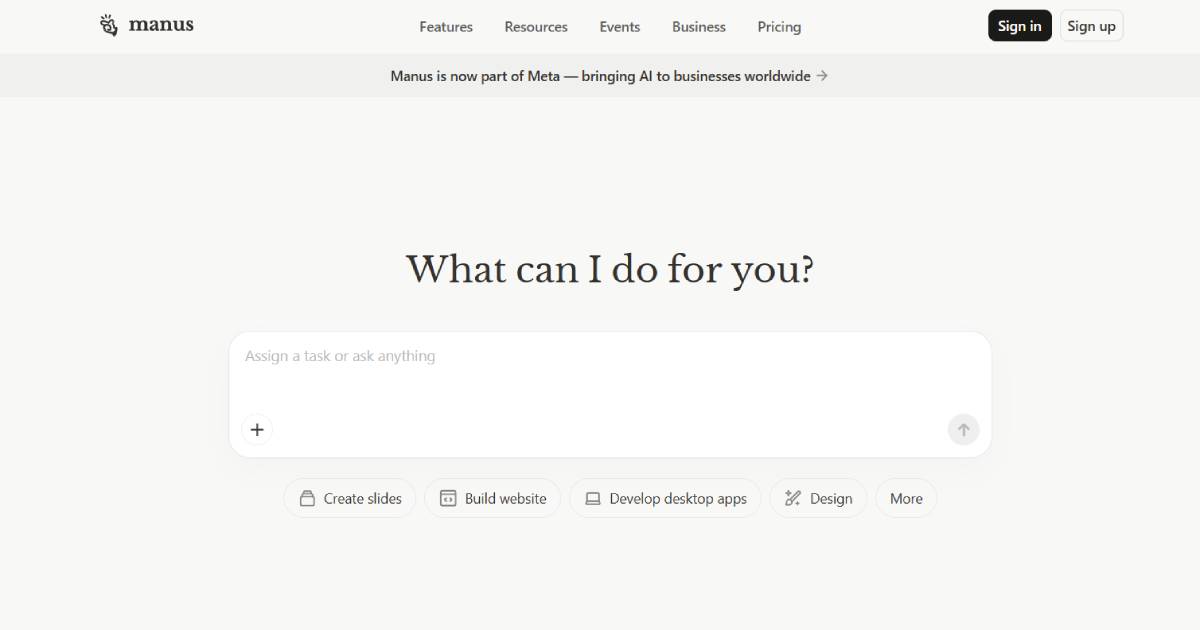
Manus AI Redefines Autonomous Workflows

Manus introduces an AI agent model designed to move beyond conversational assistance into task execution, workflow automation, and multi-step decision support.

April 13, 2026
|

A new wave of “hands-on AI” systems is emerging, with platforms like Manus positioning themselves as autonomous digital agents capable of executing complex tasks with minimal human intervention. The development signals a shift from passive generative tools toward action-oriented AI systems, reshaping enterprise automation, productivity structures, and the future of digital labor.

Manus introduces an AI agent model designed to move beyond conversational assistance into task execution, workflow automation, and multi-step decision support. The platform emphasizes autonomous reasoning, enabling users to delegate structured objectives rather than individual prompts.

The system is being positioned for enterprise and professional use cases, including research synthesis, workflow coordination, and operational task handling. Stakeholders in the AI automation ecosystem including developers, SaaS providers, and enterprise adopters—are closely tracking its evolution.

This shift aligns with broader industry movement toward agentic AI, where systems are increasingly expected to perform end-to-end tasks across digital environments rather than simply generate content.

The rise of AI agents represents a structural evolution in artificial intelligence adoption. Early generative models focused on content creation, but enterprise demand is now shifting toward systems that can execute workflows, integrate with tools, and reduce human intervention in operational processes.

Platforms like Manus emerge in a competitive environment shaped by rapid innovation from major AI labs and startups building agent-based architectures. This trend is closely tied to enterprise automation, where companies seek efficiency gains beyond productivity tools and toward partial task replacement systems.

Historically, automation revolutions from RPA to cloud-based SaaS have gradually shifted human roles from execution to oversight. Agentic AI may accelerate this transition, compressing decision cycles and redefining how digital labor is structured across industries such as finance, software development, and operations.

Industry analysts suggest that agentic AI platforms like Manus reflect the next phase of enterprise AI maturity, where “goal-driven systems” replace prompt-based interaction models. Experts highlight that the key differentiation is not content generation, but autonomy in executing multi-step processes across tools and APIs.

AI researchers caution, however, that full autonomy introduces challenges around reliability, oversight, and accountability especially in regulated industries. Some technology leaders argue that while productivity gains could be significant, governance frameworks will need to evolve in parallel to prevent operational risk.

Enterprise consultants note that adoption will likely begin in low-risk workflows such as research, scheduling, and internal documentation before expanding into mission-critical operations. The competitive landscape is expected to intensify as both startups and major cloud providers race to define the standards for agentic systems.

For enterprises, agentic AI platforms could significantly reduce operational friction by automating multi-step workflows that currently require human coordination. This may reshape job roles in analytics, administration, and digital operations, shifting workforce demand toward oversight and strategy rather than execution.

Investors are closely watching the emergence of agent-first platforms as a potential new SaaS category with high scalability. However, regulatory frameworks may lag behind deployment, raising questions around accountability, data security, and decision traceability.

For governments and policymakers, the challenge will be balancing innovation with safeguards as AI systems transition from advisory tools to autonomous actors within enterprise environments.

The evolution of Manus-style systems suggests a broader industry shift toward autonomous AI ecosystems integrated directly into enterprise workflows. Over the next phase, competition will likely focus on reliability, integrations, and governance controls rather than raw model capability. Decision-makers will closely watch adoption rates in enterprise pilots and the emergence of regulatory standards defining acceptable autonomy in AI systems.

Source: https://manus.im/
Date: April 13, 2026

  • Featured tools
Beautiful AI
Free

Beautiful AI is an AI-powered presentation platform that automates slide design and formatting, enabling users to create polished, on-brand presentations quickly.

#
Presentation
Learn more
Scalenut AI
Free

Scalenut AI is an all-in-one SEO content platform that combines AI-driven writing, keyword research, competitor insights, and optimization tools to help you plan, create, and rank content.

#
SEO
Learn more

Learn more about future of AI

Join 80,000+ Ai enthusiast getting weekly updates on exciting AI tools.
Thank you! Your submission has been received!
Oops! Something went wrong while submitting the form.

Manus AI Redefines Autonomous Workflows

April 13, 2026

Manus introduces an AI agent model designed to move beyond conversational assistance into task execution, workflow automation, and multi-step decision support.

A new wave of “hands-on AI” systems is emerging, with platforms like Manus positioning themselves as autonomous digital agents capable of executing complex tasks with minimal human intervention. The development signals a shift from passive generative tools toward action-oriented AI systems, reshaping enterprise automation, productivity structures, and the future of digital labor.

Manus introduces an AI agent model designed to move beyond conversational assistance into task execution, workflow automation, and multi-step decision support. The platform emphasizes autonomous reasoning, enabling users to delegate structured objectives rather than individual prompts.

The system is being positioned for enterprise and professional use cases, including research synthesis, workflow coordination, and operational task handling. Stakeholders in the AI automation ecosystem including developers, SaaS providers, and enterprise adopters—are closely tracking its evolution.

This shift aligns with broader industry movement toward agentic AI, where systems are increasingly expected to perform end-to-end tasks across digital environments rather than simply generate content.

The rise of AI agents represents a structural evolution in artificial intelligence adoption. Early generative models focused on content creation, but enterprise demand is now shifting toward systems that can execute workflows, integrate with tools, and reduce human intervention in operational processes.

Platforms like Manus emerge in a competitive environment shaped by rapid innovation from major AI labs and startups building agent-based architectures. This trend is closely tied to enterprise automation, where companies seek efficiency gains beyond productivity tools and toward partial task replacement systems.

Historically, automation revolutions from RPA to cloud-based SaaS have gradually shifted human roles from execution to oversight. Agentic AI may accelerate this transition, compressing decision cycles and redefining how digital labor is structured across industries such as finance, software development, and operations.

Industry analysts suggest that agentic AI platforms like Manus reflect the next phase of enterprise AI maturity, where “goal-driven systems” replace prompt-based interaction models. Experts highlight that the key differentiation is not content generation, but autonomy in executing multi-step processes across tools and APIs.

AI researchers caution, however, that full autonomy introduces challenges around reliability, oversight, and accountability especially in regulated industries. Some technology leaders argue that while productivity gains could be significant, governance frameworks will need to evolve in parallel to prevent operational risk.

Enterprise consultants note that adoption will likely begin in low-risk workflows such as research, scheduling, and internal documentation before expanding into mission-critical operations. The competitive landscape is expected to intensify as both startups and major cloud providers race to define the standards for agentic systems.

For enterprises, agentic AI platforms could significantly reduce operational friction by automating multi-step workflows that currently require human coordination. This may reshape job roles in analytics, administration, and digital operations, shifting workforce demand toward oversight and strategy rather than execution.

Investors are closely watching the emergence of agent-first platforms as a potential new SaaS category with high scalability. However, regulatory frameworks may lag behind deployment, raising questions around accountability, data security, and decision traceability.

For governments and policymakers, the challenge will be balancing innovation with safeguards as AI systems transition from advisory tools to autonomous actors within enterprise environments.

The evolution of Manus-style systems suggests a broader industry shift toward autonomous AI ecosystems integrated directly into enterprise workflows. Over the next phase, competition will likely focus on reliability, integrations, and governance controls rather than raw model capability. Decision-makers will closely watch adoption rates in enterprise pilots and the emergence of regulatory standards defining acceptable autonomy in AI systems.

Source: https://manus.im/
Date: April 13, 2026

Promote Your Tool

Copy Embed Code

Similar Blogs

April 13, 2026
|

Rudi AI Emerges in Automation Space

Rudi-AI presents itself as an AI automation platform built around intelligent agents capable of executing structured tasks and supporting workflow optimization.
Read more
April 13, 2026
|

Manus AI Redefines Autonomous Workflows

Manus introduces an AI agent model designed to move beyond conversational assistance into task execution, workflow automation, and multi-step decision support.
Read more
April 13, 2026
|

Otter AI Reshapes Meeting Intelligence

Otter.ai continues to expand its position in the enterprise AI collaboration space by offering automated meeting transcription, summarization, and insight generation.
Read more
April 13, 2026
|

InVideo AI Expands Video Automation Platform

InVideo is positioning itself within the expanding generative AI ecosystem by offering tools that enable users to create videos through automated prompts and templates.
Read more
April 13, 2026
|

US Urged to Lead Global AI Race

Sundar Pichai stated in a televised interview that the United States should take a leading role in artificial intelligence development to ensure technological competitiveness and strategic advantage.
Read more
April 13, 2026
|

AI Megacap Valuation Reset Sparks Timing Debate

The stock part of the dominant group of large-cap U.S. technology firms often referred to as the “Magnificent Seven” has experienced renewed price pressure despite continued investor interest in artificial intelligence exposure.
Read more