
AI Robotics Breakthrough Advances Sports Precision Automation

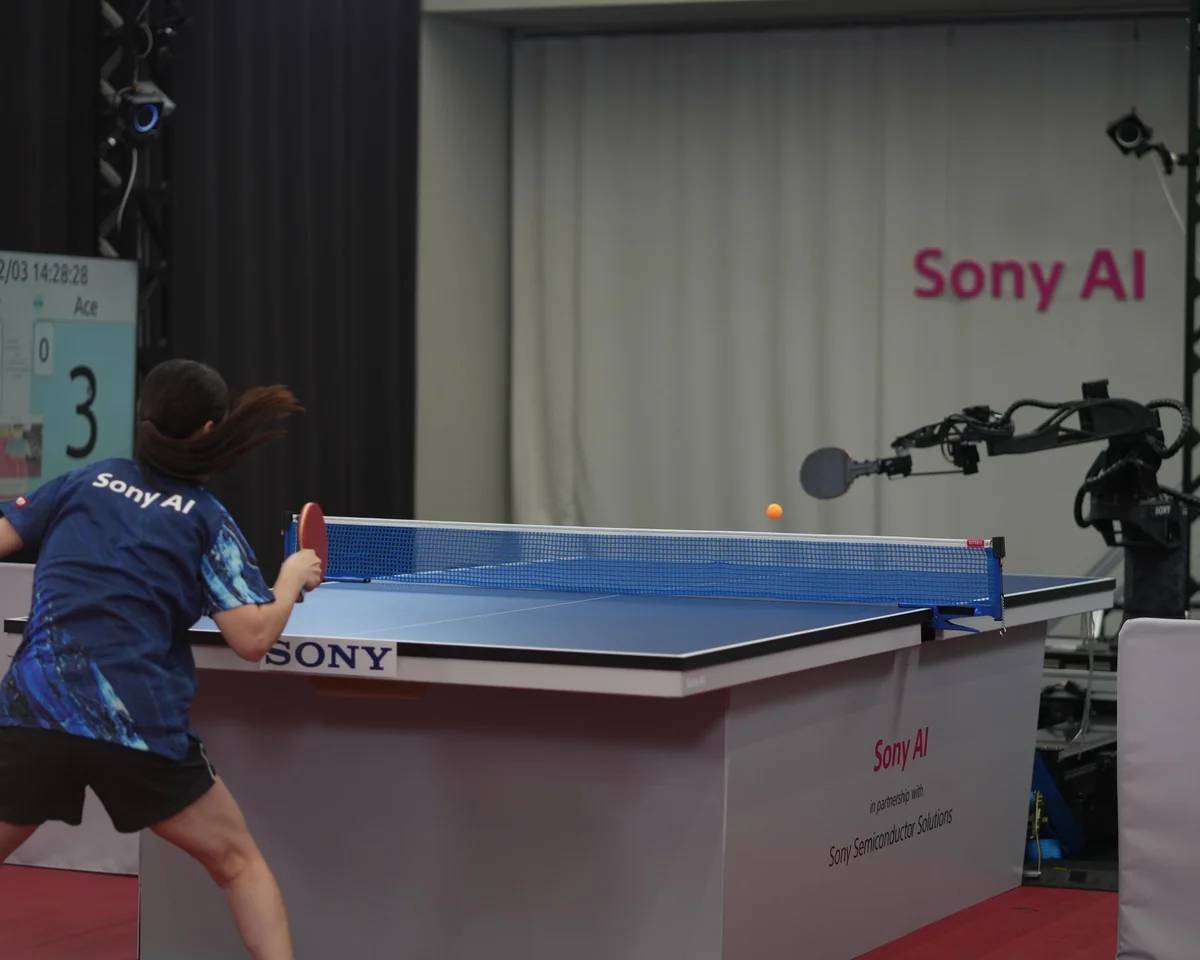
The AI-driven robotic system demonstrated the ability to compete against professional-level table tennis players, successfully reacting to high-speed shots and executing precise returns.

April 23, 2026
|
Image Source: The Guardian

A newly developed AI-powered robot has defeated elite human table tennis players, marking a significant milestone in robotics and machine learning capabilities. The achievement underscores rapid advancements in real-time decision-making systems, with implications extending beyond sport into industrial automation, defense systems, and human-machine interaction technologies.

The AI-driven robotic system demonstrated the ability to compete against professional-level table tennis players, successfully reacting to high-speed shots and executing precise returns. The system integrates advanced motion prediction, reinforcement learning, and real-time sensor feedback.

Key stakeholders include robotics researchers, AI developers, and institutions advancing human-machine interaction technologies. The timeline reflects accelerating progress in embodied AI systems capable of operating in dynamic, high-speed environments. Economically, the breakthrough highlights potential applications in manufacturing automation, precision robotics, and logistics systems where rapid decision-making and physical dexterity are increasingly valuable.

The development reflects a broader global acceleration in robotics and embodied artificial intelligence, where machines are increasingly capable of interacting with complex physical environments. Traditionally, AI systems have excelled in digital domains such as language processing and data analysis, but physical-world applications present significantly higher complexity.

Advancements in reinforcement learning, computer vision, and sensor fusion have enabled robots to perform tasks requiring real-time adaptability. Similar progress has been observed in industrial robotics and autonomous systems.

Historically, robotic performance has been limited by latency and environmental unpredictability. However, recent breakthroughs indicate a shift toward systems that can learn and adapt in real time. This evolution positions robotics as a key frontier in the broader AI transformation across global industries, including manufacturing, logistics, and defense.

Robotics experts describe the achievement as a demonstration of narrowing performance gaps between human reflexes and machine reaction capabilities in controlled environments. Analysts note that table tennis serves as a high-complexity benchmark due to its speed, precision, and continuous decision-making requirements.

Industry researchers emphasize that such systems are not merely sport-oriented but serve as testbeds for industrial automation technologies. Experts suggest that breakthroughs in real-time physical AI could accelerate adoption in sectors requiring fine motor control and rapid adaptive responses.

However, specialists caution that transferring performance from controlled environments to unpredictable real-world settings remains a significant challenge. Variability in physical conditions, object dynamics, and environmental noise continues to limit deployment scalability.

For global executives, the breakthrough signals accelerating convergence between AI research and real-world automation applications. Industries such as manufacturing, warehousing, and logistics may benefit from more adaptive robotic systems capable of handling complex tasks.

Investors are likely to increase attention toward robotics and embodied AI companies as commercialization pathways expand. From a policy perspective, governments may need to evaluate workforce displacement risks and regulatory frameworks for advanced automation technologies. The growing capability of AI-driven robotics could reshape labor dynamics in precision-based industries while creating new demand for human oversight and system management roles.

Looking ahead, advancements in embodied AI are expected to move rapidly from experimental demonstrations to industrial applications. Decision-makers should monitor deployment in logistics, manufacturing, and service robotics. The key uncertainty lies in scalability transitioning from controlled environments to real-world operational complexity will determine the pace of adoption.

Source: The Guardian
Date: April 22, 2026

  • Featured tools
Neuron AI
Free

Neuron AI is an AI-driven content optimization platform that helps creators produce SEO-friendly content by combining semantic SEO, competitor analysis, and AI-assisted writing workflows.

#
SEO
Learn more
Murf Ai
Free

Murf AI Review – Advanced AI Voice Generator for Realistic Voiceovers

#
Text to Speech
Learn more

Learn more about future of AI

Join 80,000+ Ai enthusiast getting weekly updates on exciting AI tools.
Thank you! Your submission has been received!
Oops! Something went wrong while submitting the form.

AI Robotics Breakthrough Advances Sports Precision Automation

April 23, 2026

The AI-driven robotic system demonstrated the ability to compete against professional-level table tennis players, successfully reacting to high-speed shots and executing precise returns.

Image Source: The Guardian

A newly developed AI-powered robot has defeated elite human table tennis players, marking a significant milestone in robotics and machine learning capabilities. The achievement underscores rapid advancements in real-time decision-making systems, with implications extending beyond sport into industrial automation, defense systems, and human-machine interaction technologies.

The AI-driven robotic system demonstrated the ability to compete against professional-level table tennis players, successfully reacting to high-speed shots and executing precise returns. The system integrates advanced motion prediction, reinforcement learning, and real-time sensor feedback.

Key stakeholders include robotics researchers, AI developers, and institutions advancing human-machine interaction technologies. The timeline reflects accelerating progress in embodied AI systems capable of operating in dynamic, high-speed environments. Economically, the breakthrough highlights potential applications in manufacturing automation, precision robotics, and logistics systems where rapid decision-making and physical dexterity are increasingly valuable.

The development reflects a broader global acceleration in robotics and embodied artificial intelligence, where machines are increasingly capable of interacting with complex physical environments. Traditionally, AI systems have excelled in digital domains such as language processing and data analysis, but physical-world applications present significantly higher complexity.

Advancements in reinforcement learning, computer vision, and sensor fusion have enabled robots to perform tasks requiring real-time adaptability. Similar progress has been observed in industrial robotics and autonomous systems.

Historically, robotic performance has been limited by latency and environmental unpredictability. However, recent breakthroughs indicate a shift toward systems that can learn and adapt in real time. This evolution positions robotics as a key frontier in the broader AI transformation across global industries, including manufacturing, logistics, and defense.

Robotics experts describe the achievement as a demonstration of narrowing performance gaps between human reflexes and machine reaction capabilities in controlled environments. Analysts note that table tennis serves as a high-complexity benchmark due to its speed, precision, and continuous decision-making requirements.

Industry researchers emphasize that such systems are not merely sport-oriented but serve as testbeds for industrial automation technologies. Experts suggest that breakthroughs in real-time physical AI could accelerate adoption in sectors requiring fine motor control and rapid adaptive responses.

However, specialists caution that transferring performance from controlled environments to unpredictable real-world settings remains a significant challenge. Variability in physical conditions, object dynamics, and environmental noise continues to limit deployment scalability.

For global executives, the breakthrough signals accelerating convergence between AI research and real-world automation applications. Industries such as manufacturing, warehousing, and logistics may benefit from more adaptive robotic systems capable of handling complex tasks.

Investors are likely to increase attention toward robotics and embodied AI companies as commercialization pathways expand. From a policy perspective, governments may need to evaluate workforce displacement risks and regulatory frameworks for advanced automation technologies. The growing capability of AI-driven robotics could reshape labor dynamics in precision-based industries while creating new demand for human oversight and system management roles.

Looking ahead, advancements in embodied AI are expected to move rapidly from experimental demonstrations to industrial applications. Decision-makers should monitor deployment in logistics, manufacturing, and service robotics. The key uncertainty lies in scalability transitioning from controlled environments to real-world operational complexity will determine the pace of adoption.

Source: The Guardian
Date: April 22, 2026

Promote Your Tool

Copy Embed Code

Similar Blogs

April 23, 2026
|

Google Unveils 8th-Gen TPUs for Agentic AI

Google revealed two new TPU chips as part of its eighth-generation architecture, optimized for both AI training and inference workloads. These chips are engineered to support increasingly sophisticated AI agents capable of reasoning, planning, and executing multi-step tasks.
Read more
April 23, 2026
|

Top AI Stock Picks Signal Strong Retail Investor Confidence

Investment analysts have identified a group of AI-focused companies as strong candidates for investors deploying modest capital, such as $1,000. Among the highlighted firms is Marvell Technology, recognized for its role in supplying data infrastructure critical to AI workloads.
Read more
April 23, 2026
|

Pentagon Seeks $54B for AI Warfare Push

The Pentagon’s proposed budget emphasizes AI integration across defense systems, including autonomous weapons, intelligence analysis, and battlefield decision-making tools.
Read more
April 23, 2026
|

Microsoft to Train 3M Australians in AI by 2028

Microsoft announced plans to deliver AI training to three million Australians within four years, positioning it as the country’s most expansive corporate-led digital skills initiative.
Read more
April 23, 2026
|

IBM Growth Slows as AI Monetization Concerns Rise

IBM posted quarterly earnings that exceeded analyst forecasts, supported by steady performance in its hybrid cloud and consulting businesses. However, revenue growth lagged expectations, triggering a negative market reaction and a decline in its share price.
Read more
April 23, 2026
|

Google Cloud Unveils Dual AI Chips to Rival NVIDIA

Google Cloud introduced its latest Tensor Processing Units (TPUs), including specialized chips designed for large-scale AI training and efficient inference.
Read more