
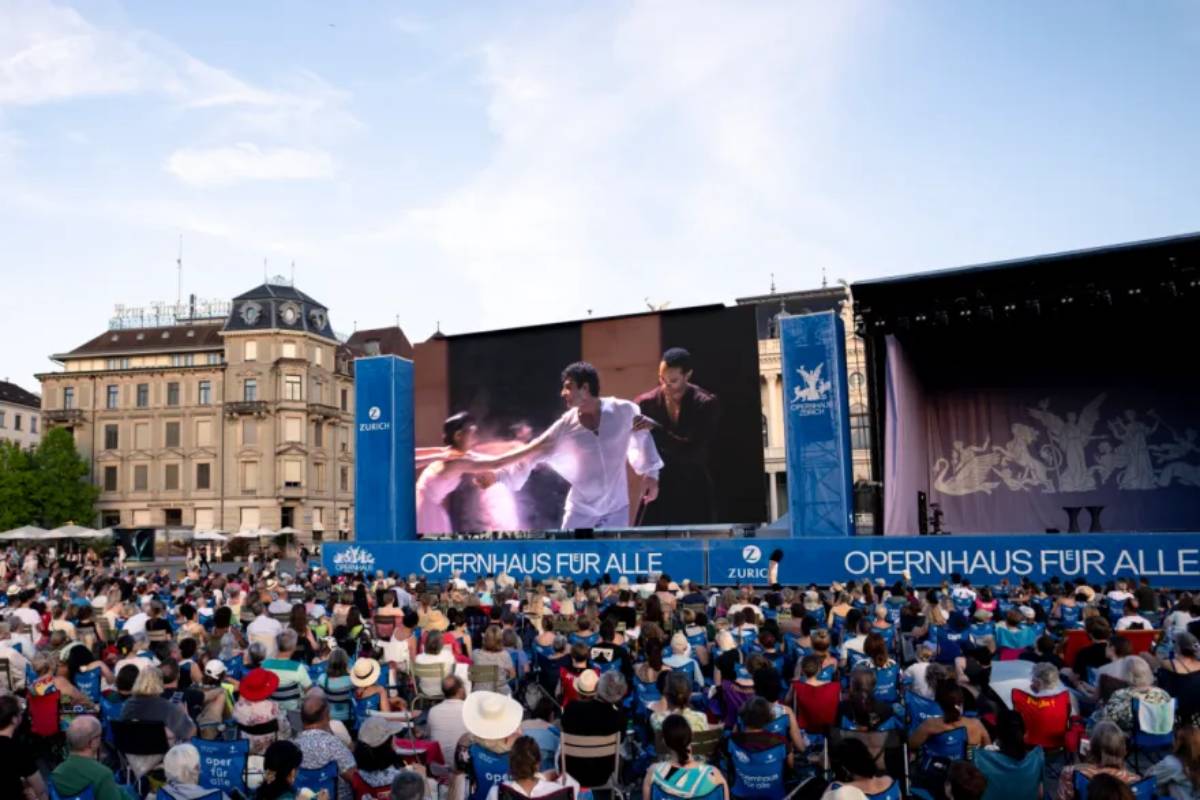
Zurich Opera for All Draws

The initiative hosted at the Zurich Opera House welcomed nearly 15,000 attendees under its “Opera House for All” program, designed to open traditionally exclusive cultural spaces to a broader public audience.

July 1, 2026
|
Image Source: Swissinfo

A major cultural engagement milestone has been recorded in Zurich, where the “Opera House for All” initiative attracted approximately 15,000 visitors. The event highlights a growing shift toward democratizing access to high culture institutions, with implications for cultural policy, urban engagement strategies, and public-private cultural programming models.

The initiative hosted at the Zurich Opera House welcomed nearly 15,000 attendees under its “Opera House for All” program, designed to open traditionally exclusive cultural spaces to a broader public audience.

The event featured guided tours, live performances, and behind-the-scenes access to one of Switzerland’s premier cultural institutions. Organizers reported strong public interest across age groups and demographics, indicating broad demand for accessible cultural experiences.

The initiative is part of a wider effort in Switzerland to increase participation in classical arts and strengthen civic engagement through cultural institutions.)

The success of the “Opera House for All” initiative in Zurich reflects a broader global trend in cultural policy where elite institutions are rethinking accessibility and audience engagement. Historically, opera houses and classical performance venues have been associated with exclusivity, limited access, and high ticket pricing structures.

In recent years, cultural institutions across Europe have increasingly adopted open-house formats, educational programming, and community engagement initiatives to expand their audience base. This shift is driven by changing demographics, evolving cultural consumption habits, and public funding expectations tied to accessibility.

Within Switzerland, cultural institutions play a significant role in national identity and tourism strategy. Events like this also align with urban branding efforts, positioning cities like Zurich as inclusive cultural hubs that balance tradition with modern public engagement models.

Cultural policy analysts describe the turnout at the Zurich Opera House as evidence of “latent demand for institutional transparency and access in high culture sectors.” Experts suggest that such initiatives help bridge the gap between elite artistic institutions and broader urban populations.

Arts administrators note that opening traditionally closed cultural venues can significantly enhance public perception and long-term audience development. They also highlight that sustained engagement, rather than one-off events, is key to building cultural participation ecosystems.

While formal executive quotes are not cited in the source material, observers emphasize that institutions in Switzerland increasingly view outreach programs as strategic investments rather than symbolic gestures. Analysts further suggest that strong turnout figures like 15,000 visitors may encourage similar models across European cultural institutions seeking to expand relevance in a digital and experience-driven economy.

For cultural institutions in Zurich, the success of the program demonstrates the commercial and reputational value of open-access cultural programming. Increased footfall can translate into broader audience development, sponsorship opportunities, and long-term ticketing growth.

For policymakers in Switzerland, the initiative reinforces the role of publicly supported cultural infrastructure in driving social cohesion and tourism appeal. It may also influence future funding models tied to accessibility outcomes.

For urban planners and cultural strategists, the event highlights how legacy institutions can be repositioned as inclusive civic spaces, contributing to city branding and experiential economy growth.

Going forward, Zurich Opera House is likely to expand similar outreach initiatives if engagement levels remain high. The key challenge will be sustaining participation beyond one-time events and integrating access programs into regular institutional operations. If successful, Zurich’s model could serve as a reference point for other European cultural capitals seeking to balance tradition with broader public engagement.

Source: Swissinfo
Date: July 1, 2026

  • Featured tools
Tome AI
Free

Tome AI is an AI-powered storytelling and presentation tool designed to help users create compelling narratives and presentations quickly and efficiently. It leverages advanced AI technologies to generate content, images, and animations based on user input.

#
Presentation
#
Startup Tools
Learn more
Symphony Ayasdi AI
Free

SymphonyAI Sensa is an AI-powered surveillance and financial crime detection platform that surfaces hidden risk behavior through explainable, AI-driven analytics.

#
Finance
Learn more

Learn more about future of AI

Join 80,000+ Ai enthusiast getting weekly updates on exciting AI tools.
Thank you! Your submission has been received!
Oops! Something went wrong while submitting the form.

Zurich Opera for All Draws

July 1, 2026

The initiative hosted at the Zurich Opera House welcomed nearly 15,000 attendees under its “Opera House for All” program, designed to open traditionally exclusive cultural spaces to a broader public audience.

Image Source: Swissinfo

A major cultural engagement milestone has been recorded in Zurich, where the “Opera House for All” initiative attracted approximately 15,000 visitors. The event highlights a growing shift toward democratizing access to high culture institutions, with implications for cultural policy, urban engagement strategies, and public-private cultural programming models.

The initiative hosted at the Zurich Opera House welcomed nearly 15,000 attendees under its “Opera House for All” program, designed to open traditionally exclusive cultural spaces to a broader public audience.

The event featured guided tours, live performances, and behind-the-scenes access to one of Switzerland’s premier cultural institutions. Organizers reported strong public interest across age groups and demographics, indicating broad demand for accessible cultural experiences.

The initiative is part of a wider effort in Switzerland to increase participation in classical arts and strengthen civic engagement through cultural institutions.)

The success of the “Opera House for All” initiative in Zurich reflects a broader global trend in cultural policy where elite institutions are rethinking accessibility and audience engagement. Historically, opera houses and classical performance venues have been associated with exclusivity, limited access, and high ticket pricing structures.

In recent years, cultural institutions across Europe have increasingly adopted open-house formats, educational programming, and community engagement initiatives to expand their audience base. This shift is driven by changing demographics, evolving cultural consumption habits, and public funding expectations tied to accessibility.

Within Switzerland, cultural institutions play a significant role in national identity and tourism strategy. Events like this also align with urban branding efforts, positioning cities like Zurich as inclusive cultural hubs that balance tradition with modern public engagement models.

Cultural policy analysts describe the turnout at the Zurich Opera House as evidence of “latent demand for institutional transparency and access in high culture sectors.” Experts suggest that such initiatives help bridge the gap between elite artistic institutions and broader urban populations.

Arts administrators note that opening traditionally closed cultural venues can significantly enhance public perception and long-term audience development. They also highlight that sustained engagement, rather than one-off events, is key to building cultural participation ecosystems.

While formal executive quotes are not cited in the source material, observers emphasize that institutions in Switzerland increasingly view outreach programs as strategic investments rather than symbolic gestures. Analysts further suggest that strong turnout figures like 15,000 visitors may encourage similar models across European cultural institutions seeking to expand relevance in a digital and experience-driven economy.

For cultural institutions in Zurich, the success of the program demonstrates the commercial and reputational value of open-access cultural programming. Increased footfall can translate into broader audience development, sponsorship opportunities, and long-term ticketing growth.

For policymakers in Switzerland, the initiative reinforces the role of publicly supported cultural infrastructure in driving social cohesion and tourism appeal. It may also influence future funding models tied to accessibility outcomes.

For urban planners and cultural strategists, the event highlights how legacy institutions can be repositioned as inclusive civic spaces, contributing to city branding and experiential economy growth.

Going forward, Zurich Opera House is likely to expand similar outreach initiatives if engagement levels remain high. The key challenge will be sustaining participation beyond one-time events and integrating access programs into regular institutional operations. If successful, Zurich’s model could serve as a reference point for other European cultural capitals seeking to balance tradition with broader public engagement.

Source: Swissinfo
Date: July 1, 2026

Promote Your Tool

Copy Embed Code

Similar Blogs

July 1, 2026
|

Ireland EU Presidency Influences Switzerland

As Ireland takes on influence within the EU policy cycle, its presidency is expected to help steer discussions across key strategic areas affecting non-EU partners such as Switzerland.
Read more
July 1, 2026
|

Swiss Traditions Face Climate Pressure

The Swiss Yodelling Festival in Basel concluded with a large-scale parade that proceeded despite unusually high temperatures affecting the region.
Read more
July 1, 2026
|

Zurich Opera for All Draws

The initiative hosted at the Zurich Opera House welcomed nearly 15,000 attendees under its “Opera House for All” program, designed to open traditionally exclusive cultural spaces to a broader public audience.
Read more
July 1, 2026
|

Palantir Signals Compliance Shift Ruling

Palantir Technologies has formally accepted a legal ruling arising from its dispute with Swiss investigative magazine Republik.
Read more
July 1, 2026
|

Switzerland Faces Extended Climate Stress

Meteorological data from Switzerland confirms that several weather stations have surpassed previous records for consecutive days of extreme heat.
Read more
July 1, 2026
|

Switzerland Leads Circular Economy Push

In Switzerland, national recycling systems processed more than 140,000 tonnes of electrical and electronic equipment, reflecting one of the highest per-capita e-waste recovery performances globally.
Read more