



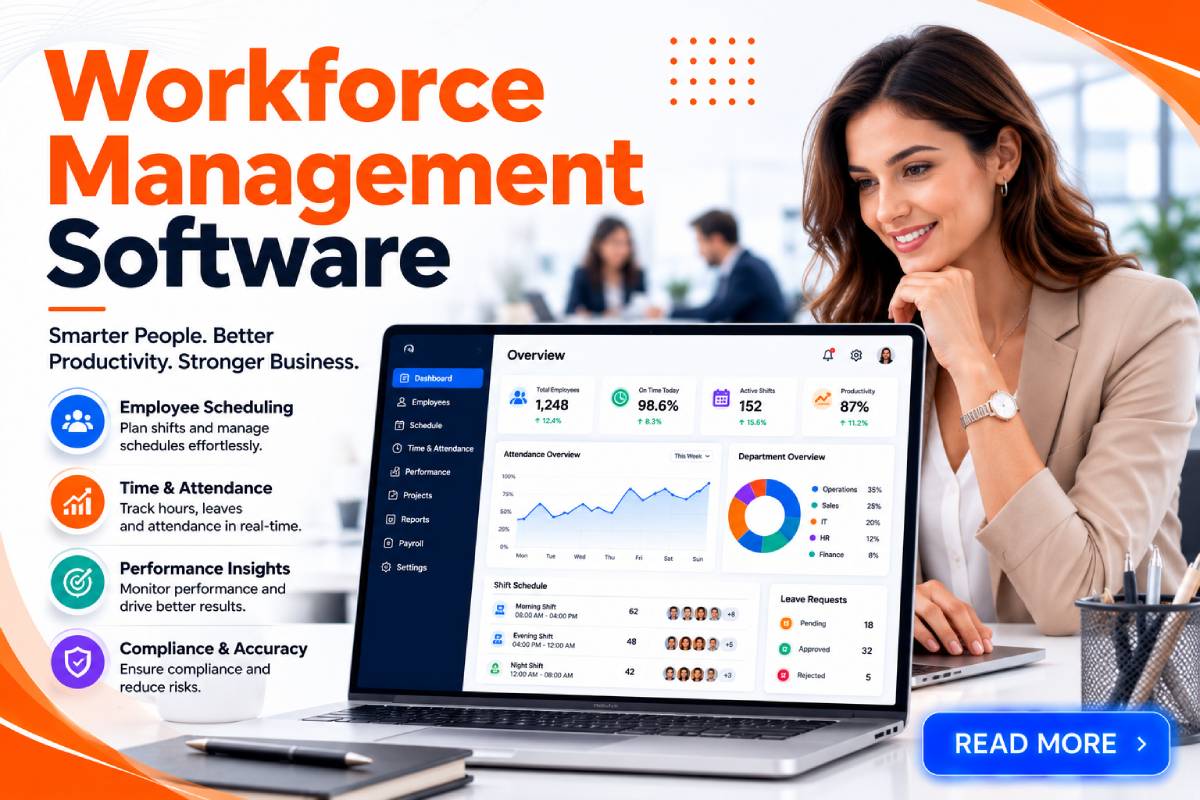
Workforce management software is becoming an increasingly important component of modern business operations as employers seek greater control over scheduling, attendance, labor costs and employee productivity. The market reflects a broader enterprise shift toward data-driven workforce planning, with technology helping organizations respond to changing labor conditions, operational complexity and demands for greater efficiency.
Modern workforce management platforms bring together capabilities such as employee scheduling, time and attendance tracking, payroll coordination, absence management, workforce forecasting and labor analytics. By centralizing these functions, organizations can gain greater visibility into staffing requirements and operational costs.
Automation is also becoming a major component of the category. Businesses can use software to automate schedules, monitor working hours, manage leave requests and identify staffing gaps. Some platforms increasingly incorporate artificial intelligence and predictive analytics to support workforce forecasting and decision-making.
The technology is relevant across industries with complex staffing requirements, including retail, healthcare, hospitality, manufacturing, logistics and professional services. For executives, the central objective is increasingly clear: align workforce capacity with business demand while controlling labor expenditure.
The development aligns with a broader transformation in workforce management driven by changing employee expectations, labor shortages, hybrid work and rising operational costs. Companies increasingly need to balance employee flexibility with reliable staffing levels and predictable business performance.
Historically, workforce scheduling and attendance management often relied on spreadsheets, paper records or disconnected HR systems. As organizations expanded, these processes became increasingly difficult to manage accurately. Workforce management platforms emerged to automate administrative tasks and provide centralized workforce data.
The market is now moving toward more sophisticated systems capable of analyzing historical patterns and forecasting future staffing requirements. Integration with payroll, human resources, finance and enterprise systems is also becoming increasingly important.
For CXOs, workforce management is no longer simply an HR function. Labor represents one of the largest operating expenses for many organizations, meaning workforce decisions can have a direct impact on profitability, customer service and business continuity.
Industry analysts generally view workforce management technology as an operational efficiency tool rather than simply an employee administration system. Its strategic value comes from connecting workforce data with business demand, allowing managers to make more informed staffing decisions.
For organizations with large hourly or distributed workforces, automated scheduling can reduce administrative workloads while helping managers respond to changing demand. Time and attendance capabilities can also improve payroll accuracy and provide stronger visibility into labor utilization.
The increasing use of artificial intelligence introduces additional opportunities. Predictive tools can potentially identify staffing requirements, anticipate demand fluctuations and highlight scheduling inefficiencies before they affect operations.
However, experts also emphasize the importance of human oversight. Automated workforce decisions can affect employees directly, making transparency, fairness, data accuracy and appropriate governance essential. Organizations adopting advanced workforce technologies must therefore balance efficiency objectives with employee experience and responsible technology management.
For businesses, workforce management software can help reduce scheduling inefficiencies, improve labor utilization and strengthen operational planning. Managers can gain clearer visibility into staffing levels while employees may benefit from more accessible scheduling and leave-management processes.
For investors and executives, the technology can contribute to cost control and productivity improvements, particularly in labor-intensive industries. The ability to forecast workforce requirements can also help organizations respond more quickly to fluctuations in demand.
Policy considerations include employee privacy, working-time regulations, data security and the responsible use of AI in workforce decisions. As organizations collect increasingly detailed workforce information, governance frameworks will become more important.
Executives should evaluate platforms based on measurable outcomes, including labor-cost optimization, scheduling accuracy, employee adoption and integration with existing HR and financial systems.
The workforce management market is likely to move toward greater automation, predictive analytics and AI-assisted planning. Future platforms may increasingly connect workforce demand forecasts with scheduling, payroll, finance and broader business planning systems.
Decision-makers should watch how vendors address data privacy, AI transparency and employee experience alongside productivity. The strongest solutions will be those that help organizations control labor costs while creating a more responsive, predictable and sustainable workforce operation.
Source: Crozdesk
Date: August 11, 2026


