
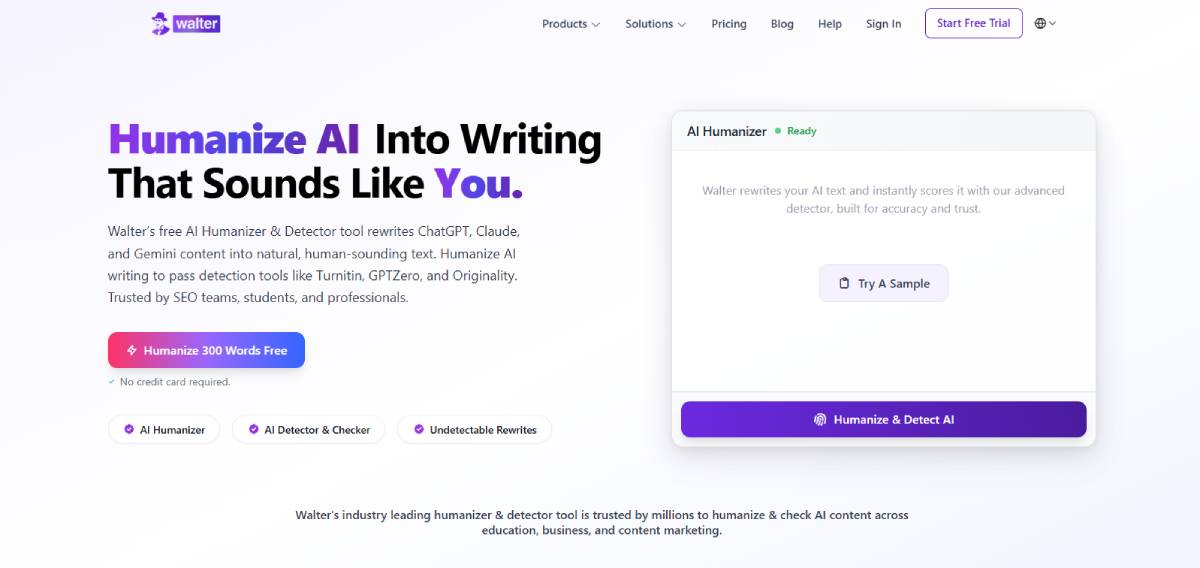
Walter Writes Blends AI Humanization and Detection

Walter Writes offers a dual-function platform that both humanizes AI-generated text and detects machine-written content. This integrated approach differentiates it from single-purpose tools.

April 13, 2026
|

The launch and positioning of Walter Writes reflects a new phase in the AI content ecosystem, where generation, detection, and humanization capabilities are converging into unified platforms. This evolution carries significant implications for enterprises, educators, and regulators navigating rising concerns around digital authenticity.

Walter Writes offers a dual-function platform that both humanizes AI-generated text and detects machine-written content. This integrated approach differentiates it from single-purpose tools, addressing growing demand for end-to-end content management solutions.

The platform targets a broad user base, including students, marketers, and enterprises seeking to refine AI outputs while maintaining compliance with authenticity standards. Its “free” positioning signals intensifying competition in the AI tools market, where accessibility is becoming a key adoption driver.

This development highlights a shift toward multifunctional AI platforms that combine creation, refinement, and verification blurring traditional boundaries between competing tool categories in the generative AI ecosystem.

The development aligns with a broader trend across global markets where generative AI adoption is rapidly transforming content creation workflows. As organizations increasingly rely on AI for communication, marketing, and documentation, the need to ensure authenticity and trust has grown significantly.

Initially, the ecosystem evolved in silos AI generators on one side and detection tools on the other. However, the emergence of platforms like Walter Writes indicates a convergence of these functions into unified systems. This mirrors patterns seen in cybersecurity and cloud computing, where integrated solutions eventually replaced fragmented toolchains.

The rise of such platforms also reflects mounting pressure from academic institutions, enterprises, and regulators to maintain transparency in AI-generated content. As the line between human and machine-generated text blurs, integrated solutions are becoming critical to managing both productivity and risk.

Industry experts view the convergence of humanization and detection tools as a natural progression in the AI lifecycle. Analysts suggest that users increasingly demand platforms that not only generate content but also ensure it meets quality, compliance, and authenticity standards.

Some experts argue that combining detection and humanization in a single platform could create conflicts of interest, as tools may be optimized to bypass their own detection mechanisms. Others see it as an efficiency gain, enabling users to manage the entire content lifecycle within one interface.

Policy specialists emphasize that transparency will remain a central concern. They advocate for standardized disclosure mechanisms and independent verification systems to ensure accountability, particularly in regulated sectors.

The discussion highlights the growing complexity of managing AI-generated content in a rapidly evolving technological landscape. For businesses, integrated platforms like Walter Writes could streamline content workflows, reducing the need for multiple tools while improving efficiency. However, they also introduce governance challenges, particularly around ensuring ethical use and maintaining brand credibility.

Investors may view this convergence as a signal of market maturation, with opportunities emerging in platforms that offer comprehensive AI content solutions. Enterprises may increasingly prioritize vendors that combine productivity with compliance features.

From a policy perspective, regulators may need to address the dual-use nature of such tools, balancing innovation with safeguards against misuse. This could lead to new requirements for transparency, auditing, and accountability in AI-driven content systems.

The integration of AI generation, detection, and humanization is expected to accelerate, driving further consolidation across the ecosystem. Decision-makers should monitor how platforms differentiate through trust, compliance, and enterprise-grade capabilities. As competition intensifies, the ability to balance efficiency with transparency will determine which players emerge as leaders in the evolving AI content economy.7. Source & Date

Source: WalterWrites.ai
Date: April 2026

  • Featured tools
WellSaid Ai
Free

WellSaid AI is an advanced text-to-speech platform that transforms written text into lifelike, human-quality voiceovers.

#
Text to Speech
Learn more
Hostinger Horizons
Freemium

Hostinger Horizons is an AI-powered platform that allows users to build and deploy custom web applications without writing code. It packs hosting, domain management and backend integration into a unified tool for rapid app creation.

#
Startup Tools
#
Coding
#
Project Management
Learn more

Learn more about future of AI

Join 80,000+ Ai enthusiast getting weekly updates on exciting AI tools.
Thank you! Your submission has been received!
Oops! Something went wrong while submitting the form.

Walter Writes Blends AI Humanization and Detection

April 13, 2026

Walter Writes offers a dual-function platform that both humanizes AI-generated text and detects machine-written content. This integrated approach differentiates it from single-purpose tools.

The launch and positioning of Walter Writes reflects a new phase in the AI content ecosystem, where generation, detection, and humanization capabilities are converging into unified platforms. This evolution carries significant implications for enterprises, educators, and regulators navigating rising concerns around digital authenticity.

Walter Writes offers a dual-function platform that both humanizes AI-generated text and detects machine-written content. This integrated approach differentiates it from single-purpose tools, addressing growing demand for end-to-end content management solutions.

The platform targets a broad user base, including students, marketers, and enterprises seeking to refine AI outputs while maintaining compliance with authenticity standards. Its “free” positioning signals intensifying competition in the AI tools market, where accessibility is becoming a key adoption driver.

This development highlights a shift toward multifunctional AI platforms that combine creation, refinement, and verification blurring traditional boundaries between competing tool categories in the generative AI ecosystem.

The development aligns with a broader trend across global markets where generative AI adoption is rapidly transforming content creation workflows. As organizations increasingly rely on AI for communication, marketing, and documentation, the need to ensure authenticity and trust has grown significantly.

Initially, the ecosystem evolved in silos AI generators on one side and detection tools on the other. However, the emergence of platforms like Walter Writes indicates a convergence of these functions into unified systems. This mirrors patterns seen in cybersecurity and cloud computing, where integrated solutions eventually replaced fragmented toolchains.

The rise of such platforms also reflects mounting pressure from academic institutions, enterprises, and regulators to maintain transparency in AI-generated content. As the line between human and machine-generated text blurs, integrated solutions are becoming critical to managing both productivity and risk.

Industry experts view the convergence of humanization and detection tools as a natural progression in the AI lifecycle. Analysts suggest that users increasingly demand platforms that not only generate content but also ensure it meets quality, compliance, and authenticity standards.

Some experts argue that combining detection and humanization in a single platform could create conflicts of interest, as tools may be optimized to bypass their own detection mechanisms. Others see it as an efficiency gain, enabling users to manage the entire content lifecycle within one interface.

Policy specialists emphasize that transparency will remain a central concern. They advocate for standardized disclosure mechanisms and independent verification systems to ensure accountability, particularly in regulated sectors.

The discussion highlights the growing complexity of managing AI-generated content in a rapidly evolving technological landscape. For businesses, integrated platforms like Walter Writes could streamline content workflows, reducing the need for multiple tools while improving efficiency. However, they also introduce governance challenges, particularly around ensuring ethical use and maintaining brand credibility.

Investors may view this convergence as a signal of market maturation, with opportunities emerging in platforms that offer comprehensive AI content solutions. Enterprises may increasingly prioritize vendors that combine productivity with compliance features.

From a policy perspective, regulators may need to address the dual-use nature of such tools, balancing innovation with safeguards against misuse. This could lead to new requirements for transparency, auditing, and accountability in AI-driven content systems.

The integration of AI generation, detection, and humanization is expected to accelerate, driving further consolidation across the ecosystem. Decision-makers should monitor how platforms differentiate through trust, compliance, and enterprise-grade capabilities. As competition intensifies, the ability to balance efficiency with transparency will determine which players emerge as leaders in the evolving AI content economy.7. Source & Date

Source: WalterWrites.ai
Date: April 2026

Promote Your Tool

Copy Embed Code

Similar Blogs

April 17, 2026
|

Cybertruck-Style E-Bike Targets Urban Mobility

The newly introduced e-bike, often described as the “Cybertruck of e-bikes,” is designed with a rugged, futuristic aesthetic and enhanced performance capabilities aimed at replacing short car commutes.
Read more
April 17, 2026
|

Casely Reissues Power Bank Recall Over Safety

Casely has officially reannounced a recall of its portable power bank products originally flagged in 2025, following confirmation of a fatality associated with battery malfunction.
Read more
April 17, 2026
|

Telegram Scrutiny Over $21B Crypto Scam

Investigations highlight that Telegram has remained a hosting channel for a sprawling crypto scam ecosystem despite prior sanctions and enforcement actions targeting related entities.
Read more
April 17, 2026
|

Europe Launches Online Age Verification App

European regulators have rolled out a new age verification app designed to help online platforms confirm user eligibility for age-restricted content and services.
Read more
April 17, 2026
|

Meta Raises Quest 3 Prices on Supply Strain

Meta has officially raised prices on its Quest 3 and Quest 3S VR headsets, citing increased memory (RAM) costs amid global supply constraints.
Read more
April 17, 2026
|

Ozlo Sleepbuds See 30% Price Cut

Ozlo Sleepbuds, designed for noise-masking and sleep optimization, are currently being offered at nearly 30% off their standard retail price in a limited-time promotional campaign aligned with Mother’s Day gifting demand.
Read more