



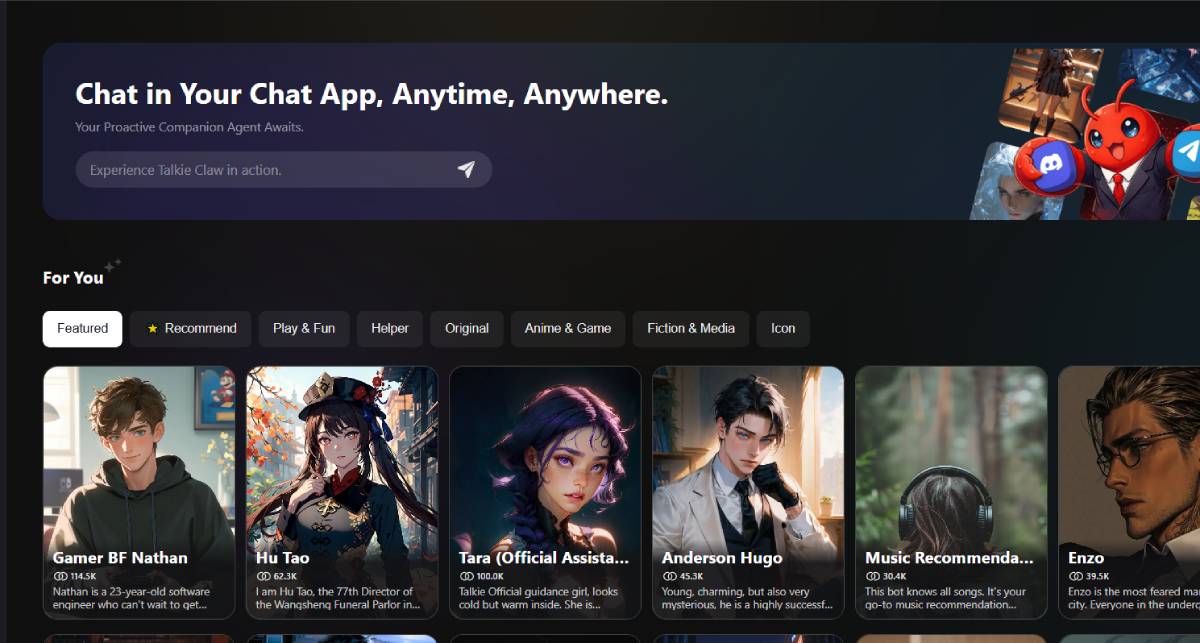
A notable shift is underway as Talkie AI expands its free AI character chat ecosystem, enabling users to engage with interactive virtual personas at scale. The development signals accelerating demand for conversational entertainment platforms, with implications for digital media, user engagement models, and the broader generative AI economy.
Talkie AI offers a free platform where users can interact with a wide range of AI-generated characters through conversational chat experiences. The system focuses on immersive dialogue, personality-driven interactions, and continuous engagement across multiple character types.
The platform is positioned within the fast-growing AI companion and interactive entertainment segment, where accessibility and personalization drive adoption. Key stakeholders include AI developers, mobile users, content creators, and digital entertainment platforms. The model reflects intensifying competition in consumer AI applications, particularly in areas where emotional engagement, narrative interaction, and user retention are central to growth strategies.
The development aligns with a broader trend across global markets where AI-driven conversational platforms are evolving into mainstream entertainment ecosystems. These systems combine large language models with character simulation to create dynamic, interactive storytelling experiences.
Companies such as OpenAI and Character AI have helped establish the category, while platforms like Talkie AI extend accessibility through free-to-use mobile-first experiences. Historically, digital entertainment has evolved from static content to interactive gaming and now toward AI-driven co-creation environments. Users are increasingly seeking personalized, always-available digital companions capable of adaptive conversation and emotional tone matching.
This shift reflects a convergence of gaming, social interaction, and generative AI technologies, reshaping how audiences engage with digital narratives and virtual personas.
Industry analysts suggest that free AI character chat platforms are accelerating mass adoption of conversational AI by lowering entry barriers for users. Experts highlight that personalization and emotional responsiveness are key drivers of engagement in this segment.
Behavioral researchers note that such systems can enhance creativity, storytelling, and language learning, while also raising concerns about emotional dependency and over-engagement with virtual personas.
Some analysts caution that sustaining free platforms at scale presents monetization challenges, particularly due to high computational costs and infrastructure demands. While official positioning emphasizes creativity and user empowerment, experts stress the importance of implementing responsible AI frameworks to ensure safe, transparent, and ethically designed user interactions across increasingly immersive digital environments.
For global executives, this shift could redefine engagement strategies in digital entertainment and AI consumer platforms. Companies may increasingly compete on conversational depth, character realism, and user retention metrics.
Investors are likely to view AI character ecosystems as a high-growth segment within the broader generative AI industry, particularly in mobile entertainment. Policymakers may need to evaluate emerging issues around AI companionship, data privacy, and user well-being in highly immersive conversational systems.
The expansion of platforms like Talkie AI signals a structural transformation in how digital entertainment is consumed, shifting from passive content to interactive AI-driven experiences. Looking ahead, AI character chat platforms are expected to evolve toward richer multimodal interaction, including voice, memory retention, and visual integration. Decision-makers will monitor user engagement, safety frameworks, and monetization sustainability.
The central uncertainty remains how platforms balance large-scale accessibility with responsible AI governance as conversational ecosystems continue to expand globally.
Source: Talkie AI
Date: April 2026


