



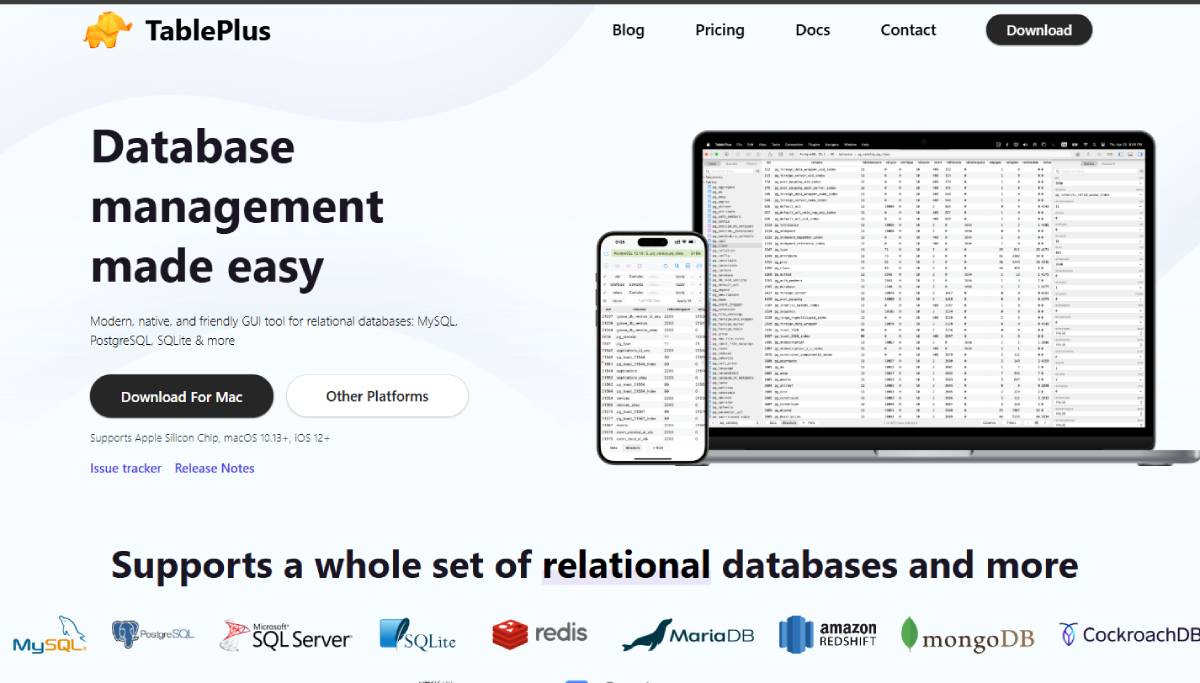
A notable advancement in database management software underscores the growing demand for efficient, secure, and cross-platform development tools. TablePlus continues strengthening its unified database client, enabling software developers, database administrators, and enterprise IT teams to manage multiple database systems through a streamlined interface, supporting faster application development and operational efficiency.
TablePlus expands its capabilities by providing a lightweight yet powerful database management platform compatible with leading database engines, including MySQL, PostgreSQL, SQL Server, SQLite, MariaDB, Oracle, Redis, Cassandra, and MongoDB. The platform combines secure database connectivity, SQL editing, query execution, data visualization, and administrative tools within a modern user interface.
Its multi-database support allows developers to manage diverse technology stacks without switching between multiple applications. Advanced security features, customizable workflows, and optimized performance enable engineering teams to improve productivity while maintaining greater control over enterprise data environments across Windows, macOS, and Linux ecosystems.
As organizations accelerate digital transformation, effective database management has become fundamental to enterprise application development, cloud migration, and business intelligence initiatives. Modern enterprises increasingly operate hybrid environments spanning cloud-native databases, on-premises infrastructure, and distributed architectures, requiring flexible management solutions capable of supporting multiple database technologies.
This trend aligns with broader growth in DevOps, platform engineering, cloud computing, and software modernization, where automation and developer productivity remain strategic priorities. Organizations are replacing fragmented administration tools with unified database clients that simplify maintenance, reduce operational complexity, and improve collaboration across engineering teams.
Growing adoption of artificial intelligence, analytics, Internet of Things (IoT), and real-time applications continues increasing demand for efficient database administration, making unified management platforms an important component of enterprise software development infrastructure.
Industry analysts view unified database management tools as increasingly valuable for organizations managing complex, multi-cloud application environments. Experts note that developer productivity depends not only on database performance but also on efficient administrative workflows that reduce repetitive tasks and simplify access to multiple database systems.
Technology consultants highlight the importance of secure credential management, intuitive interfaces, and broad database compatibility in supporting agile software development. Integration with modern DevOps practices further enables faster deployment cycles and improved collaboration between development, operations, and security teams.
Although no specific executive statement accompanies this development, market observers believe continued investment in database management technologies reflects sustained enterprise demand for simplified infrastructure management as organizations continue expanding cloud-native and data-driven business strategies.
For enterprises, streamlined database management can improve software delivery, reduce operational costs, and strengthen governance across increasingly complex data environments. Faster database administration supports innovation while helping organizations maintain system performance and security standards.
Software vendors, managed service providers, and technology consultancies also benefit from tools that simplify deployment across diverse customer environments. From a policy perspective, regulators continue emphasizing stronger data governance, cybersecurity, privacy protection, and compliance requirements, encouraging organizations to adopt secure database management practices capable of supporting evolving regulatory expectations and digital infrastructure resilience.
Database management platforms are expected to evolve through deeper integration with artificial intelligence, automation, cloud-native services, and developer productivity tools. Decision-makers should monitor innovations in AI-assisted query optimization, security automation, and multi-cloud database administration. As enterprise data volumes continue expanding, unified database management solutions are likely to remain central to efficient software development and digital transformation strategies.
Source: Crozdesk – TablePlus
Date: August 4, 2026


