



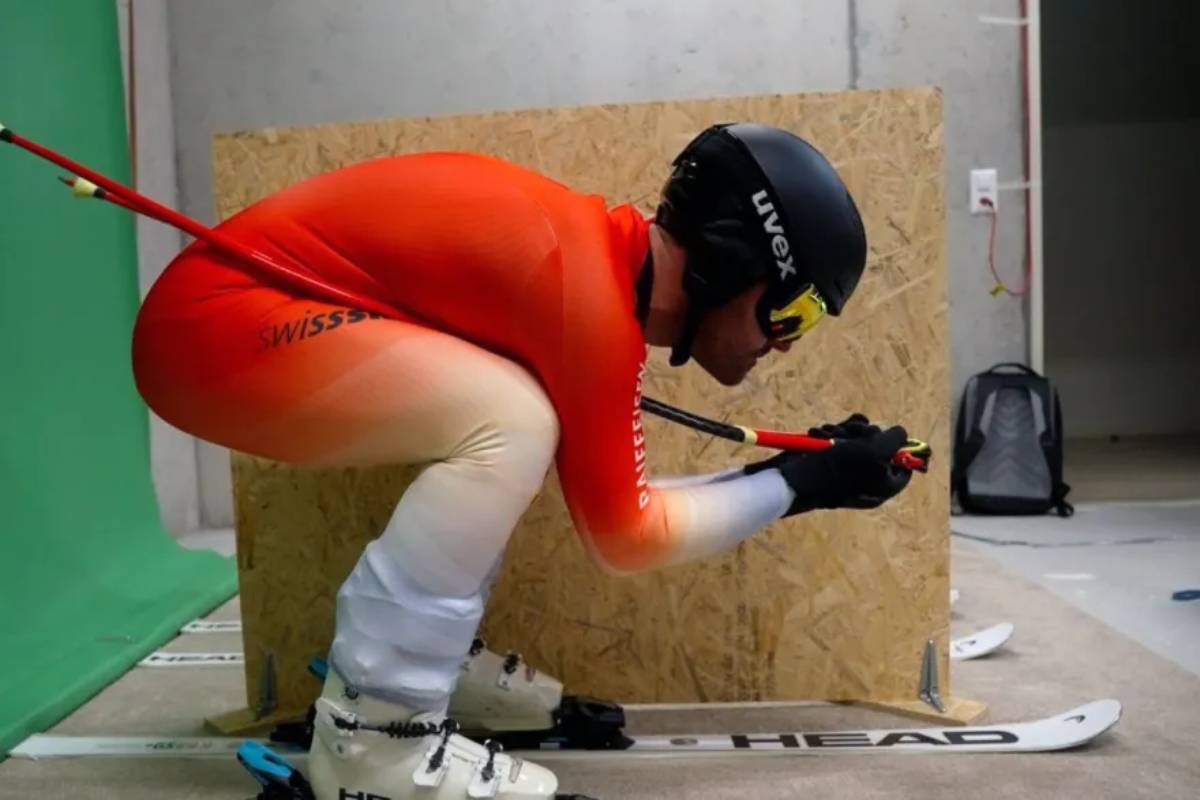
A Swiss sports innovation initiative is leveraging artificial intelligence to improve skier aerodynamics through advanced simulation modelling. The system aims to optimise body positioning and performance efficiency for elite athletes. The development underscores the growing convergence of AI, biomechanics, and competitive sports science with implications for performance engineering and elite training ecosystems.
The AI-driven simulator uses computational modelling to analyse skier posture, motion dynamics, and air resistance under varying slope conditions. By simulating real-time adjustments, the system provides data-backed recommendations to improve speed and stability.
Developed within Switzerland’s advanced sports science ecosystem, the project targets professional and Olympic-level athletes seeking marginal performance gains. Researchers are combining motion capture, physics-based modelling, and machine learning algorithms to refine aerodynamic efficiency. The initiative reflects growing investment in precision sports technology, where even millisecond-level improvements can determine competitive outcomes in elite alpine skiing events.
Alpine skiing has long been a discipline where marginal gains define competitive advantage. Historically, improvements have come from equipment innovation, training methodologies, and biomechanical analysis. In recent years, however, artificial intelligence has begun reshaping how athletes train, moving from retrospective performance review to predictive optimisation systems.
Switzerland, with its strong tradition in winter sports science and engineering research, has emerged as a key hub for sports technology innovation. The integration of AI into biomechanics reflects a broader global trend where elite sports are increasingly data-driven. Similar approaches are being adopted in cycling, Formula 1 racing, and athletics, where aerodynamic efficiency and movement optimisation are critical.
This shift represents a transition from intuition-based coaching to algorithm-supported performance design, particularly in high-stakes international competitions. Sports scientists argue that AI-enabled simulation tools could fundamentally change how elite athletes prepare for competition. Instead of relying solely on physical trials, athletes can now test thousands of motion variations virtually before applying them on snow.
Experts in biomechanics highlight that airflow resistance remains one of the most significant performance variables in downhill skiing, and even minor posture adjustments can translate into measurable time advantages.
While proponents emphasise efficiency and precision, some analysts caution that over-reliance on simulation may risk reducing adaptability in real-world conditions. Nevertheless, coaching teams are increasingly viewing AI systems as complementary tools rather than replacements for traditional training methods, particularly in disciplines where environmental variability plays a major role.
For sports technology companies, this development reinforces the commercial potential of AI-driven performance analytics in elite athletics. It opens opportunities for commercialisation in training systems, simulation software, and performance monitoring platforms.
For national sports federations, AI integration could influence athlete development strategies and funding priorities, particularly in Olympic programmes.
From a broader perspective, the convergence of AI and sports science raises questions around competitive fairness, access to advanced training tools, and the widening performance gap between well-funded and emerging sporting nations. The technology may ultimately redefine how elite athletic performance is engineered and evaluated.
The next phase will focus on validating simulator outputs against real-world race performance to ensure predictive accuracy. Expansion into other winter sports and broader athletic disciplines is also likely. As AI becomes more embedded in elite training environments, decision-makers will watch closely how governing bodies regulate the use of simulation technologies in competitive preparation.
Source: Swissinfo News
Date: June 30, 2026


