
Swiss Rail Solar Shows Gains

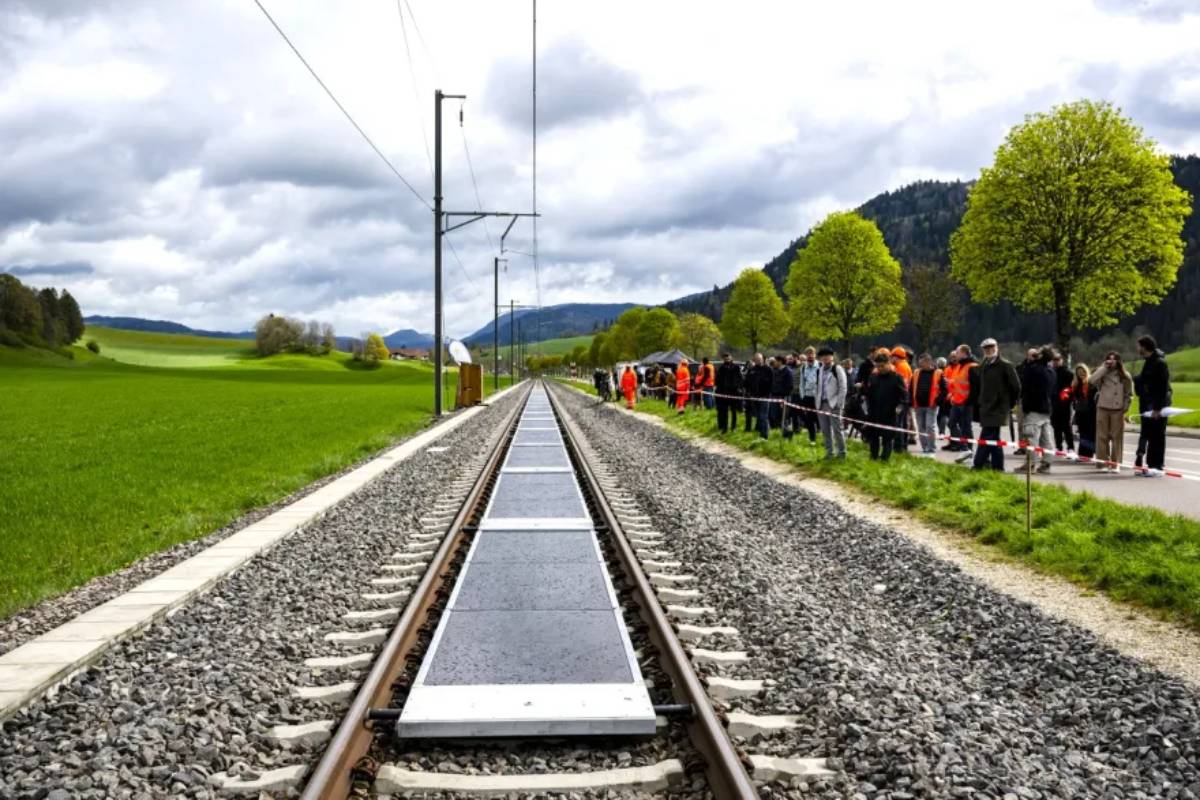
The Swiss pilot project, which integrates solar panels within railway infrastructure, has demonstrated encouraging early outcomes in energy generation and grid contribution.

June 26, 2026
|
Image Source: : Swissinfo

Switzerland’s experimental railway-based solar energy project is reporting its first positive performance results, marking a significant step in integrating renewable energy into transport infrastructure. The pilot underscores how rail networks can double as clean power generators, supporting national decarbonization goals while offering new models for distributed solar energy production.

The Swiss pilot project, which integrates solar panels within railway infrastructure, has demonstrated encouraging early outcomes in energy generation and grid contribution. Initial data indicates that solar installations along railway lines can produce measurable electricity outputs while coexisting with active transport operations.

The initiative is part of a broader effort to diversify renewable energy sources and maximize land-use efficiency in a country with limited available space for large-scale solar farms. Stakeholders include Swiss transport authorities, energy researchers, and infrastructure partners testing the feasibility of scaling the model across additional rail corridors.

As Europe accelerates its transition toward net-zero emissions, countries are increasingly exploring innovative ways to expand renewable energy capacity without compromising land availability or urban development needs. Switzerland, with its mountainous terrain and limited flat land, faces unique constraints in scaling traditional solar farms.

Railway-based solar systems represent an emerging category of infrastructure-integrated energy solutions, where transport networks serve dual functions mobility and power generation. Similar experiments have been explored in other parts of Europe and Asia, but Switzerland’s structured pilot program is among the more advanced implementations.

The development aligns with broader EU climate objectives, which emphasize decentralized energy generation, infrastructure efficiency, and multi-use public assets as critical pillars of long-term sustainability strategies.

Energy analysts suggest that railway solar systems could become a viable complementary energy source, particularly in regions where land constraints limit traditional renewable expansion. Experts highlight that while output per installation may be modest compared to utility-scale solar farms, the distributed nature of rail infrastructure could provide stable, incremental energy contributions.

Infrastructure specialists note that the key challenge lies in balancing safety, maintenance, and energy efficiency without disrupting rail operations. Early findings from Switzerland’s pilot are being closely watched by European transport and energy agencies.

Policy researchers also emphasize that such hybrid infrastructure models could redefine how public assets are utilized, turning transportation corridors into active components of national energy systems rather than passive infrastructure.

For energy and infrastructure companies, railway-integrated solar systems open new opportunities in distributed energy development, smart grid integration, and public-private partnerships. Engineering firms may see growing demand for modular solar technologies adapted to transport environments.

For investors, the model represents a long-term infrastructure play tied to energy transition policies rather than short-term energy pricing cycles. Risk profiles will depend on regulatory support and scalability outcomes.

From a policy standpoint, the project reinforces Switzerland’s and Europe’s broader push toward innovative land-efficient renewable solutions. Governments may increasingly evaluate transport infrastructure as a dual-use asset in national energy planning frameworks.

The Swiss pilot will now move into extended monitoring to assess long-term efficiency, durability, and scalability across different rail environments. Decision-makers will focus on whether output levels justify broader deployment across national rail networks. If successful, the concept could influence infrastructure planning across Europe, embedding renewable energy generation directly into transport systems as a standard design principle.

Source: Swissinfo
Date: June 26, 2026

  • Featured tools
Upscayl AI
Free

Upscayl AI is a free, open-source AI-powered tool that enhances and upscales images to higher resolutions. It transforms blurry or low-quality visuals into sharp, detailed versions with ease.

#
Productivity
Learn more
Alli AI
Free

Alli AI is an all-in-one, AI-powered SEO automation platform that streamlines on-page optimization, site auditing, speed improvements, schema generation, internal linking, and ranking insights.

#
SEO
Learn more

Learn more about future of AI

Join 80,000+ Ai enthusiast getting weekly updates on exciting AI tools.
Thank you! Your submission has been received!
Oops! Something went wrong while submitting the form.

Swiss Rail Solar Shows Gains

June 26, 2026

The Swiss pilot project, which integrates solar panels within railway infrastructure, has demonstrated encouraging early outcomes in energy generation and grid contribution.

Image Source: : Swissinfo

Switzerland’s experimental railway-based solar energy project is reporting its first positive performance results, marking a significant step in integrating renewable energy into transport infrastructure. The pilot underscores how rail networks can double as clean power generators, supporting national decarbonization goals while offering new models for distributed solar energy production.

The Swiss pilot project, which integrates solar panels within railway infrastructure, has demonstrated encouraging early outcomes in energy generation and grid contribution. Initial data indicates that solar installations along railway lines can produce measurable electricity outputs while coexisting with active transport operations.

The initiative is part of a broader effort to diversify renewable energy sources and maximize land-use efficiency in a country with limited available space for large-scale solar farms. Stakeholders include Swiss transport authorities, energy researchers, and infrastructure partners testing the feasibility of scaling the model across additional rail corridors.

As Europe accelerates its transition toward net-zero emissions, countries are increasingly exploring innovative ways to expand renewable energy capacity without compromising land availability or urban development needs. Switzerland, with its mountainous terrain and limited flat land, faces unique constraints in scaling traditional solar farms.

Railway-based solar systems represent an emerging category of infrastructure-integrated energy solutions, where transport networks serve dual functions mobility and power generation. Similar experiments have been explored in other parts of Europe and Asia, but Switzerland’s structured pilot program is among the more advanced implementations.

The development aligns with broader EU climate objectives, which emphasize decentralized energy generation, infrastructure efficiency, and multi-use public assets as critical pillars of long-term sustainability strategies.

Energy analysts suggest that railway solar systems could become a viable complementary energy source, particularly in regions where land constraints limit traditional renewable expansion. Experts highlight that while output per installation may be modest compared to utility-scale solar farms, the distributed nature of rail infrastructure could provide stable, incremental energy contributions.

Infrastructure specialists note that the key challenge lies in balancing safety, maintenance, and energy efficiency without disrupting rail operations. Early findings from Switzerland’s pilot are being closely watched by European transport and energy agencies.

Policy researchers also emphasize that such hybrid infrastructure models could redefine how public assets are utilized, turning transportation corridors into active components of national energy systems rather than passive infrastructure.

For energy and infrastructure companies, railway-integrated solar systems open new opportunities in distributed energy development, smart grid integration, and public-private partnerships. Engineering firms may see growing demand for modular solar technologies adapted to transport environments.

For investors, the model represents a long-term infrastructure play tied to energy transition policies rather than short-term energy pricing cycles. Risk profiles will depend on regulatory support and scalability outcomes.

From a policy standpoint, the project reinforces Switzerland’s and Europe’s broader push toward innovative land-efficient renewable solutions. Governments may increasingly evaluate transport infrastructure as a dual-use asset in national energy planning frameworks.

The Swiss pilot will now move into extended monitoring to assess long-term efficiency, durability, and scalability across different rail environments. Decision-makers will focus on whether output levels justify broader deployment across national rail networks. If successful, the concept could influence infrastructure planning across Europe, embedding renewable energy generation directly into transport systems as a standard design principle.

Source: Swissinfo
Date: June 26, 2026

Promote Your Tool

Copy Embed Code

Similar Blogs

June 26, 2026
|

AlpineAI Raises Seed Round

AlpineAI has successfully closed a double-digit million seed funding round aimed at accelerating the development of sovereign AI technologies.
Read more
June 26, 2026
|

Fruitful AI Secures Funding Round

Fruitful AI has successfully completed a strategic investment round, strengthening its financial position to scale operations and enhance its AI-driven product suite.
Read more
June 26, 2026
|

Visium Raises AI Funding Round

Visium has successfully raised fresh funding aimed at scaling its operations across key European markets and expanding deeper into the US enterprise AI ecosystem.
Read more
June 26, 2026
|

Nuclidium Raises CHF 105M Series B

Nuclidium has successfully expanded its Series B funding round to CHF 105 million through a latest extension, attracting continued backing from existing and new investors.
Read more
June 26, 2026
|

Temenos Bets on AI Orchestration

Temenos has announced the acquisition of additiv, aiming to strengthen its AI-enabled orchestration capabilities across digital banking and wealth management platforms.
Read more
June 26, 2026
|

Switzerland Rules Out 2027 Cuts

The Swiss government has confirmed that no additional budget cuts are planned for 2027, signaling a pause in its recent tightening cycle.
Read more