



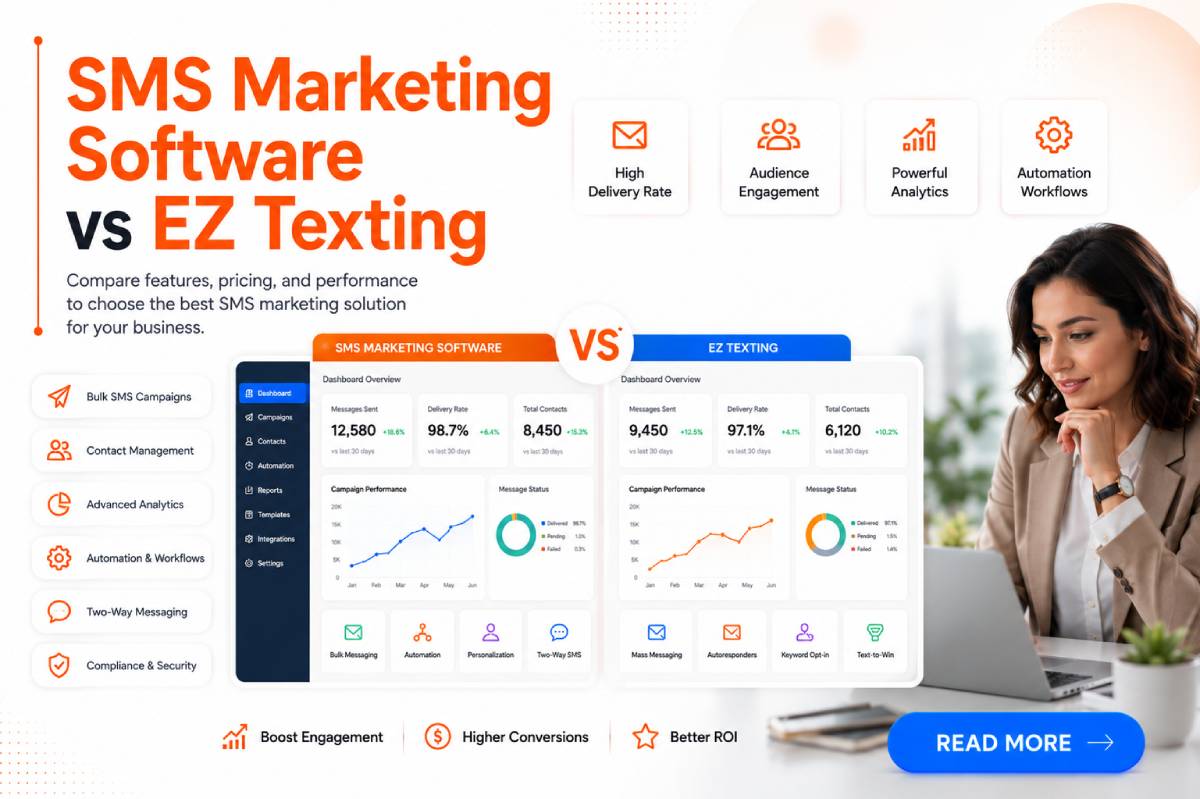
The comparison between SMS Marketing Software and EZ Texting highlights a broader shift in how businesses engage customers through mobile messaging. As organizations prioritize direct, measurable communication, SMS platforms are becoming important tools for marketing, customer engagement and promotions, while businesses increasingly evaluate capabilities, scalability, automation and compliance before selecting a provider.
The comparison places general SMS marketing capabilities alongside EZ Texting, a platform focused on business text messaging and customer outreach. Key evaluation areas include campaign management, contact organization, automated messaging, scheduling, analytics and audience engagement.
SMS platforms can help businesses communicate directly with customers through a channel that is highly accessible and suited to time-sensitive promotions. Businesses can use messaging for announcements, reminders, offers and customer communications.
The comparison also reflects a growing emphasis on ease of use and scalability. Smaller businesses may prioritize straightforward campaign creation, while larger organizations may require automation, integrations and more advanced reporting.
For executives, the central question is increasingly how effectively an SMS platform converts customer attention into measurable commercial outcomes. The development aligns with the broader evolution of digital marketing, where businesses are seeking communication channels that provide direct access to customers without relying entirely on crowded social-media feeds or email inboxes.
SMS remains particularly relevant because mobile phones are deeply embedded in consumers' daily routines. Businesses can use text messaging for promotional campaigns, appointment reminders, customer updates and time-sensitive communications.
However, the expansion of business messaging has also increased competition among technology providers. Companies now evaluate platforms based on automation, personalization, integrations, analytics and overall campaign management rather than basic message delivery alone.
The comparison between SMS Marketing Software and EZ Texting illustrates this competitive environment. Businesses must determine whether they need a simple messaging solution or a broader marketing infrastructure capable of supporting increasingly sophisticated campaigns.
For CXOs and marketing leaders, the strategic issue extends beyond sending texts. The priority is building a messaging operation that delivers measurable engagement while protecting customer trust and complying with applicable communication and privacy requirements.
Marketing specialists increasingly view SMS as one component of a broader customer-engagement strategy rather than an isolated communication channel. Its value can increase when messaging is connected with customer databases, marketing automation and other digital touchpoints.
The comparison highlights the importance of matching platform capabilities with business requirements. Smaller organizations may value simplicity and rapid deployment, while larger marketing teams may prioritize automation, integrations, segmentation and analytics.
For executives, compliance is equally important. Commercial text messaging requires careful management of customer consent, opt-out requests and applicable communications regulations. A technically capable platform cannot compensate for weak internal governance.
Industry observers are also watching the growing use of artificial intelligence in marketing automation. AI could help businesses personalize campaigns, identify customer segments and optimize messaging schedules, but organizations will need controls to prevent excessive or inappropriate communications.
The competitive landscape is therefore increasingly shaped by both technology capabilities and the quality of the customer experience. For businesses, SMS marketing can provide a direct channel for reaching customers with promotions, alerts and service communications. The right platform can help reduce manual campaign management and improve measurement of customer engagement.
For investors and executives, platform selection should consider scalability, pricing structure, integrations, automation and analytics rather than headline features alone. Consumers may benefit from more relevant and timely communications, but excessive messaging can quickly damage customer relationships. From a policy perspective, businesses must maintain appropriate consent and privacy practices when collecting and using customer phone numbers. Clear opt-out mechanisms and responsible data handling remain essential.
Executives should therefore treat SMS marketing as both a growth opportunity and a governance responsibility. Strong campaign performance will depend on balancing personalization and frequency with customer expectations.
The SMS marketing market is likely to move toward greater automation, personalization and integration with broader customer-engagement systems. Businesses will increasingly assess platforms based on their ability to connect messaging data with marketing and sales workflows.
Decision-makers should watch developments in AI-driven campaign optimization, customer segmentation and compliance management. Providers that combine simple execution with measurable performance and responsible data practices will be better positioned as businesses expand their mobile engagement strategies.
Source: Crozdesk
Date: August 12, 2026


