
Skyfora Builds Telecom Climate Intelligence

Skyfora has secured €6.5 million in fresh funding to expand its satellite-assisted weather intelligence platform. The company leverages GNSS signal distortion data from telecom infrastructure to generate hyper-local weather insights.

July 2, 2026
|
Image Source:  Nordictech news

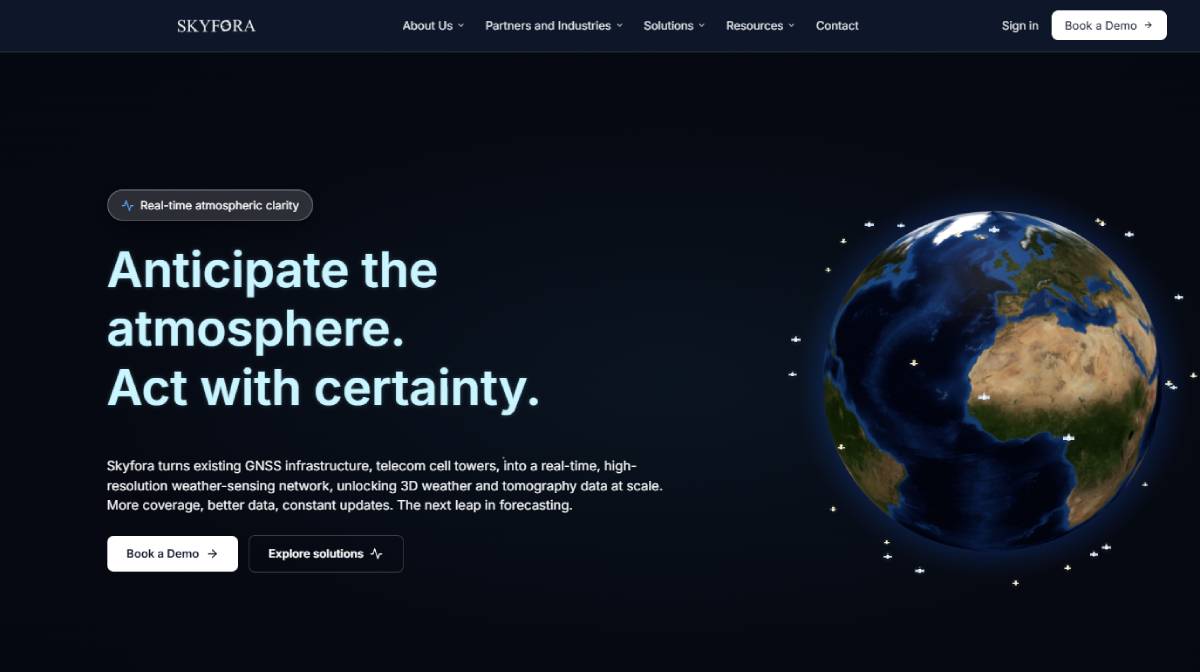
Finnish climate-tech startup Skyfora has raised €6.5 million to transform telecom cell towers into a distributed weather sensing network. The funding highlights growing investor interest in climate intelligence infrastructure, where existing telecommunications assets are repurposed for real-time atmospheric data collection and predictive environmental modeling.

Skyfora has secured €6.5 million in fresh funding to expand its satellite-assisted weather intelligence platform. The company leverages GNSS signal distortion data from telecom infrastructure to generate hyper-local weather insights.

The investment round will support scaling across European telecom networks and improving predictive accuracy for extreme weather events. Skyfora’s model converts existing cell towers into environmental sensors without requiring additional physical hardware deployments.

The funding is backed by climate-focused investors and deep-tech funds seeking scalable solutions for climate risk monitoring, infrastructure resilience, and data-driven environmental forecasting.

Climate volatility has increased demand for high-resolution weather data, particularly for industries such as aviation, agriculture, energy, and logistics. Traditional weather stations, while accurate, are sparsely distributed and unable to capture microclimate variations in real time.

Telecommunications infrastructure offers an underutilized sensing layer. Cell towers continuously interact with atmospheric conditions through GNSS signal propagation, which can be analyzed to infer humidity, precipitation, and storm formation patterns.

Europe has become a key hub for climate-tech innovation, with startups increasingly focusing on data-layer solutions rather than physical hardware deployment. Skyfora’s approach aligns with this shift, using existing infrastructure to build scalable environmental intelligence networks.

Historically, weather forecasting has relied on centralized systems. The transition toward distributed sensing represents a structural shift in climate analytics, improving both speed and spatial resolution of forecasting models.

Environmental data analysts argue that distributed sensing networks represent the next evolution of meteorological infrastructure. By leveraging telecom signals, companies can achieve granular weather insights without the high cost of deploying dense physical sensor grids.

Climate researchers note that improving real-time atmospheric data is critical for modeling extreme weather patterns, which are increasing in frequency and severity due to climate change.

Investors view Skyfora’s model as part of a broader “infrastructure repurposing” trend, where existing digital networks are monetized for secondary scientific and industrial applications.

While the company has not disclosed specific commercial contracts, sector observers suggest strong interest from aviation and insurance industries, both of which rely heavily on accurate localized forecasting for operational and risk management decisions.

For businesses, Skyfora’s platform introduces a new category of climate intelligence services that can improve supply chain planning, insurance risk modeling, and energy demand forecasting.

For investors, the company signals growing convergence between telecom infrastructure and climate analytics, creating new monetization pathways for existing networks. For governments, distributed weather sensing could enhance disaster preparedness and early warning systems, particularly in regions vulnerable to floods and storms.

For telecom operators, the model presents an opportunity to diversify revenue streams by turning passive infrastructure into active data-generating assets, potentially reshaping how network value is defined.

Skyfora’s next phase will depend on large-scale telecom integration and validation of its predictive accuracy across diverse climates. Expansion into global markets could follow if performance benchmarks are met. The broader industry is expected to explore similar infrastructure-layer climate applications, particularly as demand for hyper-local environmental intelligence continues to rise amid increasing climate volatility.

Source: Nordictech news
Date: July 2, 2026

  • Featured tools
WellSaid Ai
Free

WellSaid AI is an advanced text-to-speech platform that transforms written text into lifelike, human-quality voiceovers.

#
Text to Speech
Learn more
Hostinger Website Builder
Paid

Hostinger Website Builder is a drag-and-drop website creator bundled with hosting and AI-powered tools, designed for businesses, blogs and small shops with minimal technical effort.It makes launching a site fast and affordable, with templates, responsive design and built-in hosting all in one.

#
Productivity
#
Startup Tools
#
Ecommerce
Learn more

Learn more about future of AI

Join 80,000+ Ai enthusiast getting weekly updates on exciting AI tools.
Thank you! Your submission has been received!
Oops! Something went wrong while submitting the form.

Skyfora Builds Telecom Climate Intelligence

July 2, 2026

Skyfora has secured €6.5 million in fresh funding to expand its satellite-assisted weather intelligence platform. The company leverages GNSS signal distortion data from telecom infrastructure to generate hyper-local weather insights.

Image Source:  Nordictech news

Finnish climate-tech startup Skyfora has raised €6.5 million to transform telecom cell towers into a distributed weather sensing network. The funding highlights growing investor interest in climate intelligence infrastructure, where existing telecommunications assets are repurposed for real-time atmospheric data collection and predictive environmental modeling.

Skyfora has secured €6.5 million in fresh funding to expand its satellite-assisted weather intelligence platform. The company leverages GNSS signal distortion data from telecom infrastructure to generate hyper-local weather insights.

The investment round will support scaling across European telecom networks and improving predictive accuracy for extreme weather events. Skyfora’s model converts existing cell towers into environmental sensors without requiring additional physical hardware deployments.

The funding is backed by climate-focused investors and deep-tech funds seeking scalable solutions for climate risk monitoring, infrastructure resilience, and data-driven environmental forecasting.

Climate volatility has increased demand for high-resolution weather data, particularly for industries such as aviation, agriculture, energy, and logistics. Traditional weather stations, while accurate, are sparsely distributed and unable to capture microclimate variations in real time.

Telecommunications infrastructure offers an underutilized sensing layer. Cell towers continuously interact with atmospheric conditions through GNSS signal propagation, which can be analyzed to infer humidity, precipitation, and storm formation patterns.

Europe has become a key hub for climate-tech innovation, with startups increasingly focusing on data-layer solutions rather than physical hardware deployment. Skyfora’s approach aligns with this shift, using existing infrastructure to build scalable environmental intelligence networks.

Historically, weather forecasting has relied on centralized systems. The transition toward distributed sensing represents a structural shift in climate analytics, improving both speed and spatial resolution of forecasting models.

Environmental data analysts argue that distributed sensing networks represent the next evolution of meteorological infrastructure. By leveraging telecom signals, companies can achieve granular weather insights without the high cost of deploying dense physical sensor grids.

Climate researchers note that improving real-time atmospheric data is critical for modeling extreme weather patterns, which are increasing in frequency and severity due to climate change.

Investors view Skyfora’s model as part of a broader “infrastructure repurposing” trend, where existing digital networks are monetized for secondary scientific and industrial applications.

While the company has not disclosed specific commercial contracts, sector observers suggest strong interest from aviation and insurance industries, both of which rely heavily on accurate localized forecasting for operational and risk management decisions.

For businesses, Skyfora’s platform introduces a new category of climate intelligence services that can improve supply chain planning, insurance risk modeling, and energy demand forecasting.

For investors, the company signals growing convergence between telecom infrastructure and climate analytics, creating new monetization pathways for existing networks. For governments, distributed weather sensing could enhance disaster preparedness and early warning systems, particularly in regions vulnerable to floods and storms.

For telecom operators, the model presents an opportunity to diversify revenue streams by turning passive infrastructure into active data-generating assets, potentially reshaping how network value is defined.

Skyfora’s next phase will depend on large-scale telecom integration and validation of its predictive accuracy across diverse climates. Expansion into global markets could follow if performance benchmarks are met. The broader industry is expected to explore similar infrastructure-layer climate applications, particularly as demand for hyper-local environmental intelligence continues to rise amid increasing climate volatility.

Source: Nordictech news
Date: July 2, 2026

Promote Your Tool

Copy Embed Code

Similar Blogs

July 2, 2026
|

Swiss Warn Against Rogue Peptides

The Swiss Confederation has cautioned consumers and health professionals about the presence of unregulated peptide products being sold as performance enhancers.
Read more
July 2, 2026
|

Switzerland Pushes Cross Border Framework

Swiss policymakers are evaluating the implementation of updated agreements governing Italian cross-border workers, who represent a significant portion of the workforce in several Swiss regions.
Read more
July 2, 2026
|

Switzerland Delays e-ID Security Upgrade

Swiss authorities have postponed the introduction of the national e-ID system, originally planned as part of the country’s digital transformation agenda.
Read more
July 2, 2026
|

ICEYE Raises €1B Space Eyes

ICEYE, a Finnish space technology company, has raised €1 billion in a major funding round led by General Atlantic.
Read more
July 2, 2026
|

Rotomate Replaces Factory Expertise AI

Rotomate, an industrial AI startup, has raised €2.1 million in pre-seed funding to address a growing workforce challenge in manufacturing: the retirement of experienced factory specialists.
Read more
July 2, 2026
|

Skyfora Builds Telecom Climate Intelligence

Skyfora has secured €6.5 million in fresh funding to expand its satellite-assisted weather intelligence platform. The company leverages GNSS signal distortion data from telecom infrastructure to generate hyper-local weather insights.
Read more