



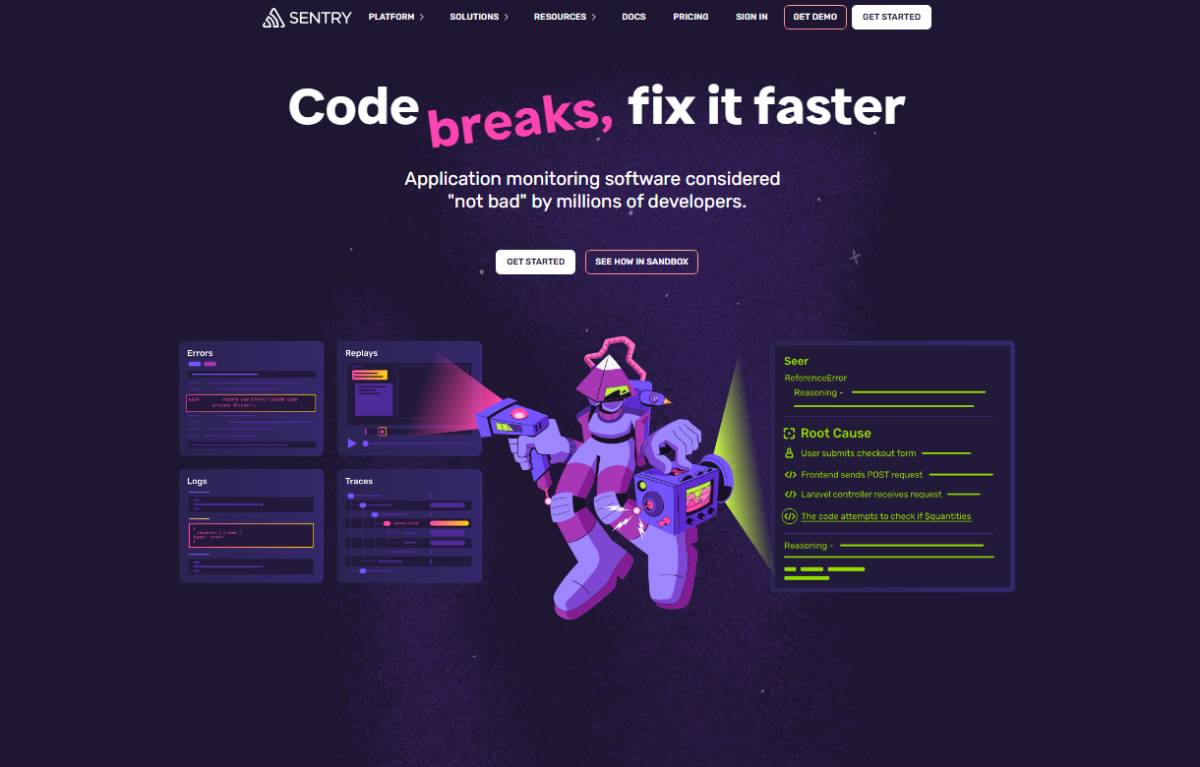
Sentry is strengthening the software development ecosystem with tools designed to help engineering teams detect, diagnose and resolve application errors and performance issues in real time. Its observability-focused platform reflects a broader enterprise shift toward proactive software monitoring as businesses increasingly depend on reliable digital products and continuously available applications.
Sentry provides application monitoring capabilities that help developers identify errors, crashes, performance bottlenecks and other issues across software environments. The platform is designed to provide engineering teams with contextual information that can accelerate troubleshooting and reduce the time required to identify the source of technical problems.
Its capabilities extend across application performance monitoring, error tracking, tracing, profiling and release monitoring. This allows teams to connect technical events with application behavior and investigate problems through a centralized workflow.
The platform supports multiple programming languages, frameworks and development environments, enabling organizations to integrate monitoring into existing software development processes. This positioning makes Sentry relevant to startups, technology companies and larger enterprises operating complex digital infrastructure.
The growing dependence on cloud applications, APIs and digital services has made software reliability a strategic business issue. A technical failure can quickly affect customer experience, revenue, employee productivity and brand reputation, particularly for organizations operating mission-critical digital platforms.
This environment has accelerated the transition from traditional error logging toward broader observability. Modern engineering teams increasingly need visibility into application performance, infrastructure behavior and user-facing issues rather than simply knowing that an error occurred.
Sentry's focus on developer-centric monitoring fits within this broader transformation. By placing diagnostics directly into engineering workflows, observability platforms can help teams identify problems earlier and understand how technical issues affect applications.
For executives, the significance extends beyond engineering productivity. Faster incident detection and resolution can contribute to stronger service reliability, reduced operational disruption and better customer experiences. As digital operations become increasingly central to corporate strategy, application observability is becoming an important component of technology risk management.
Sentry's approach is centered on giving developers greater visibility into software failures and performance issues while they are building and operating applications. The emphasis on contextual diagnostics is particularly relevant as modern applications become more distributed across cloud services, APIs and third-party dependencies.
From an engineering perspective, the value of observability is closely connected to reducing the time between detecting a problem and understanding its root cause. Centralized information can help development teams move from reactive troubleshooting toward more structured incident response and prevention.
The broader market is also seeing increased convergence between monitoring, application performance management and developer workflows. This creates opportunities for platforms that can provide technical insight without forcing engineering teams to operate across numerous disconnected systems.
However, observability strategies must also consider data volume, alert quality, privacy and operational costs. Organizations need to ensure that monitoring generates actionable information rather than overwhelming teams with excessive alerts or low-value telemetry.
For businesses, stronger application monitoring can help reduce downtime, improve software reliability and protect customer-facing digital services. Engineering leaders can use performance and error data to prioritize technical issues based on their potential business impact.
For investors and technology executives, the expansion of observability reflects the growing importance of software resilience as organizations digitize operations. Reliable applications are increasingly tied directly to revenue generation, customer retention and competitive positioning.
There are also governance implications. Companies must establish appropriate policies for collecting, storing and accessing application data, particularly when monitoring systems process information connected to users or production environments.
Executives should therefore evaluate observability investments through both an engineering and business-risk lens, considering reliability, productivity, security, compliance and total operating costs.
Sentry's trajectory will depend on how effectively it evolves alongside increasingly complex application architectures and AI-driven software development. As engineering teams manage larger volumes of code, services and telemetry, demand for intelligent monitoring and faster diagnosis is likely to grow. The key challenge will be turning increasingly complex technical data into clear, actionable intelligence that improves reliability without adding unnecessary operational complexity.
Source: Sentry
Date: August 12, 2026


