



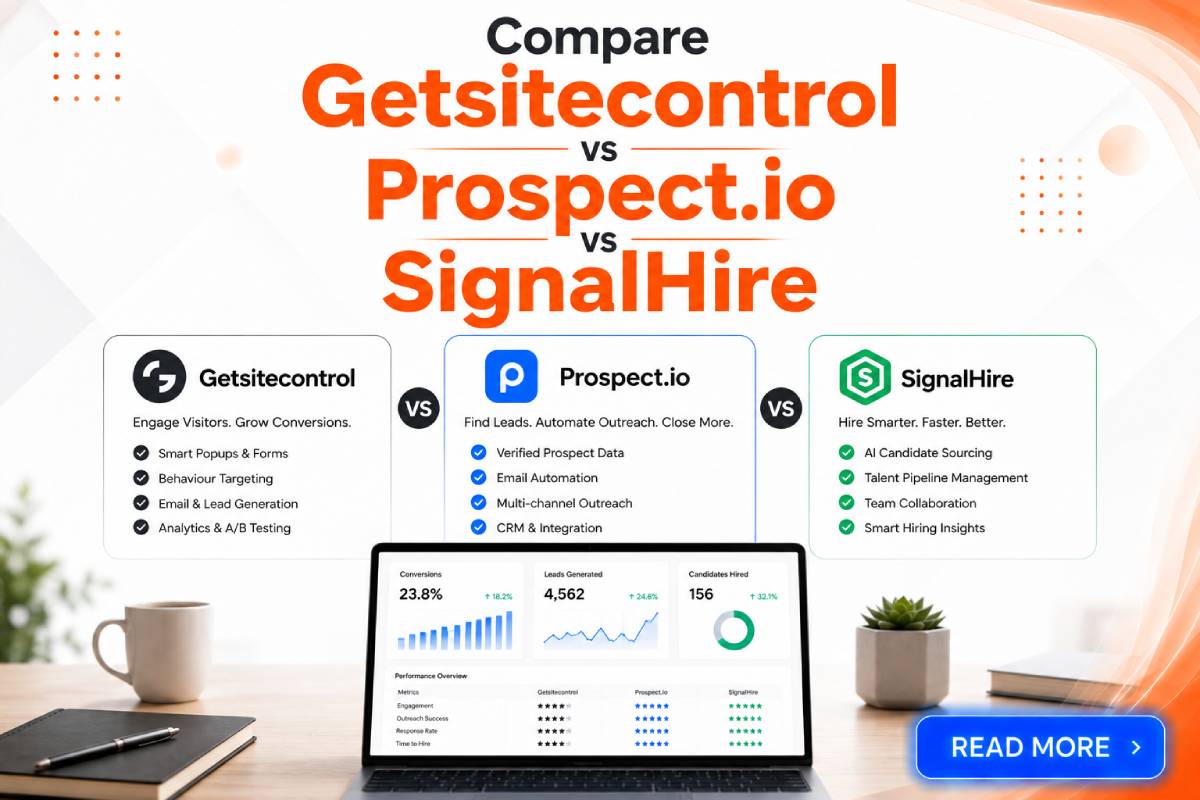
A comparison of Getsitecontrol, Prospect.io and SignalHire highlights how modern sales and marketing technology is evolving around distinct business priorities. While Getsitecontrol emphasizes website engagement and email marketing, SignalHire focuses heavily on contact discovery and prospect intelligence. The comparison offers executives a useful view of competing approaches to customer acquisition and outreach.
The three platforms represent different segments of the broader sales and marketing technology landscape. Getsitecontrol combines website widgets, lead capture, email marketing and automation, while SignalHire specializes in finding professional contact information and supporting prospecting activities.
SignalHire currently promotes access to a database of more than 850 million profiles and 30 million companies, alongside email and phone discovery, CSV enrichment, browser extensions, API access and ATS or CRM integrations. Its plans include free access with limited credits and paid options based on contact retrieval. Getsitecontrol, meanwhile, offers website widgets, email campaigns, automations, segmentation and AI-assisted email content.
The comparison reflects a wider shift in how companies approach digital customer acquisition. Businesses increasingly require connected technology that can attract prospects, capture customer information, automate communication and support sales teams with accurate contact intelligence.
Getsitecontrol occupies the engagement side of this ecosystem. Its tools are designed to help businesses collect contacts through website forms, popups and other interactive elements before nurturing those contacts through email campaigns and automated workflows.
SignalHire operates further down the sales funnel, focusing on identifying potential prospects and retrieving business contact information. Its current offering includes access to a large contact database, contact enrichment, prospect exports and integrations with sales and recruitment systems.
Prospect.io has historically been associated with sales prospecting and email outreach, placing it closer to the outbound-sales segment. Together, the three names illustrate how customer acquisition technology has fragmented into specialized platforms serving different stages of the revenue cycle.
From an executive perspective, the comparison is less about selecting a universal winner and more about matching technology to a company's acquisition strategy. A business focused on converting website visitors may prioritize engagement tools, while a sales organization building outbound prospect lists may place greater value on contact intelligence.
SignalHire's current positioning emphasizes its large database, browser-based prospecting capabilities, contact exports and CRM or ATS integrations. The company also offers email, phone and combined contact plans, allowing teams to select prospecting capabilities according to their requirements.
Getsitecontrol's current product direction increasingly combines website engagement with email marketing and automation. Its platform includes features such as AI-generated email content, segmentation, A/B testing and automated workflows.
These developments indicate that vendors are competing not only on individual features but also on how effectively they fit into broader revenue-generation workflows. For businesses, the comparison reinforces the importance of evaluating sales technology according to measurable commercial objectives. Marketing teams may prioritize lead capture, engagement and automated nurturing, while sales teams may require prospect databases, contact enrichment and outreach capabilities.
For executives, technology selection also raises questions around data quality, integration, privacy and compliance. Prospecting platforms that provide contact information must operate within applicable data-protection requirements, while businesses remain responsible for how collected information is used.
The economic implication is equally important. Companies are increasingly expected to demonstrate a measurable return from every sales and marketing technology investment. Choosing a specialized platform that fits an existing workflow may therefore prove more valuable than adopting a larger toolset with capabilities that teams rarely use.
The sales-technology market is likely to continue moving toward greater specialization and integration. Website engagement, marketing automation, prospect intelligence and outbound communication may increasingly connect through shared CRM and data ecosystems.
For decision-makers, the critical question will be which platform delivers the strongest combination of data quality, workflow efficiency, integration and measurable revenue impact. The comparison ultimately underscores a broader trend: modern sales technology is becoming more specialized, while business buyers increasingly demand clear evidence of value.
Source: Crozdesk
Date: August 11, 2026


