



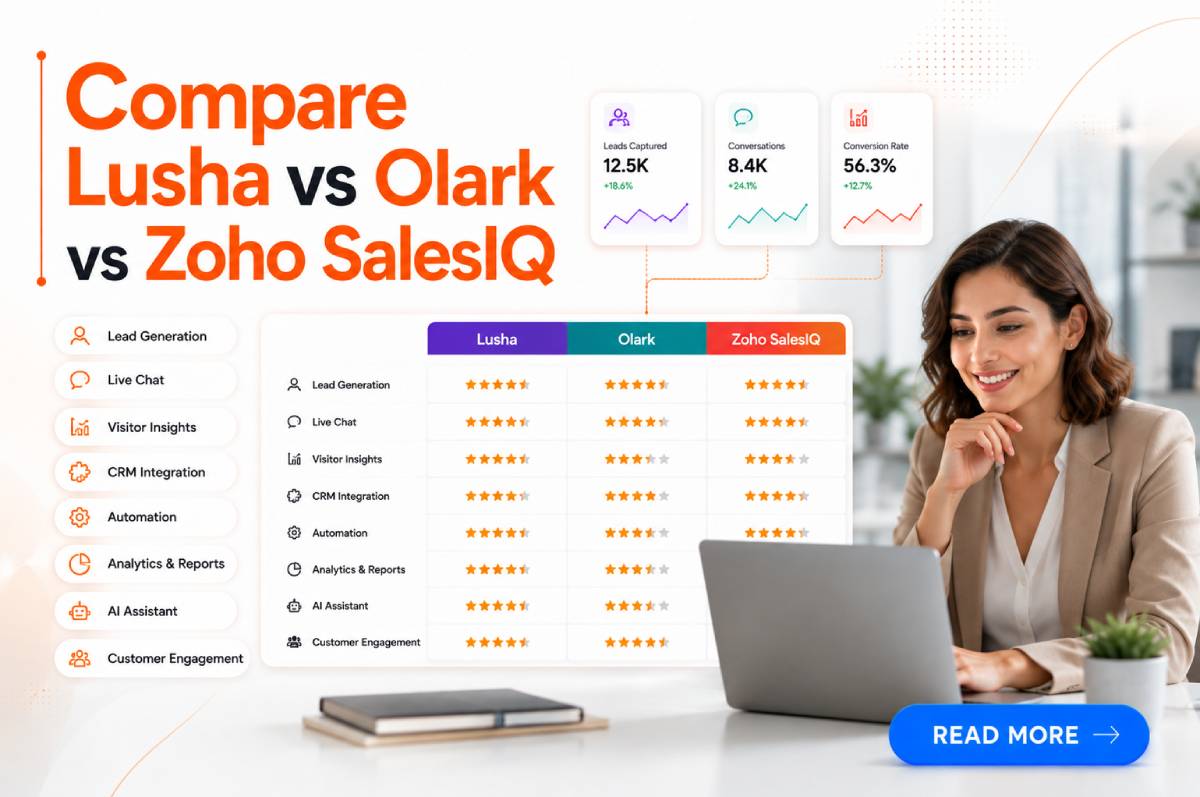
The comparison of Lusha, Olark, and Zoho SalesIQ highlights the evolving landscape of sales intelligence, customer engagement, and business communication technologies. As companies prioritize data-driven outreach and personalized customer experiences, these platforms represent different approaches to improving lead generation, sales productivity, and real-time customer interactions across global markets.
Lusha, Olark, and Zoho SalesIQ serve different segments of the modern sales and customer engagement ecosystem. Lusha focuses on sales intelligence by helping businesses discover and connect with potential prospects through verified contact data. Olark specializes in live chat and customer communication, enabling companies to engage website visitors in real time.
Zoho SalesIQ combines website visitor tracking, live chat, and customer analytics to support broader sales automation strategies. The comparison reflects growing demand among businesses for integrated tools that improve customer acquisition, engagement efficiency, and revenue generation. Sales teams, marketers, and customer support departments are key stakeholders affected by these solutions.
The global sales technology market is undergoing rapid transformation as organizations increasingly rely on automation, analytics, and artificial intelligence to improve customer relationships. Traditional sales methods are being replaced by digital platforms that provide deeper insights into buyer behavior and enable more personalized engagement.
Sales intelligence platforms like Lusha address the challenge of identifying qualified prospects, while communication-focused tools such as Olark help businesses convert website visitors into customers. Comprehensive platforms like Zoho SalesIQ combine multiple capabilities, including visitor tracking, messaging, and analytics, reflecting the industry’s movement toward unified customer engagement solutions.
This shift is driven by increasing competition, changing consumer expectations, and the need for businesses to maximize efficiency. Companies worldwide are investing in technologies that help sales teams make faster, smarter, and more informed decisions.
Industry analysts suggest that businesses are moving toward sales platforms that combine data intelligence, automation, and customer experience management. Experts emphasize that companies capable of understanding customer behavior and delivering timely engagement are better positioned to improve conversion rates and strengthen long-term relationships.
Market observers note that sales technology providers are increasingly differentiating themselves through advanced analytics, integrations, and artificial intelligence capabilities. While specific executive statements regarding this comparison are unavailable, industry trends indicate that organizations are evaluating platforms based on scalability, data accuracy, ease of use, and alignment with business goals.
The competition among solutions such as Lusha, Olark, and Zoho SalesIQ reflects a broader transformation where sales and customer service functions are becoming increasingly connected through digital ecosystems.
For businesses, selecting the right sales engagement platform can directly influence lead generation, customer satisfaction, and operational efficiency. Companies focused on outbound sales may prioritize intelligence-driven tools, while organizations seeking stronger website engagement may benefit from communication and analytics solutions.
Investors and technology leaders view sales automation as a growing market segment due to increasing demand for productivity tools. Consumers benefit from faster responses and more personalized interactions with businesses.
From a policy perspective, companies adopting sales intelligence platforms must carefully manage customer data, privacy regulations, and compliance requirements. Data protection and responsible use of customer information will remain critical as these technologies expand.
The future of sales technology will likely center on AI-powered insights, predictive analytics, and seamless customer engagement experiences. Platforms competing in this space will continue evolving to provide smarter automation and deeper integrations. Businesses should monitor advancements in artificial intelligence, data privacy standards, and customer experience technologies as organizations seek more effective ways to connect with prospects and build lasting relationships.
Source: Crozdesk
Date: August 5, 2026


