
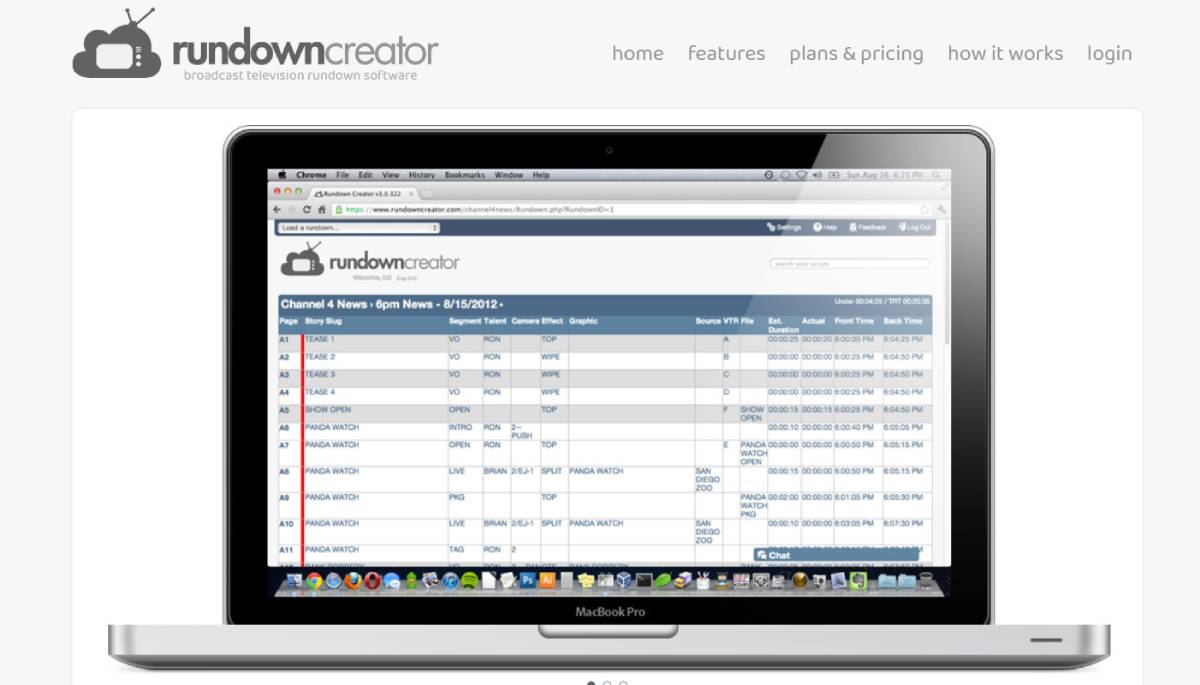
Rundown Creator Streamlines Production Workflows

Rundown Creator is designed to simplify production planning by enabling users to create, manage, and update rundowns for live broadcasts, events, and multimedia productions.

July 31, 2026
|

Digital media production is becoming increasingly dependent on workflow automation and collaborative planning tools. Rundown Creator reflects this transition by providing an integrated solution for organizing production rundowns, coordinating teams, and streamlining live event management, signaling broader opportunities for broadcasters, media organizations, and enterprise communication teams.

Rundown Creator is designed to simplify production planning by enabling users to create, manage, and update rundowns for live broadcasts, events, and multimedia productions. The platform centralizes scheduling, production sequencing, and team collaboration to improve operational efficiency.

Primary stakeholders include television broadcasters, digital media companies, production houses, corporate communications teams, educational institutions, and event organizers. As live content production expands across streaming platforms and hybrid events, workflow management solutions are becoming increasingly valuable for reducing production delays and improving coordination among distributed teams.

The platform illustrates the growing role of digital production technologies in modern content creation. The global media industry has undergone rapid transformation as broadcasters, content creators, and enterprises increasingly adopt digital-first production workflows. Traditional production planning methods are being replaced by cloud-based collaboration tools that improve communication, scheduling accuracy, and operational transparency.

This development aligns with a broader trend across global markets where organizations are investing in workflow automation, remote collaboration, and cloud infrastructure to support increasingly complex production environments. The rapid expansion of live streaming, virtual events, podcasts, webinars, and digital broadcasting has accelerated demand for production management software capable of coordinating multiple stakeholders simultaneously.

Artificial intelligence, cloud computing, and real-time collaboration technologies are also reshaping production operations by reducing manual administrative work while enabling faster decision-making. These innovations continue improving productivity across both media organizations and enterprise communications.

Industry analysts suggest that production workflow platforms are becoming essential operational assets as organizations seek greater efficiency in increasingly digital media environments. Centralized production management reduces scheduling conflicts, improves communication, and enhances overall execution quality.

Technology specialists also note that integration with cloud services, automation tools, and collaborative workspaces enables production teams to respond more quickly to changing requirements while maintaining operational consistency across geographically distributed teams.

Media consultants emphasize that workflow optimization is no longer limited to traditional broadcasting. Corporate communications, educational institutions, marketing agencies, and event management firms increasingly require production planning platforms to coordinate complex multimedia projects. Future innovation is expected to focus on AI-assisted scheduling, predictive resource allocation, and deeper integration with content management ecosystems.

For businesses, production workflow platforms present opportunities to improve operational efficiency, reduce production costs, and enhance collaboration across creative teams. Organizations adopting modern production management technologies may achieve faster project delivery and higher-quality output.

Investors continue monitoring software markets focused on enterprise collaboration, media technology, and workflow automation as digital content production expands globally. Policymakers remain attentive to issues involving data security, cloud infrastructure resilience, digital accessibility, and workforce modernization.

For executives, investing in integrated production management systems could strengthen organizational agility while supporting scalable digital content strategies. Demand for intelligent production workflow solutions is expected to increase as digital broadcasting, live streaming, and enterprise communications continue expanding worldwide. Decision-makers should monitor developments in artificial intelligence, cloud-native collaboration, workflow automation, and integrated production ecosystems. Organizations that successfully combine operational efficiency with secure, scalable production infrastructure will be better positioned to compete in the evolving digital media landscape.

Source: AlternativeTo
Date: July 31, 2026

  • Featured tools
Neuron AI
Free

Neuron AI is an AI-driven content optimization platform that helps creators produce SEO-friendly content by combining semantic SEO, competitor analysis, and AI-assisted writing workflows.

#
SEO
Learn more
Writesonic AI
Free

Writesonic AI is a versatile AI writing platform designed for marketers, entrepreneurs, and content creators. It helps users create blog posts, ad copies, product descriptions, social media posts, and more with ease. With advanced AI models and user-friendly tools, Writesonic streamlines content production and saves time for busy professionals.

#
Copywriting
Learn more

Learn more about future of AI

Join 80,000+ Ai enthusiast getting weekly updates on exciting AI tools.
Thank you! Your submission has been received!
Oops! Something went wrong while submitting the form.

Rundown Creator Streamlines Production Workflows

July 31, 2026

Rundown Creator is designed to simplify production planning by enabling users to create, manage, and update rundowns for live broadcasts, events, and multimedia productions.

Digital media production is becoming increasingly dependent on workflow automation and collaborative planning tools. Rundown Creator reflects this transition by providing an integrated solution for organizing production rundowns, coordinating teams, and streamlining live event management, signaling broader opportunities for broadcasters, media organizations, and enterprise communication teams.

Rundown Creator is designed to simplify production planning by enabling users to create, manage, and update rundowns for live broadcasts, events, and multimedia productions. The platform centralizes scheduling, production sequencing, and team collaboration to improve operational efficiency.

Primary stakeholders include television broadcasters, digital media companies, production houses, corporate communications teams, educational institutions, and event organizers. As live content production expands across streaming platforms and hybrid events, workflow management solutions are becoming increasingly valuable for reducing production delays and improving coordination among distributed teams.

The platform illustrates the growing role of digital production technologies in modern content creation. The global media industry has undergone rapid transformation as broadcasters, content creators, and enterprises increasingly adopt digital-first production workflows. Traditional production planning methods are being replaced by cloud-based collaboration tools that improve communication, scheduling accuracy, and operational transparency.

This development aligns with a broader trend across global markets where organizations are investing in workflow automation, remote collaboration, and cloud infrastructure to support increasingly complex production environments. The rapid expansion of live streaming, virtual events, podcasts, webinars, and digital broadcasting has accelerated demand for production management software capable of coordinating multiple stakeholders simultaneously.

Artificial intelligence, cloud computing, and real-time collaboration technologies are also reshaping production operations by reducing manual administrative work while enabling faster decision-making. These innovations continue improving productivity across both media organizations and enterprise communications.

Industry analysts suggest that production workflow platforms are becoming essential operational assets as organizations seek greater efficiency in increasingly digital media environments. Centralized production management reduces scheduling conflicts, improves communication, and enhances overall execution quality.

Technology specialists also note that integration with cloud services, automation tools, and collaborative workspaces enables production teams to respond more quickly to changing requirements while maintaining operational consistency across geographically distributed teams.

Media consultants emphasize that workflow optimization is no longer limited to traditional broadcasting. Corporate communications, educational institutions, marketing agencies, and event management firms increasingly require production planning platforms to coordinate complex multimedia projects. Future innovation is expected to focus on AI-assisted scheduling, predictive resource allocation, and deeper integration with content management ecosystems.

For businesses, production workflow platforms present opportunities to improve operational efficiency, reduce production costs, and enhance collaboration across creative teams. Organizations adopting modern production management technologies may achieve faster project delivery and higher-quality output.

Investors continue monitoring software markets focused on enterprise collaboration, media technology, and workflow automation as digital content production expands globally. Policymakers remain attentive to issues involving data security, cloud infrastructure resilience, digital accessibility, and workforce modernization.

For executives, investing in integrated production management systems could strengthen organizational agility while supporting scalable digital content strategies. Demand for intelligent production workflow solutions is expected to increase as digital broadcasting, live streaming, and enterprise communications continue expanding worldwide. Decision-makers should monitor developments in artificial intelligence, cloud-native collaboration, workflow automation, and integrated production ecosystems. Organizations that successfully combine operational efficiency with secure, scalable production infrastructure will be better positioned to compete in the evolving digital media landscape.

Source: AlternativeTo
Date: July 31, 2026

Promote Your Tool

Copy Embed Code

Similar Blogs

July 31, 2026
|

Deep Realms Advances Immersive Digital Experiences

Deep Realms is positioned within the category of immersive digital experiences, offering users a platform focused on exploration, creativity, and interactive engagement.
Read more
July 31, 2026
|

Spirality Expands Creative Generative Design Tools

Spirality is a digital creativity tool focused on generating spiral-based artwork, patterns, and visually engaging designs through automated processes.
Read more
July 31, 2026
|

Gallery DL Enhances Automated Content Management

Gallery-DL is a command-line program designed for downloading image galleries and collections from various online sources.
Read more
July 31, 2026
|

Transwiz Simplifies Windows Data Migration

Transwiz is designed to assist users and IT teams in transferring Windows user profiles, settings, and personal data between computers.
Read more
July 31, 2026
|

Moviejoy Drives Digital Entertainment Growth

The continued expansion of digital entertainment platforms reflects changing consumer viewing habits and accelerating investment in streaming technologies.
Read more
July 31, 2026
|

Hex Edit Advances Low-Level Data Engineering

Hex Edit provides developers, engineers, and IT professionals with the ability to inspect and modify binary files at the hexadecimal level.
Read more