
Rotomate Replaces Factory Expertise AI

Rotomate, an industrial AI startup, has raised €2.1 million in pre-seed funding to address a growing workforce challenge in manufacturing: the retirement of experienced factory specialists.

July 2, 2026
|

A new wave of industrial AI adoption is underway as Rotomate secures €2.1 million in pre-seed funding to digitize factory expertise before critical knowledge is lost to retiring workers. The development signals a structural shift in manufacturing intelligence, with implications for productivity, labor transition, and industrial competitiveness across Europe’s aging industrial base.

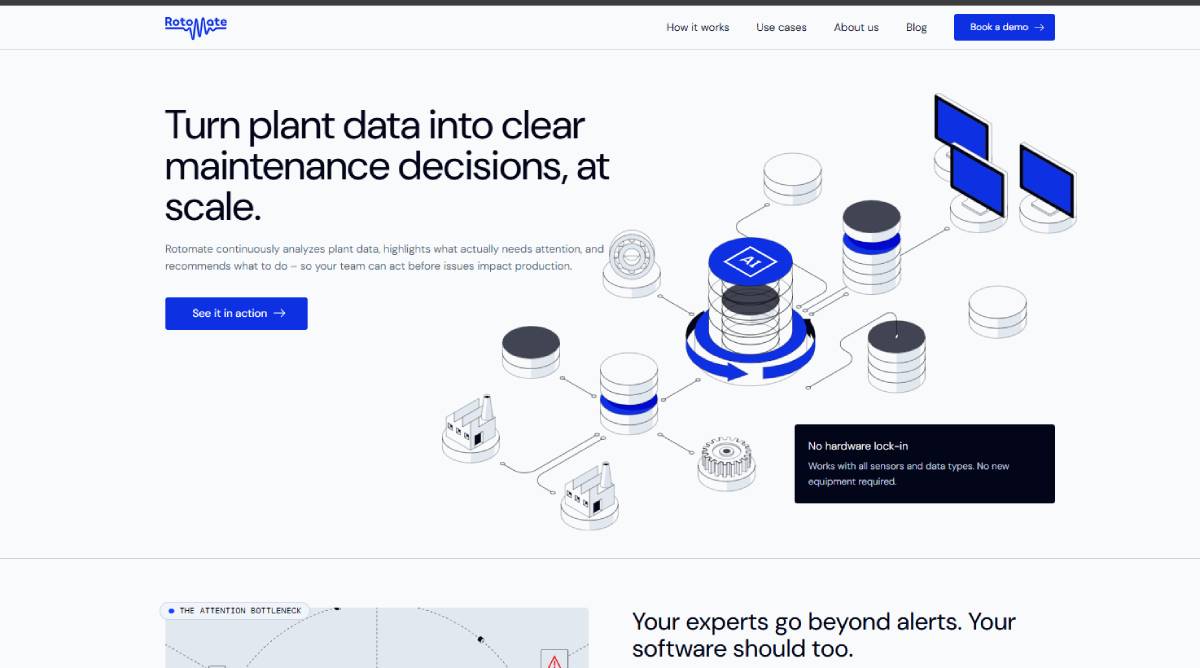
Rotomate, an industrial AI startup, has raised €2.1 million in pre-seed funding to address a growing workforce challenge in manufacturing: the retirement of experienced factory specialists. The round will support the company’s AI-driven condition monitoring and knowledge-capture systems designed to replicate human expertise in production environments.

The funding will be deployed to scale product development, expand pilot deployments, and strengthen partnerships with industrial operators across Europe. Key stakeholders include manufacturing firms facing skilled labor shortages and investors betting on AI-enabled industrial resilience. The timing aligns with increasing pressure on factories to maintain output despite demographic shifts in the workforce.

European manufacturing is entering a critical transition phase as aging workforces retire faster than new skilled technicians are trained. This has created a “knowledge gap” in factory operations where decades of tacit expertise often disappear with departing workers. Rotomate’s approach reflects a broader trend in industrial AI: capturing experiential know-how and converting it into machine-readable intelligence.

This shift aligns with Industry 4.0 transformation efforts, where predictive maintenance, digital twins, and sensor-driven automation are becoming standard across advanced manufacturing ecosystems. Governments across Europe have also been pushing for digital resilience in industrial sectors to reduce dependency on scarce human expertise.

Historically, manufacturing efficiency has relied heavily on human intuition in maintenance and troubleshooting. The current transition marks a structural departure toward AI systems that can replicate, and in some cases outperform, those human decision loops.

Industry analysts view Rotomate’s funding as part of a broader acceleration in “knowledge automation” technologies. According to industrial AI specialists, the most valuable manufacturing data is often not captured in formal systems but resides in experienced technicians’ decision-making patterns.

A recurring view among sector observers is that factories without structured knowledge transfer mechanisms face rising operational risk as workforce turnover increases. Investors see strong potential in startups that can convert legacy expertise into scalable AI models, particularly in energy-intensive and high-precision manufacturing environments.

While no direct quotes are available, experts consistently emphasize that the success of such platforms depends on data quality, sensor integration, and factory-level adoption speed. The competitive edge will likely go to companies that can integrate seamlessly into existing industrial infrastructure without costly retrofitting.

For manufacturers, Rotomate’s model highlights an urgent operational challenge: preserving institutional knowledge in the absence of experienced labor. Companies may need to rethink workforce planning, investing more aggressively in AI-assisted training and predictive systems.

For investors, industrial AI is increasingly viewed as a defensive-growth segment, particularly in regions facing demographic decline. Policymakers may also see this as a strategic enabler for maintaining industrial output without proportional labor replacement.

Analysts suggest that firms slow to adopt such systems risk efficiency erosion and higher maintenance downtime. Over time, AI-driven expertise replication could become a baseline requirement for competitiveness in advanced manufacturing ecosystems.

Rotomate is expected to expand pilot deployments across European factories over the next growth phase, with emphasis on scaling its AI models in real-world industrial environments. The key test will be whether its system can reliably replicate complex human decision-making under operational stress. As industrial labor shortages deepen, similar startups are likely to attract increased capital and strategic interest from manufacturers and automation providers.

Source: Nordictech news
Date: July 2, 2026

  • Featured tools
Upscayl AI
Free

Upscayl AI is a free, open-source AI-powered tool that enhances and upscales images to higher resolutions. It transforms blurry or low-quality visuals into sharp, detailed versions with ease.

#
Productivity
Learn more
WellSaid Ai
Free

WellSaid AI is an advanced text-to-speech platform that transforms written text into lifelike, human-quality voiceovers.

#
Text to Speech
Learn more

Learn more about future of AI

Join 80,000+ Ai enthusiast getting weekly updates on exciting AI tools.
Thank you! Your submission has been received!
Oops! Something went wrong while submitting the form.

Rotomate Replaces Factory Expertise AI

July 2, 2026

Rotomate, an industrial AI startup, has raised €2.1 million in pre-seed funding to address a growing workforce challenge in manufacturing: the retirement of experienced factory specialists.

A new wave of industrial AI adoption is underway as Rotomate secures €2.1 million in pre-seed funding to digitize factory expertise before critical knowledge is lost to retiring workers. The development signals a structural shift in manufacturing intelligence, with implications for productivity, labor transition, and industrial competitiveness across Europe’s aging industrial base.

Rotomate, an industrial AI startup, has raised €2.1 million in pre-seed funding to address a growing workforce challenge in manufacturing: the retirement of experienced factory specialists. The round will support the company’s AI-driven condition monitoring and knowledge-capture systems designed to replicate human expertise in production environments.

The funding will be deployed to scale product development, expand pilot deployments, and strengthen partnerships with industrial operators across Europe. Key stakeholders include manufacturing firms facing skilled labor shortages and investors betting on AI-enabled industrial resilience. The timing aligns with increasing pressure on factories to maintain output despite demographic shifts in the workforce.

European manufacturing is entering a critical transition phase as aging workforces retire faster than new skilled technicians are trained. This has created a “knowledge gap” in factory operations where decades of tacit expertise often disappear with departing workers. Rotomate’s approach reflects a broader trend in industrial AI: capturing experiential know-how and converting it into machine-readable intelligence.

This shift aligns with Industry 4.0 transformation efforts, where predictive maintenance, digital twins, and sensor-driven automation are becoming standard across advanced manufacturing ecosystems. Governments across Europe have also been pushing for digital resilience in industrial sectors to reduce dependency on scarce human expertise.

Historically, manufacturing efficiency has relied heavily on human intuition in maintenance and troubleshooting. The current transition marks a structural departure toward AI systems that can replicate, and in some cases outperform, those human decision loops.

Industry analysts view Rotomate’s funding as part of a broader acceleration in “knowledge automation” technologies. According to industrial AI specialists, the most valuable manufacturing data is often not captured in formal systems but resides in experienced technicians’ decision-making patterns.

A recurring view among sector observers is that factories without structured knowledge transfer mechanisms face rising operational risk as workforce turnover increases. Investors see strong potential in startups that can convert legacy expertise into scalable AI models, particularly in energy-intensive and high-precision manufacturing environments.

While no direct quotes are available, experts consistently emphasize that the success of such platforms depends on data quality, sensor integration, and factory-level adoption speed. The competitive edge will likely go to companies that can integrate seamlessly into existing industrial infrastructure without costly retrofitting.

For manufacturers, Rotomate’s model highlights an urgent operational challenge: preserving institutional knowledge in the absence of experienced labor. Companies may need to rethink workforce planning, investing more aggressively in AI-assisted training and predictive systems.

For investors, industrial AI is increasingly viewed as a defensive-growth segment, particularly in regions facing demographic decline. Policymakers may also see this as a strategic enabler for maintaining industrial output without proportional labor replacement.

Analysts suggest that firms slow to adopt such systems risk efficiency erosion and higher maintenance downtime. Over time, AI-driven expertise replication could become a baseline requirement for competitiveness in advanced manufacturing ecosystems.

Rotomate is expected to expand pilot deployments across European factories over the next growth phase, with emphasis on scaling its AI models in real-world industrial environments. The key test will be whether its system can reliably replicate complex human decision-making under operational stress. As industrial labor shortages deepen, similar startups are likely to attract increased capital and strategic interest from manufacturers and automation providers.

Source: Nordictech news
Date: July 2, 2026

Promote Your Tool

Copy Embed Code

Similar Blogs

July 2, 2026
|

Rotomate Replaces Factory Expertise AI

Rotomate, an industrial AI startup, has raised €2.1 million in pre-seed funding to address a growing workforce challenge in manufacturing: the retirement of experienced factory specialists.
Read more
July 2, 2026
|

Skyfora Builds Telecom Climate Intelligence

Skyfora has secured €6.5 million in fresh funding to expand its satellite-assisted weather intelligence platform. The company leverages GNSS signal distortion data from telecom infrastructure to generate hyper-local weather insights.
Read more
July 2, 2026
|

Omda Expands Public Safety Stack

Omda has acquired a public safety and emergency software division from Saab, a unit focused on critical incident management and emergency response systems.
Read more
July 2, 2026
|

Nordic Capital Backs Defense Tech

Sandwater, in partnership with Gardar Fund, has secured €80 million in fresh capital commitments aimed at Ukrainian defense and dual-use technology startups.
Read more
July 2, 2026
|

Telenor Bets on Fibre Infrastructure

Telenor has agreed to acquire Enivest in a transaction valued at approximately NOK 2.5 billion. The deal expands Telenor’s fibre footprint in western Norway, adding critical last-mile infrastructure assets to its existing network.
Read more
July 2, 2026
|

Arkeon Tackles Quantum Qubit Defects

Arkeon’s €594K seed round will be directed toward solving yield instability in qubit fabrication, a persistent challenge in scalable quantum systems.
Read more