



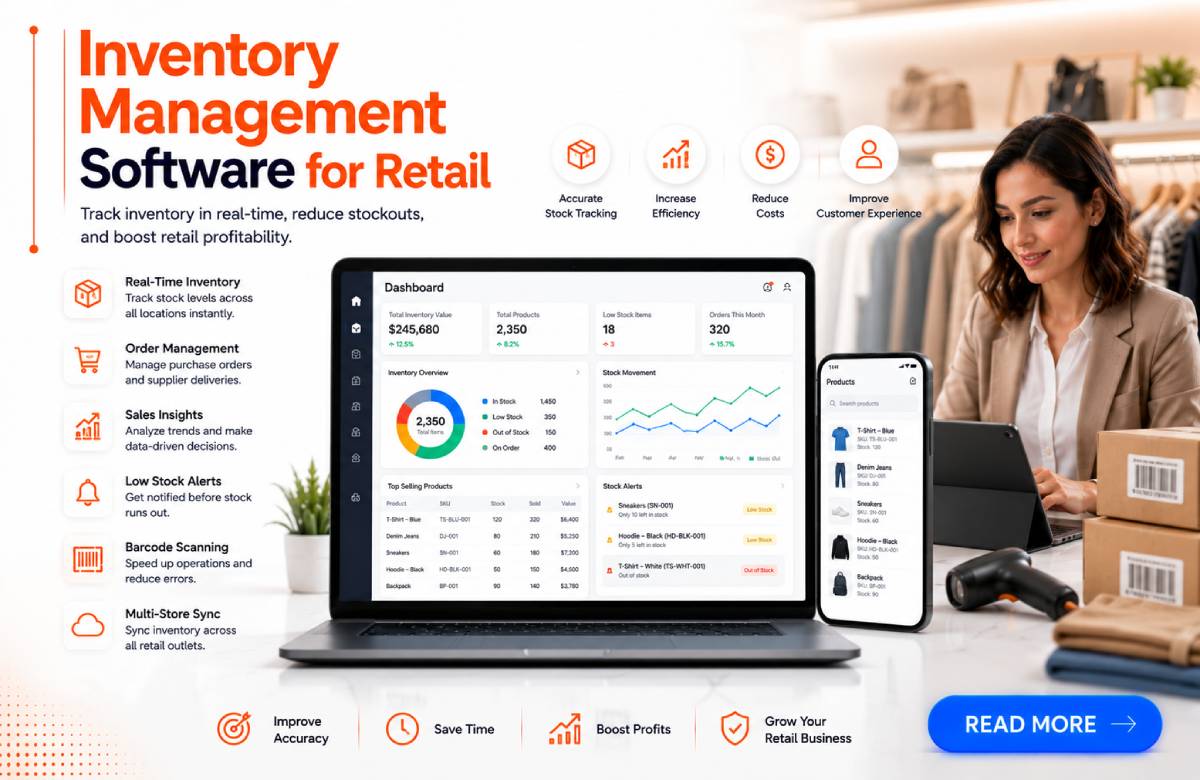
Retail inventory management software is becoming increasingly important as businesses seek greater control over stock, purchasing and fulfillment. Digital inventory platforms help retailers monitor products across locations, automate routine processes and improve stock visibility. The shift is particularly relevant as retailers balance changing consumer demand, supply-chain uncertainty and pressure to protect margins.
Modern retail inventory platforms are designed to centralize information about products, stock levels, purchases and sales across physical and digital channels. Core capabilities commonly include real-time inventory tracking, barcode management, purchase-order processing, stock alerts, warehouse coordination and reporting. More advanced systems can also connect inventory data with point-of-sale, ecommerce and accounting platforms.
For retailers operating across multiple stores or fulfillment locations, centralized inventory information can improve coordination and reduce discrepancies between available and recorded stock.
Automation is becoming another important development, helping businesses identify low-stock products, support replenishment and reduce manual inventory administration. The broader market is increasingly focused on providing retailers with accurate, timely information for faster operational and purchasing decisions.
Retail inventory management has become more complex as consumer purchasing increasingly spans stores, websites, marketplaces and mobile channels. Customers expect products to be available when promised, while retailers must avoid carrying excessive inventory that ties up capital and increases storage costs.
Traditional spreadsheets and manual stock counts can struggle to provide an accurate view across multiple locations and sales channels. Inventory-management technology addresses this challenge by connecting stock information and operational workflows within centralized systems.
The development aligns with broader retail digitization, where businesses are investing in technology to improve forecasting, fulfillment and supply-chain visibility. The rise of omnichannel commerce has made inventory accuracy particularly important because the same product may be sold through several channels simultaneously.
For executives, inventory management has a direct connection to profitability. Overstocking can increase carrying costs and markdowns, while stockouts can result in lost sales and weaker customer loyalty. Effective technology therefore supports both operational efficiency and financial performance.
Retail technology specialists increasingly view inventory visibility as a foundational capability for modern commerce. Accurate inventory data enables retailers to make faster decisions about replenishment, purchasing and product allocation.
Automation can also reduce the administrative burden associated with stock management. Instead of relying entirely on manual checks, businesses can use system-generated alerts and reports to identify unusual inventory movements or products approaching critical stock levels.
However, technology alone cannot eliminate inventory problems. Data accuracy, barcode discipline, supplier reliability and consistent operational processes remain essential. Poor input data can undermine even sophisticated inventory platforms.
The growth of AI and predictive analytics is also changing expectations. Retailers are increasingly exploring systems capable of forecasting demand, identifying purchasing patterns and recommending replenishment strategies.
For business leaders, the strategic question is how effectively inventory technology connects operational data with purchasing, sales and financial decisions. The strongest systems can turn stock information into actionable intelligence rather than simply providing a digital inventory count.
For retailers, stronger inventory management can improve stock accuracy, reduce unnecessary carrying costs and support more reliable fulfillment. Better visibility can also help businesses coordinate inventory across stores, warehouses and ecommerce channels.
For investors and executives, efficient inventory control can improve working-capital management and protect margins. Reducing stockouts and excess inventory can directly influence revenue and profitability.
Consumers benefit indirectly through better product availability, more accurate delivery expectations and smoother purchasing experiences. From a governance perspective, retailers must consider data security, system reliability and integration controls when connecting inventory platforms with payment, ecommerce and financial systems.
Executives should evaluate real-time visibility, forecasting, integrations, automation, scalability and reporting capabilities when selecting retail inventory-management technology.
Retail inventory management is expected to become increasingly predictive as AI, automation and real-time analytics become embedded in supply-chain operations. Future systems will likely move beyond tracking existing stock toward anticipating demand and recommending purchasing decisions. Decision-makers should monitor forecasting accuracy, omnichannel integration and automation capabilities. The strategic objective will be to maintain the right products in the right locations at the right time while minimizing capital tied up in inventory.
Source: Crozdesk
Date: August 13, 2026


