
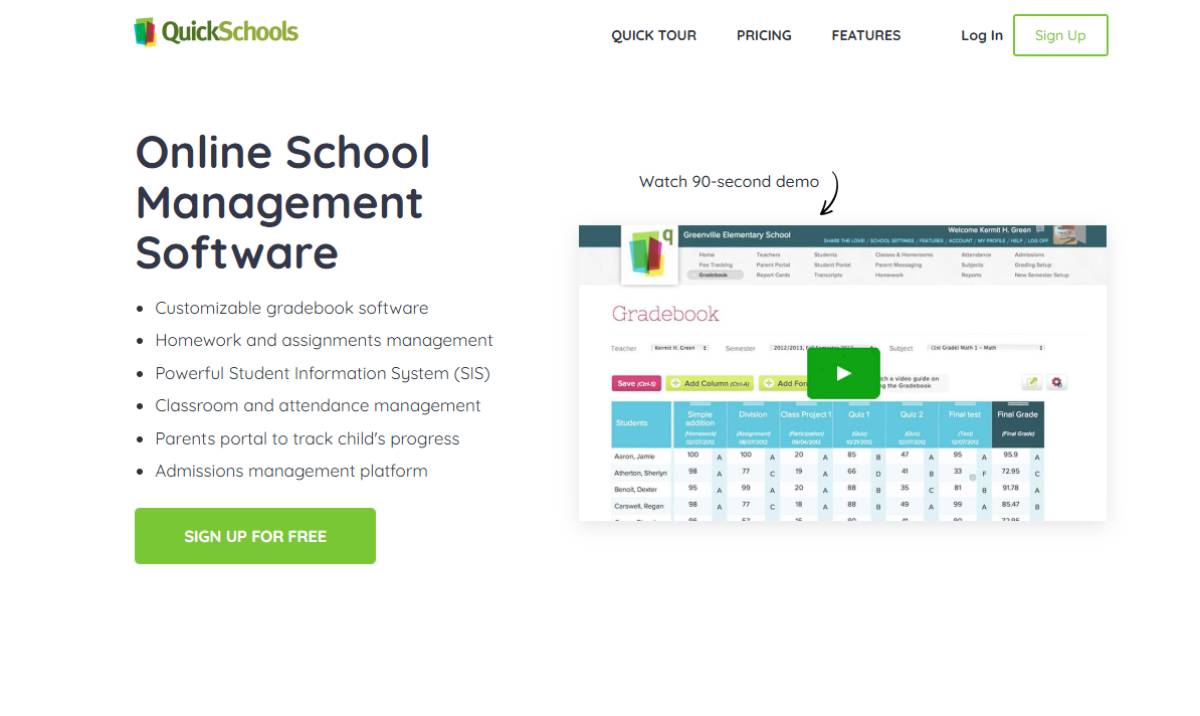
QuickSchools Transforms K–12 Education Management

QuickSchools delivers a comprehensive school management solution that centralizes student records, attendance tracking, gradebooks, report cards, admissions, scheduling, and administrative workflows within a secure cloud-based environment.

August 6, 2026
|

QuickSchools is advancing cloud-based school management by providing an integrated platform that streamlines student information, attendance, grading, scheduling, and parent communication. As educational institutions continue modernizing administrative operations, the platform supports schools in improving efficiency, enhancing collaboration, and delivering better digital experiences for educators, students, and families.

QuickSchools delivers a comprehensive school management solution that centralizes student records, attendance tracking, gradebooks, report cards, admissions, scheduling, and administrative workflows within a secure cloud-based environment. The platform also enables communication between teachers, administrators, students, and parents through digital portals and automated notifications.

Designed primarily for K–12 schools and educational institutions, the solution helps reduce manual paperwork while improving operational visibility and academic record management. As schools increasingly adopt digital administration systems, platforms like QuickSchools enable educational leaders to optimize institutional performance, strengthen data accuracy, and support more efficient school operations.

Education systems worldwide have accelerated digital transformation in response to evolving learning environments, growing student populations, and increasing expectations for administrative efficiency. Cloud-based education management platforms have become essential infrastructure for schools seeking to modernize operations while improving communication and access to academic information.

Governments, private institutions, and educational organizations continue investing in education technology to strengthen learning outcomes and simplify institutional management. Digital student information systems now support everything from enrollment and attendance monitoring to performance analytics and compliance reporting.

The transition toward integrated education management platforms also reflects broader trends in public sector modernization, cloud computing, and data-driven decision-making. Within this rapidly evolving landscape, QuickSchools represents the growing adoption of scalable software solutions that improve operational resilience while enabling educational institutions to deliver more connected and efficient learning environments.

Education technology analysts consistently identify cloud-based school management systems as key drivers of administrative modernization. Experts note that centralized digital platforms reduce administrative workloads, improve data accuracy, and enable educators to devote more time to teaching rather than manual record management.

Industry specialists also emphasize that integrated education platforms strengthen collaboration among teachers, administrators, students, and parents by providing real-time access to academic information and institutional communications. As digital learning ecosystems continue expanding, schools increasingly prioritize solutions that combine operational efficiency with enhanced educational experiences.

Although no official executive statement accompanies this platform overview, QuickSchools reflects broader education technology priorities centered on digital transformation, institutional efficiency, data accessibility, and scalable cloud infrastructure that supports evolving educational requirements across diverse learning environments.

For educational institutions, cloud-based school management systems improve operational efficiency, reduce administrative costs, and strengthen academic record management while enhancing communication with families and stakeholders. Administrators gain greater visibility into institutional performance and resource planning.

Investors continue to monitor the education technology sector as schools expand digital infrastructure investments worldwide. Policymakers are also emphasizing secure student data management, privacy protection, accessibility, and regulatory compliance, encouraging institutions to adopt modern technology platforms that support transparent governance and effective educational administration.

Demand for cloud-based education management solutions is expected to grow as schools continue investing in digital infrastructure, automation, and data-driven administration. Future innovation will likely focus on artificial intelligence, predictive student analytics, personalized learning support, and deeper integration across education ecosystems. Decision-makers should monitor evolving education technology standards and digital governance policies that will shape the future of institutional management.

Source: Crozdesk
Date: August 6, 2026

  • Featured tools
Murf Ai
Free

Murf AI Review – Advanced AI Voice Generator for Realistic Voiceovers

#
Text to Speech
Learn more
Alli AI
Free

Alli AI is an all-in-one, AI-powered SEO automation platform that streamlines on-page optimization, site auditing, speed improvements, schema generation, internal linking, and ranking insights.

#
SEO
Learn more

Learn more about future of AI

Join 80,000+ Ai enthusiast getting weekly updates on exciting AI tools.
Thank you! Your submission has been received!
Oops! Something went wrong while submitting the form.

QuickSchools Transforms K–12 Education Management

August 6, 2026

QuickSchools delivers a comprehensive school management solution that centralizes student records, attendance tracking, gradebooks, report cards, admissions, scheduling, and administrative workflows within a secure cloud-based environment.

QuickSchools is advancing cloud-based school management by providing an integrated platform that streamlines student information, attendance, grading, scheduling, and parent communication. As educational institutions continue modernizing administrative operations, the platform supports schools in improving efficiency, enhancing collaboration, and delivering better digital experiences for educators, students, and families.

QuickSchools delivers a comprehensive school management solution that centralizes student records, attendance tracking, gradebooks, report cards, admissions, scheduling, and administrative workflows within a secure cloud-based environment. The platform also enables communication between teachers, administrators, students, and parents through digital portals and automated notifications.

Designed primarily for K–12 schools and educational institutions, the solution helps reduce manual paperwork while improving operational visibility and academic record management. As schools increasingly adopt digital administration systems, platforms like QuickSchools enable educational leaders to optimize institutional performance, strengthen data accuracy, and support more efficient school operations.

Education systems worldwide have accelerated digital transformation in response to evolving learning environments, growing student populations, and increasing expectations for administrative efficiency. Cloud-based education management platforms have become essential infrastructure for schools seeking to modernize operations while improving communication and access to academic information.

Governments, private institutions, and educational organizations continue investing in education technology to strengthen learning outcomes and simplify institutional management. Digital student information systems now support everything from enrollment and attendance monitoring to performance analytics and compliance reporting.

The transition toward integrated education management platforms also reflects broader trends in public sector modernization, cloud computing, and data-driven decision-making. Within this rapidly evolving landscape, QuickSchools represents the growing adoption of scalable software solutions that improve operational resilience while enabling educational institutions to deliver more connected and efficient learning environments.

Education technology analysts consistently identify cloud-based school management systems as key drivers of administrative modernization. Experts note that centralized digital platforms reduce administrative workloads, improve data accuracy, and enable educators to devote more time to teaching rather than manual record management.

Industry specialists also emphasize that integrated education platforms strengthen collaboration among teachers, administrators, students, and parents by providing real-time access to academic information and institutional communications. As digital learning ecosystems continue expanding, schools increasingly prioritize solutions that combine operational efficiency with enhanced educational experiences.

Although no official executive statement accompanies this platform overview, QuickSchools reflects broader education technology priorities centered on digital transformation, institutional efficiency, data accessibility, and scalable cloud infrastructure that supports evolving educational requirements across diverse learning environments.

For educational institutions, cloud-based school management systems improve operational efficiency, reduce administrative costs, and strengthen academic record management while enhancing communication with families and stakeholders. Administrators gain greater visibility into institutional performance and resource planning.

Investors continue to monitor the education technology sector as schools expand digital infrastructure investments worldwide. Policymakers are also emphasizing secure student data management, privacy protection, accessibility, and regulatory compliance, encouraging institutions to adopt modern technology platforms that support transparent governance and effective educational administration.

Demand for cloud-based education management solutions is expected to grow as schools continue investing in digital infrastructure, automation, and data-driven administration. Future innovation will likely focus on artificial intelligence, predictive student analytics, personalized learning support, and deeper integration across education ecosystems. Decision-makers should monitor evolving education technology standards and digital governance policies that will shape the future of institutional management.

Source: Crozdesk
Date: August 6, 2026

Promote Your Tool

Copy Embed Code

Similar Blogs

August 14, 2026
|

Benefitfocus Expands Digital Benefits Administration

Benefitfocus provides cloud-based technology covering benefits enrollment, administration, communications, billing, payments and data exchange.
Read more
August 14, 2026
|

Travel Agent Revenue Models Evolve Digitally

Travel agencies can earn commissions when customers book hotels, cruises, tours, vacation packages and other travel products through them. Suppliers may pay agents for generating bookings, making commissions a traditional component of agency revenue.
Read more
August 14, 2026
|

Sofon Advances Guided Selling CPQ Automation

Sofon's platform combines guided selling, product configuration, pricing, quotation and sales-management capabilities. Guided questionnaires help sales teams identify customer requirements and translate them into suitable product configurations.
Read more
August 14, 2026
|

WellRyde Advances Medical Transportation Management

WellRyde provides technology for managing non-emergency medical transportation operations, including trip scheduling, dispatch coordination, transportation-provider management and reporting.
Read more
August 14, 2026
|

Review WAVE Advances Digital Patient Engagement

Review WAVE provides healthcare practices with tools for online appointment scheduling, two-way texting, automated appointment reminders, digital forms, web chat, marketing campaigns and online review generation.
Read more
August 14, 2026
|

Edgenuity Expands Digital Virtual Education

Edgenuity provides digital curriculum and learning solutions covering core academic subjects, electives, Advanced Placement and career-oriented education.
Read more