



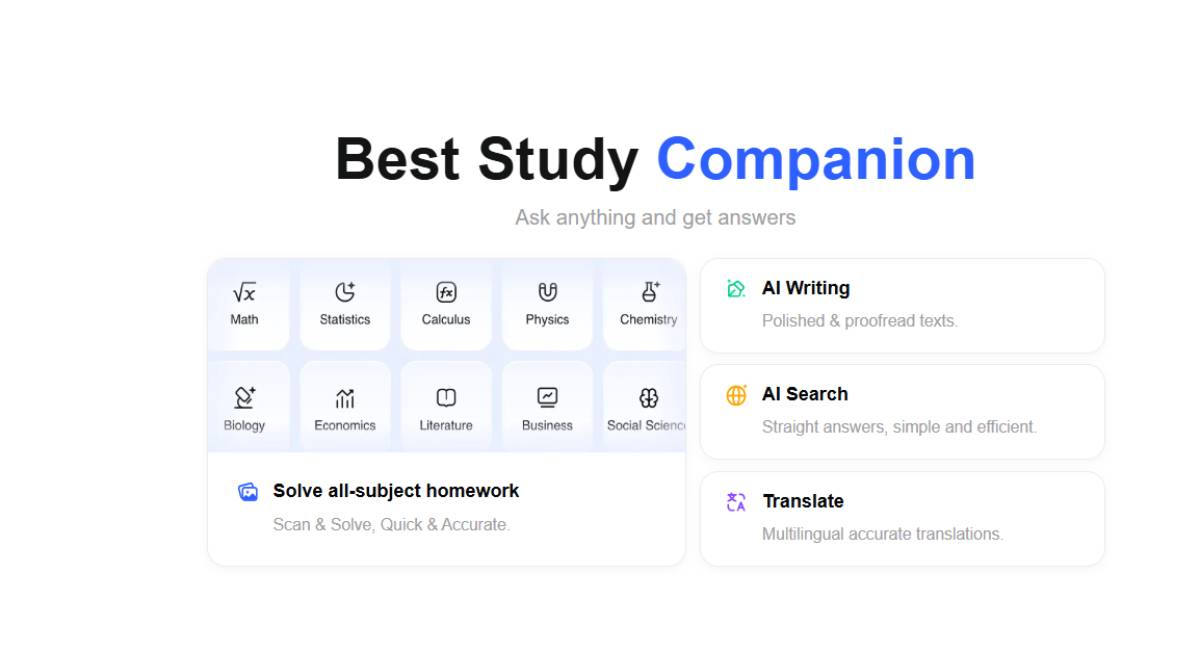
A major development unfolded as Question AI scaled its AI-driven homework assistance platform, offering instant solutions across academic subjects. The move signals a broader transformation in global education technology, with implications for learning models, institutional integrity, and the growing role of AI in student productivity and assessment.
- Question AI provides AI-powered solutions for academic queries, enabling students to receive instant answers and explanations.
- The platform supports multiple subjects, including mathematics, science, and language-based assignments.
- It leverages AI to interpret and solve questions, often through text or image-based inputs.
- The tool targets students, educators, and self-learners seeking efficient academic support.
- Its accessibility and ease of use position it as a scalable solution in global EdTech markets.
- Analysts highlight its potential to reshape traditional study methods and reduce reliance on conventional tutoring services.
The rise of AI-powered educational tools reflects a significant shift in how knowledge is accessed and consumed. Platforms like Question AI are part of a broader wave of EdTech innovation aimed at improving learning efficiency and accessibility.
Globally, education systems are undergoing transformation as digital tools become integral to both formal and informal learning environments. The COVID-19 pandemic accelerated adoption of online learning, creating fertile ground for AI-driven solutions.
However, the increasing use of AI in education also raises questions about academic integrity, assessment standards, and the role of educators. Institutions are grappling with how to integrate these tools while maintaining rigorous evaluation processes. The development underscores the growing influence of AI in shaping the future of education and workforce readiness.
Education and technology experts view AI homework assistants as both an opportunity and a challenge. “AI tools can democratize access to knowledge, but they also require careful integration into academic systems,” noted an EdTech analyst.
Platforms like Question AI are praised for improving accessibility, particularly in regions with limited access to quality educational resources. However, experts caution that over-reliance on AI could impact critical thinking and problem-solving skills.
Educators emphasize the need for balanced adoption, where AI complements rather than replaces traditional learning methods. Analysts also highlight the competitive landscape, with multiple AI-driven platforms entering the education sector. The ability to combine accuracy, usability, and ethical considerations will be critical in determining
For global executives, the rise of AI-powered education tools signals significant opportunities in the EdTech sector. Companies may explore partnerships, integrations, and new business models to capitalize on growing demand.
Investors could view this as a high-growth segment, driven by increasing adoption of digital learning solutions. However, concerns around academic integrity and regulatory compliance may influence market dynamics.
From a policy perspective, governments and educational institutions may need to establish guidelines for the use of AI in academic settings. This could include frameworks for ethical use, assessment standards, and data privacy, ensuring that AI enhances rather than undermines educational outcomes.
Decision-makers should monitor adoption trends, institutional responses, and regulatory developments in AI-driven education. Future advancements may include more personalized learning experiences and deeper integration into formal education systems.
Key uncertainties include the balance between innovation and academic integrity, as well as long-term impacts on learning outcomes. For executives and policymakers, the evolution of AI in education will be a defining factor in shaping future talent ecosystems.
Source: Question AI
Date: April 9, 2026


