
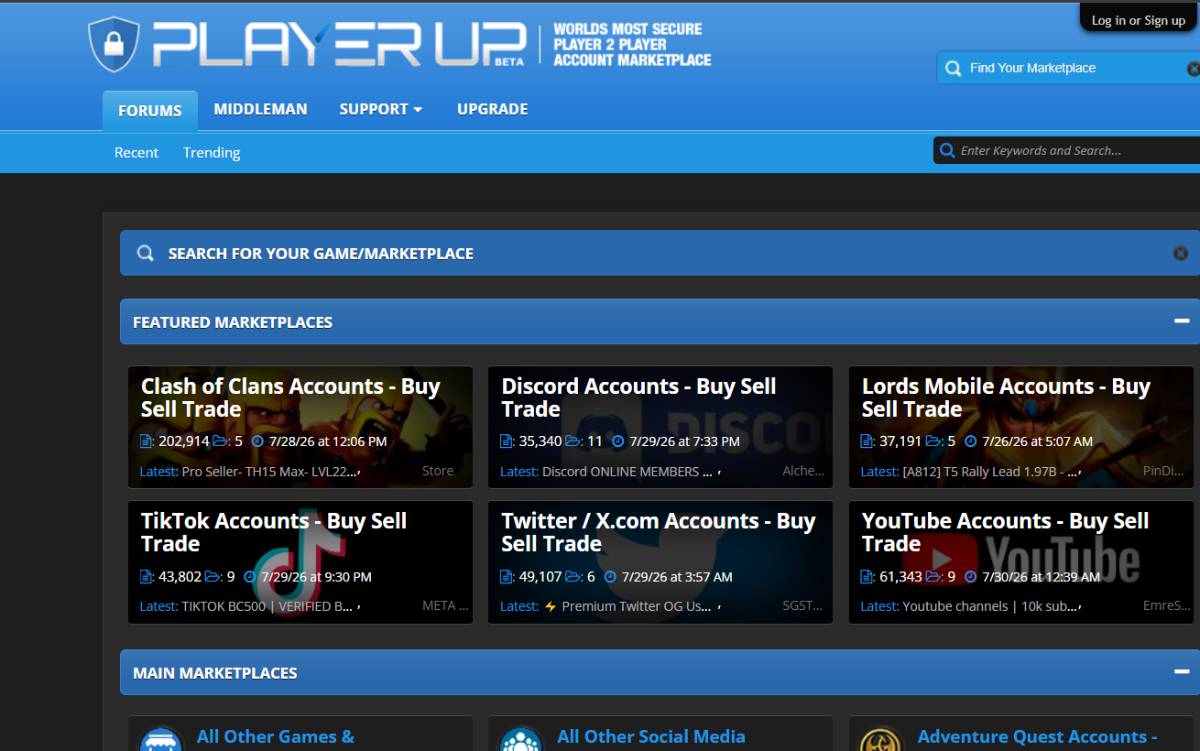
PlayerUp Expands Gaming Asset Marketplace

PlayerUp operates as a digital marketplace that facilitates transactions involving gaming accounts, virtual goods, online services, and digital assets across multiple gaming and social media platforms.

July 31, 2026
|

A notable development is reshaping the global digital gaming economy as online marketplaces for gaming accounts, virtual assets, and digital services continue expanding. PlayerUp reflects the increasing commercialization of digital ownership, connecting buyers and sellers in a growing ecosystem that serves gamers, creators, and digital entrepreneurs worldwide.

PlayerUp operates as a digital marketplace that facilitates transactions involving gaming accounts, virtual goods, online services, and digital assets across multiple gaming and social media platforms. The platform serves individuals, gaming communities, and online entrepreneurs seeking secure peer-to-peer transactions.

Key stakeholders include gamers, esports participants, digital asset traders, marketplace operators, payment providers, and cybersecurity firms. The continued growth of virtual economies has increased demand for trusted intermediary platforms that support account transfers and digital commerce.

The platform reflects broader market momentum toward monetizing digital assets as gaming evolves into a significant component of the global digital economy. The global gaming industry has evolved beyond entertainment into a multi-billion-dollar digital economy driven by virtual goods, online identities, creator ecosystems, and competitive gaming. Digital assets including game accounts, skins, collectibles, and virtual currencies have become increasingly valuable, creating new commercial opportunities for consumers and businesses alike.

This development aligns with a broader trend across global markets where digital ownership is expanding through gaming ecosystems, creator platforms, and virtual marketplaces. As gaming communities continue to grow, secondary markets have emerged to facilitate the exchange of digital assets between users.

However, the industry also faces ongoing challenges related to cybersecurity, fraud prevention, intellectual property rights, and compliance with publisher terms of service. Marketplace operators are increasingly investing in identity verification, escrow mechanisms, and dispute resolution systems to improve transaction security and user confidence.

Industry analysts view digital asset marketplaces as an important extension of the modern gaming economy. Experts suggest that secure trading environments can unlock additional economic value for users while supporting broader participation in digital commerce.

Technology specialists emphasize that trust remains the foundation of online marketplaces. Features such as escrow services, transaction verification, fraud detection, and transparent dispute resolution are increasingly regarded as competitive differentiators.

Market observers also note that game publishers continue evaluating policies regarding account transfers and virtual asset ownership. Regulatory experts expect governments to pay closer attention to digital marketplace governance as virtual economies expand and digital assets gain greater financial significance.

Overall, analysts believe that platforms capable of balancing user security, compliance, and marketplace efficiency will be best positioned for long-term growth. For businesses, the growth of gaming asset marketplaces creates new revenue opportunities across payments, cybersecurity, digital identity verification, and marketplace infrastructure. Companies supporting virtual commerce may benefit from increasing user participation in online gaming ecosystems.

Investors are likely to continue monitoring the digital gaming economy as monetization models diversify beyond traditional game sales. Meanwhile, policymakers may examine issues surrounding consumer protection, taxation, fraud prevention, and digital ownership rights.

For executives, expanding virtual economies present both commercial opportunities and governance challenges requiring strong security frameworks and evolving regulatory compliance strategies.

Digital marketplaces for gaming assets are expected to grow alongside expanding virtual economies and creator ecosystems. Decision-makers should monitor developments in digital ownership standards, marketplace regulation, cybersecurity technologies, and platform governance. Organizations that prioritize secure transactions, user trust, and regulatory compliance will be well positioned to capitalize on the next phase of growth in the global digital gaming marketplace.

Source: AlternativeTo
Date: July 31, 2026

  • Featured tools
Writesonic AI
Free

Writesonic AI is a versatile AI writing platform designed for marketers, entrepreneurs, and content creators. It helps users create blog posts, ad copies, product descriptions, social media posts, and more with ease. With advanced AI models and user-friendly tools, Writesonic streamlines content production and saves time for busy professionals.

#
Copywriting
Learn more
Beautiful AI
Free

Beautiful AI is an AI-powered presentation platform that automates slide design and formatting, enabling users to create polished, on-brand presentations quickly.

#
Presentation
Learn more

Learn more about future of AI

Join 80,000+ Ai enthusiast getting weekly updates on exciting AI tools.
Thank you! Your submission has been received!
Oops! Something went wrong while submitting the form.

PlayerUp Expands Gaming Asset Marketplace

July 31, 2026

PlayerUp operates as a digital marketplace that facilitates transactions involving gaming accounts, virtual goods, online services, and digital assets across multiple gaming and social media platforms.

A notable development is reshaping the global digital gaming economy as online marketplaces for gaming accounts, virtual assets, and digital services continue expanding. PlayerUp reflects the increasing commercialization of digital ownership, connecting buyers and sellers in a growing ecosystem that serves gamers, creators, and digital entrepreneurs worldwide.

PlayerUp operates as a digital marketplace that facilitates transactions involving gaming accounts, virtual goods, online services, and digital assets across multiple gaming and social media platforms. The platform serves individuals, gaming communities, and online entrepreneurs seeking secure peer-to-peer transactions.

Key stakeholders include gamers, esports participants, digital asset traders, marketplace operators, payment providers, and cybersecurity firms. The continued growth of virtual economies has increased demand for trusted intermediary platforms that support account transfers and digital commerce.

The platform reflects broader market momentum toward monetizing digital assets as gaming evolves into a significant component of the global digital economy. The global gaming industry has evolved beyond entertainment into a multi-billion-dollar digital economy driven by virtual goods, online identities, creator ecosystems, and competitive gaming. Digital assets including game accounts, skins, collectibles, and virtual currencies have become increasingly valuable, creating new commercial opportunities for consumers and businesses alike.

This development aligns with a broader trend across global markets where digital ownership is expanding through gaming ecosystems, creator platforms, and virtual marketplaces. As gaming communities continue to grow, secondary markets have emerged to facilitate the exchange of digital assets between users.

However, the industry also faces ongoing challenges related to cybersecurity, fraud prevention, intellectual property rights, and compliance with publisher terms of service. Marketplace operators are increasingly investing in identity verification, escrow mechanisms, and dispute resolution systems to improve transaction security and user confidence.

Industry analysts view digital asset marketplaces as an important extension of the modern gaming economy. Experts suggest that secure trading environments can unlock additional economic value for users while supporting broader participation in digital commerce.

Technology specialists emphasize that trust remains the foundation of online marketplaces. Features such as escrow services, transaction verification, fraud detection, and transparent dispute resolution are increasingly regarded as competitive differentiators.

Market observers also note that game publishers continue evaluating policies regarding account transfers and virtual asset ownership. Regulatory experts expect governments to pay closer attention to digital marketplace governance as virtual economies expand and digital assets gain greater financial significance.

Overall, analysts believe that platforms capable of balancing user security, compliance, and marketplace efficiency will be best positioned for long-term growth. For businesses, the growth of gaming asset marketplaces creates new revenue opportunities across payments, cybersecurity, digital identity verification, and marketplace infrastructure. Companies supporting virtual commerce may benefit from increasing user participation in online gaming ecosystems.

Investors are likely to continue monitoring the digital gaming economy as monetization models diversify beyond traditional game sales. Meanwhile, policymakers may examine issues surrounding consumer protection, taxation, fraud prevention, and digital ownership rights.

For executives, expanding virtual economies present both commercial opportunities and governance challenges requiring strong security frameworks and evolving regulatory compliance strategies.

Digital marketplaces for gaming assets are expected to grow alongside expanding virtual economies and creator ecosystems. Decision-makers should monitor developments in digital ownership standards, marketplace regulation, cybersecurity technologies, and platform governance. Organizations that prioritize secure transactions, user trust, and regulatory compliance will be well positioned to capitalize on the next phase of growth in the global digital gaming marketplace.

Source: AlternativeTo
Date: July 31, 2026

Promote Your Tool

Copy Embed Code

Similar Blogs

July 31, 2026
|

Rundown Creator Streamlines Production Workflows

Rundown Creator is designed to simplify production planning by enabling users to create, manage, and update rundowns for live broadcasts, events, and multimedia productions.
Read more
July 31, 2026
|

Licensed Streaming Platforms Gain Momentum

The evolution of online media distribution reflects increasing demand for accessible digital entertainment while reinforcing the industry's emphasis on copyright compliance and licensed content delivery.
Read more
July 31, 2026
|

Umingle Strengthens Digital Community Networking

Umingle is positioned as a digital networking and community-building platform that enables users to connect, organize discussions, and foster engagement within online groups.
Read more
July 31, 2026
|

Seanime Simplifies Unified Anime Streaming

Seanime is designed as an anime management platform that helps users organize personal libraries, monitor viewing progress, discover new series, and integrate multiple media management features within a unified interface.
Read more
July 31, 2026
|

OKmusi Expands Flexible Music Access

OKmusi is presented as a music download and management solution designed to help users search, organize, and access audio content across supported online sources.
Read more
July 31, 2026
|

ReProvision Simplifies iOS App Management

ReProvision is designed to automate the re-signing and renewal of sideloaded iOS applications by managing Apple developer certificates and provisioning profiles on supported devices.
Read more