



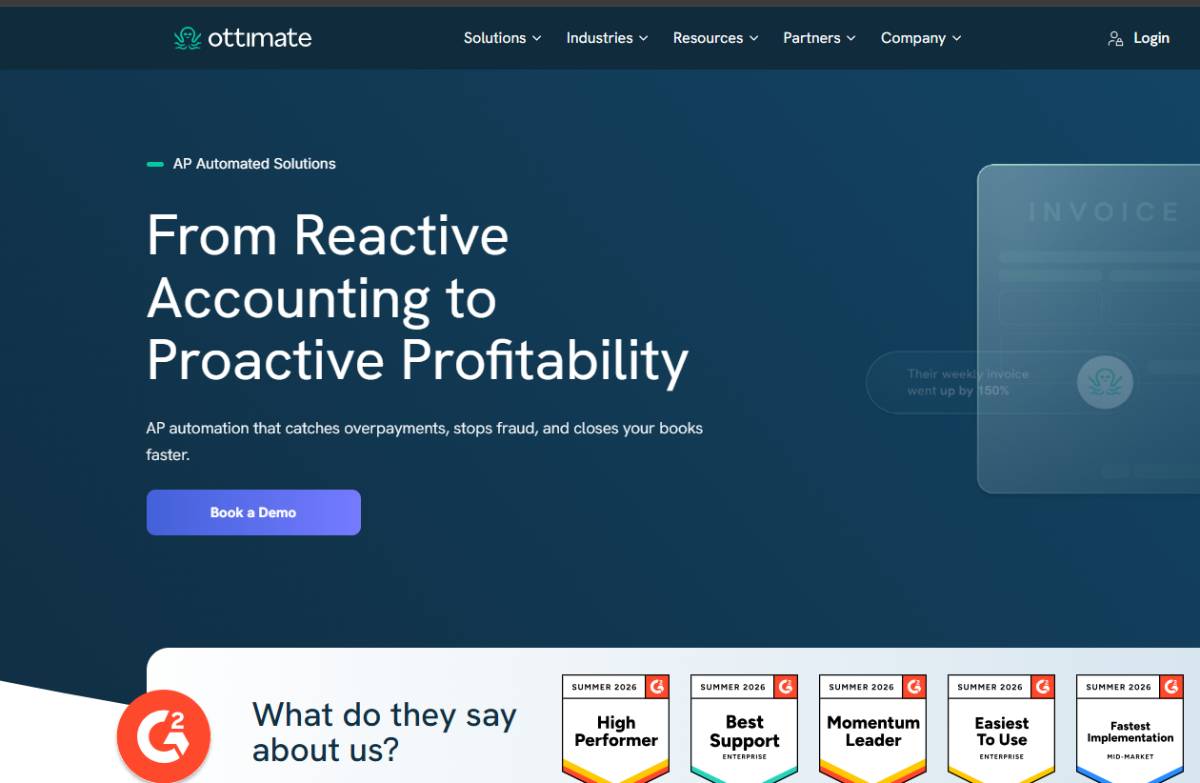
Plate IQ is advancing digital accounts payable management by helping businesses automate invoice processing, payment workflows and financial data management. The platform is particularly relevant to organizations handling large volumes of supplier invoices, including hospitality and multi-location businesses, where manual processes can increase costs, delays and the risk of financial errors.
Plate IQ focuses on automating accounts payable workflows, helping organizations capture invoice information, organize financial data and manage supplier payments through a centralized digital environment.
Its capabilities are designed to reduce manual data entry and streamline the movement of invoices from receipt through approval and payment. This can provide finance teams with greater visibility into outstanding obligations and vendor activity.
The platform is particularly relevant to businesses with high transaction volumes and distributed operations, where managing invoices across multiple locations and suppliers can become increasingly complex.
Plate IQ's positioning reflects the broader evolution of accounts payable technology from basic invoice storage toward automated financial workflows, data extraction and operational intelligence.
Accounts payable has traditionally been one of the more manual areas of corporate finance. Businesses frequently receive invoices through different channels, requiring employees to enter information, verify amounts, obtain approvals and coordinate payments.
As organizations expand, these processes can become significantly more complicated. Multi-location companies may work with hundreds or thousands of suppliers, creating substantial administrative workloads for finance departments.
The growth of AP automation platforms reflects a wider digital transformation in corporate finance. Modern systems increasingly use automation and data extraction to reduce repetitive work while improving visibility into financial obligations.
Plate IQ operates within this broader shift by focusing on the workflow connecting invoices, suppliers, approvals and payments. The economic significance is considerable because inefficient accounts payable processes can affect working capital, supplier relationships and finance-team productivity.
For executives, AP automation is increasingly viewed as a strategic efficiency initiative rather than simply an accounting upgrade. Better invoice visibility can help organizations identify spending patterns, improve controls and make more informed cash-management decisions.
Plate IQ's approach reflects the growing expectation that finance technology should automate routine transaction processing while providing stronger visibility into financial operations. Automating invoice data capture can reduce repetitive administrative work and allow finance professionals to focus on higher-value analysis and oversight.
For organizations with complex supplier networks, centralized AP workflows can also improve consistency in invoice approvals and payment management. Standardized processes may reduce the likelihood of duplicate entries, missed approvals or delayed payments.
However, automation must be accompanied by strong financial controls. Organizations still need appropriate approval policies, supplier verification, access controls and monitoring to protect against payment errors and fraud.
The broader financial-technology market is moving toward increasingly intelligent accounts payable systems, with AI and machine learning being used to classify documents, identify anomalies and support financial analysis.
For CFOs and finance leaders, the key question is how effectively automation improves processing efficiency while maintaining accuracy, security and control. For businesses, AP automation can reduce manual processing costs, accelerate invoice approvals and provide greater visibility into supplier obligations. Companies with large or geographically distributed operations may see particularly strong benefits from centralized workflows.
For finance executives, improved invoice data can support better cash-flow management and spending analysis. Suppliers may also benefit from more predictable payment processes and clearer invoice-status visibility.
The policy and governance implications include financial controls, data security, tax documentation and fraud prevention. Organizations must ensure automated payment processes remain compliant with applicable financial and regulatory requirements.
Executives should evaluate automation accuracy, supplier integrations, approval controls, security, reporting capabilities and measurable processing savings before expanding AP automation across their finance operations.
Accounts payable technology is likely to become increasingly intelligent, with AI-assisted invoice processing, anomaly detection, payment optimization and predictive cash-flow analysis becoming more common. Plate IQ is positioned within this broader transformation of corporate finance operations. Decision-makers should monitor automation accuracy, fraud controls, integrations and financial visibility. The long-term opportunity is to transform accounts payable from a largely administrative function into a more automated and strategically valuable source of financial intelligence.
Source: Plate IQ and Crozdesk
Date: August 13, 2026


