



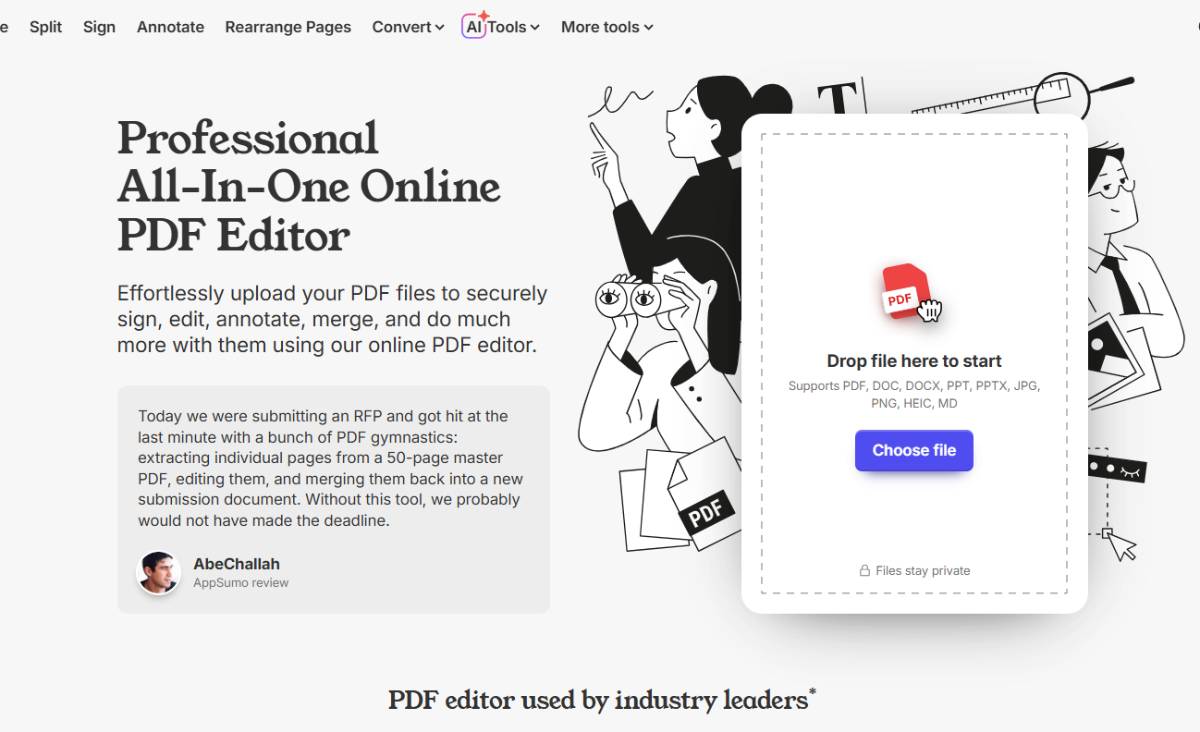
PDF.net is positioned within the expanding digital document-management landscape, addressing business demand for tools that simplify the creation, conversion, editing and handling of PDF files. As organizations continue replacing paper-based workflows with digital processes, document platforms are becoming increasingly important for productivity, collaboration and operational efficiency.
PDF.net provides capabilities centered on managing PDF documents and supporting common digital document workflows. Such tools can help users create, edit, convert, organize and process documents without relying entirely on traditional desktop applications.
The platform's relevance extends across businesses and individual users that regularly exchange PDF files for administrative, financial, operational and collaborative purposes. Streamlining document tasks can reduce repetitive manual work and improve accessibility.
For organizations, PDF management is increasingly connected with broader digital-transformation initiatives. Employees need to handle documents across different devices and workflows while maintaining consistency and accessibility.
The wider market is also moving toward browser-based and cloud-enabled document tools, allowing users to perform routine document operations with fewer software-installation requirements.
The development reflects the continuing digitization of business documentation. PDF files remain widely used for contracts, invoices, reports, forms, proposals and other business materials because they preserve document formatting across different systems.
However, managing PDFs can become complicated when organizations need to repeatedly convert formats, edit content, combine files or prepare documents for distribution. Manual processes can consume employee time and create unnecessary workflow friction.
The shift toward digital-first workplaces has increased demand for accessible document-management tools. Employees increasingly work across laptops, mobile devices and cloud applications, making flexible document processing more important.
Businesses are also seeking to reduce dependence on paper-based processes as part of broader efficiency and sustainability initiatives. Digital documents can support faster collaboration and easier storage while reducing physical administrative requirements.
For CXOs, document management is therefore not simply a productivity issue. It can influence operational speed, collaboration, compliance processes and the efficiency of information-intensive departments.
Digital-workflow specialists increasingly emphasize that document processing should be integrated into broader business operations rather than treated as a standalone administrative task. Employees often move documents through multiple stages, from creation and editing to approval, conversion and distribution.
PDF.net's positioning reflects demand for tools that simplify these recurring activities. Accessible PDF capabilities can reduce friction for employees who need to handle documents without advanced technical expertise.
For technology leaders, security and reliability remain important considerations. Business documents may contain financial information, customer records, contracts or other sensitive content, making responsible document handling essential.
Industry observers are also monitoring the convergence of document management with automation and artificial intelligence. AI-enabled tools can potentially extract information, summarize documents, classify files and automate repetitive processing.
The next stage of document technology is therefore likely to focus not only on editing PDFs but also on making documents more intelligent and connected to broader workflows. For businesses, streamlined PDF processing can reduce administrative workload and improve the speed of document-based operations. Finance, legal, human resources, sales and operations teams can all benefit from more efficient document workflows.
For executives, the key value lies in reducing repetitive tasks and enabling employees to manage documents more efficiently across digital environments. Consumers and employees may benefit from simpler access to document tools across different devices.
From a policy perspective, organizations should consider data protection, document retention, access controls and secure handling when processing sensitive files digitally. For investors and technology leaders, the broader opportunity lies in the convergence of document management with workflow automation. Platforms that move beyond basic file manipulation toward intelligent document processing could play a larger role in enterprise digital transformation.
Digital document management is expected to become increasingly automated as artificial intelligence, cloud computing and workflow technologies mature. Future platforms may provide automated extraction, classification, conversion and document analysis alongside traditional PDF functionality.
Decision-makers should watch how document platforms address security, interoperability and AI integration. The strongest solutions will likely combine ease of use with reliable document processing and deeper connections to business workflows, helping organizations transform documents from static files into actionable digital information.
Source: Crozdesk; PDF.net
Date: August 12, 2026


