



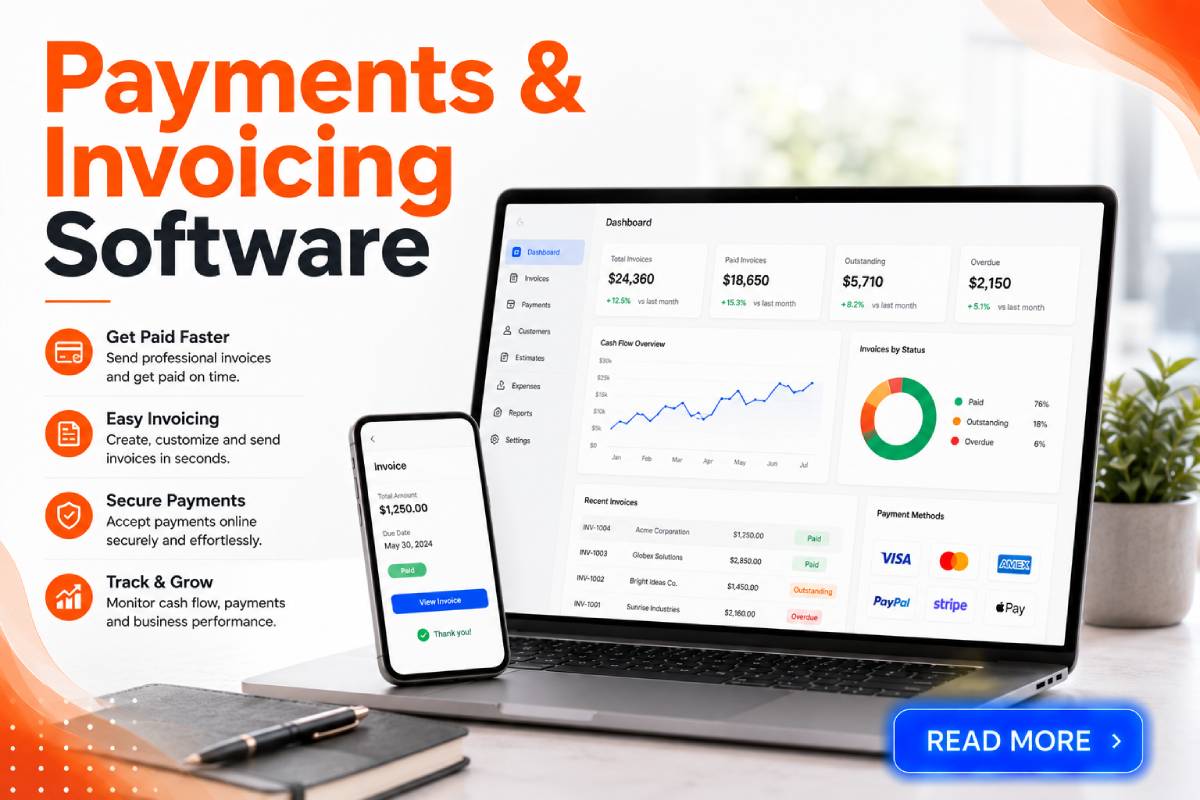
Payments and invoicing software is becoming a core component of digital financial operations as businesses seek faster billing, automated collections and greater visibility into cash flow. The market reflects a broader shift toward connected financial technology, helping companies reduce administrative workloads, improve payment efficiency and manage receivables in increasingly digital and distributed commercial environments.
Modern payments and invoicing platforms combine invoice creation, payment processing, recurring billing, accounts receivable management, reminders, reconciliation and financial reporting. Automation allows businesses to generate invoices, follow up on outstanding balances and process payments with less manual intervention.
Many solutions also integrate with accounting, enterprise resource planning, customer relationship management and banking systems. This enables financial information to move more efficiently between operational and accounting workflows.
The category is particularly important for small businesses and growing enterprises that need reliable cash-flow management without building extensive internal finance operations. Larger organizations are also adopting automation to standardize billing processes across departments, markets and customer segments.
The development aligns with a broader transformation in corporate finance as businesses move away from paper-based invoices, manual payment tracking and fragmented accounting processes. Digital commerce has accelerated demand for financial systems capable of supporting multiple payment methods, currencies, customer types and billing arrangements.
Cash-flow management has become a strategic priority as businesses face higher operating costs, complex supply chains and changing customer payment behavior. Delays in invoicing or collections can place additional pressure on working capital, particularly for smaller organizations.
Payments and invoicing platforms increasingly address this challenge by connecting billing, payment collection and financial reporting within a unified workflow. Cloud deployment also allows finance teams to access information remotely and coordinate activities across geographically distributed operations.
For executives, the significance extends beyond administrative efficiency. Faster invoicing and improved collections can directly affect working capital, liquidity and financial forecasting, making payment technology an increasingly important element of broader business strategy.
Financial-technology specialists increasingly emphasize automation as a key mechanism for improving accounts receivable performance. Automated invoice generation, payment reminders and reconciliation can reduce repetitive work while giving finance teams greater visibility into outstanding balances.
The evolution of payment technology is also changing customer expectations. Businesses increasingly expect digital payment options, faster transaction processing and convenient billing experiences. Companies that maintain slow or fragmented payment processes risk creating unnecessary friction for customers.
At the same time, financial automation requires strong controls. Finance leaders must consider transaction security, fraud prevention, data protection, regulatory requirements and system reliability when selecting technology.
The broader industry direction suggests that successful platforms will increasingly combine invoicing, payments, reconciliation and analytics rather than treating each process as a separate financial function. For executives, the ability to connect these activities can provide a clearer view of cash flow and financial performance.
For businesses, payments and invoicing software can reduce administrative costs, accelerate collections and improve financial visibility. Automated reminders and recurring billing can also help organizations maintain more predictable revenue cycles.
For investors and executives, the technology can contribute to stronger working-capital management. Companies that reduce invoice delays and improve payment collection may gain greater control over liquidity and forecasting.
Consumers and business customers are also affected as digital payment expectations continue to rise. Organizations increasingly need to offer convenient, secure and transparent payment experiences.
From a policy perspective, digital financial operations raise important considerations around payment security, fraud prevention, taxation, privacy and financial compliance. Businesses adopting these systems must ensure that automation does not weaken internal controls.
Payments and invoicing technology is likely to move toward deeper automation, artificial intelligence, real-time payment connectivity and predictive cash-flow management. Future platforms may increasingly identify collection risks, automate reconciliation and provide finance leaders with forward-looking insights.
Decision-makers should watch how payment providers address cybersecurity, regulatory compliance and interoperability. The strongest solutions will be those that combine faster transactions with reliable controls, helping businesses improve cash flow without compromising financial security.
Source: Crozdesk
Date: August 11, 2026


