
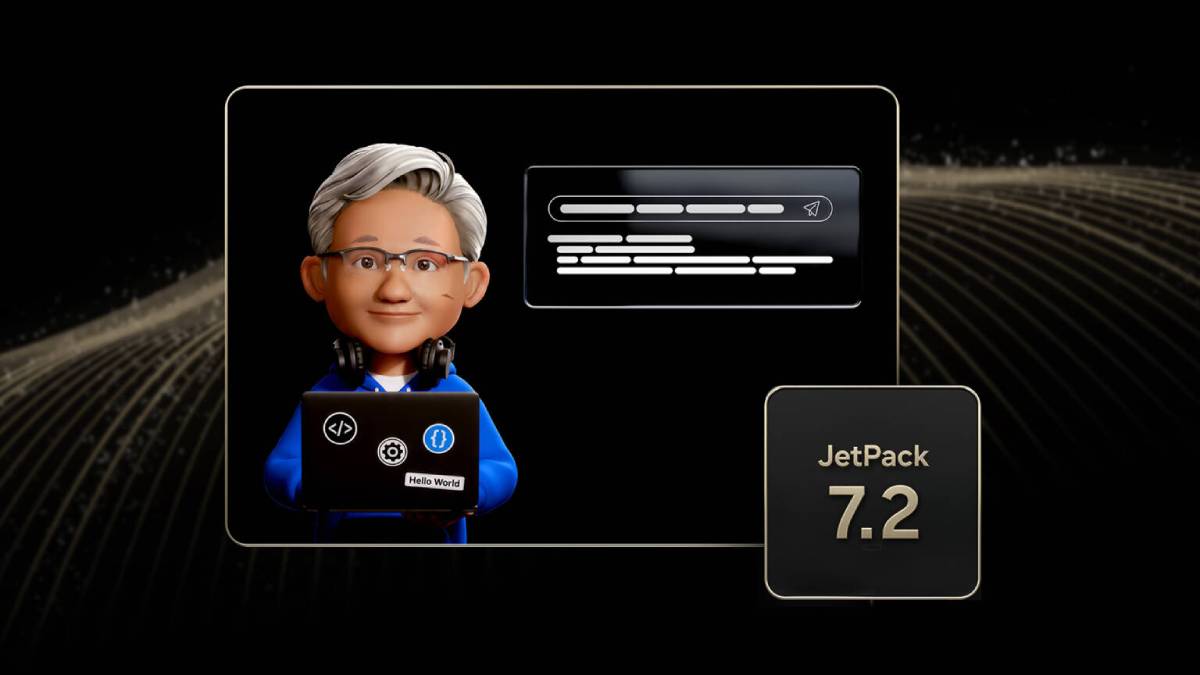
Nvidia Advances Edge AI JetPack 7.2

Nvidia’s JetPack 7.2 introduces enhancements aimed at optimizing memory efficiency and enabling the deployment of advanced AI agents on edge devices such as robotics systems.

June 2, 2026
|
Image Source: Nvidia Developer Blog

A significant development in edge artificial intelligence infrastructure emerged as Nvidia introduced JetPack 7.2, a software stack designed to enable memory-efficient, agentic-ready AI deployment at the edge. The update signals a strategic shift toward running increasingly autonomous AI systems on low-power devices, expanding the reach of generative and agentic AI beyond centralized cloud environments into real-world applications across industries.

Nvidia’s JetPack 7.2 introduces enhancements aimed at optimizing memory efficiency and enabling the deployment of advanced AI agents on edge devices such as robotics systems, embedded platforms, and industrial computing environments.

The update is designed to support next-generation AI workloads that require both autonomy and real-time responsiveness. By improving memory management and computational efficiency, JetPack 7.2 allows developers to deploy larger and more capable AI models on constrained hardware without relying heavily on cloud connectivity.

The platform is positioned for use across industries including manufacturing, robotics, autonomous systems, healthcare devices, and smart infrastructure. It integrates with Nvidia’s broader AI ecosystem, including CUDA acceleration libraries and inference optimization tools, to streamline development and deployment workflows.

The release reflects Nvidia’s continued expansion beyond data center AI into distributed intelligence systems that operate closer to data sources and end users. The development aligns with a broader trend across global markets where artificial intelligence is increasingly shifting from centralized cloud computing toward edge-based and hybrid deployment models.

As AI models grow in complexity, enterprises face increasing challenges related to latency, bandwidth constraints, data privacy, and operational costs. Edge AI addresses these challenges by enabling computation directly on devices or local networks, reducing reliance on cloud infrastructure while improving real-time responsiveness.

JetPack 7.2 arrives amid accelerating demand for agentic AI systems software capable of performing multi-step reasoning, autonomous decision-making, and task execution with minimal human intervention. These systems require optimized inference environments capable of sustaining memory-intensive workloads under constrained hardware conditions.

Nvidia has positioned itself at the center of this transition by developing integrated hardware and software ecosystems that support AI training, inference, and deployment across cloud, data center, and edge environments. The company’s JetPack platform is widely used in robotics and embedded computing applications, making it a critical enabler of industrial AI adoption.

Geopolitically, edge AI also plays a growing role in national technology strategies, particularly in sectors involving defense, infrastructure, and critical systems where data sovereignty and operational independence are priorities.

Historically, major computing transitions from mainframes to PCs to cloud computing have been defined by shifts in where computation occurs. Edge AI represents the next structural evolution in this continuum.

Industry analysts view JetPack 7.2 as an important step toward operationalizing agentic AI outside of data center environments. Experts argue that while large-scale AI models dominate cloud-based applications, the next wave of innovation will depend on their ability to function efficiently in distributed and resource-constrained environments.

Technology strategists highlight that memory optimization is a critical bottleneck in edge AI deployment. Advanced AI agents require significant contextual memory to perform multi-step tasks, making efficient resource management essential for real-world deployment scenarios.

Nvidia engineers have emphasized the importance of creating unified platforms that allow developers to scale AI applications seamlessly from cloud training environments to edge inference systems. The JetPack ecosystem is designed to reduce fragmentation across development pipelines and accelerate production deployment.

Market observers note that demand for edge AI solutions is rising across industrial automation, autonomous robotics, smart cities, and healthcare devices. These sectors require real-time decision-making capabilities that cannot depend on cloud latency or connectivity constraints.

Analysts also suggest that Nvidia’s continued investment in edge AI reflects a broader industry expectation that distributed intelligence will become a foundational layer of future computing architectures.

For businesses, JetPack 7.2 enables new opportunities to deploy AI-driven automation in environments where cloud connectivity is limited, expensive, or impractical. Industries such as manufacturing, logistics, energy, and healthcare may benefit from improved operational efficiency and real-time intelligence at the edge.

Investors are likely to view Nvidia’s expansion into edge AI as a continuation of its dominance in the AI infrastructure stack, extending its influence beyond data centers into embedded and industrial computing markets.

For governments and policymakers, edge AI raises important considerations around data governance, security, and technological sovereignty. The ability to process sensitive data locally may reduce exposure to external networks while increasing reliance on embedded AI systems in critical infrastructure.

The shift also suggests broader implications for workforce automation and industrial modernization strategies across global economies. The next phase of edge AI development will focus on scalability, interoperability, and real-world deployment across complex environments. Decision-makers should monitor adoption trends in robotics, autonomous systems, and industrial AI applications powered by JetPack and similar platforms.

As AI systems become increasingly agentic and distributed, edge computing is expected to play a central role in enabling real-time intelligence across physical and digital environments. Nvidia’s JetPack 7.2 positions the company at the forefront of this transition, where the future of AI will be defined not only by model capability, but by where and how intelligence is deployed.

Source: Nvidia Developer Blog
Date: June 2, 2026

  • Featured tools
Neuron AI
Free

Neuron AI is an AI-driven content optimization platform that helps creators produce SEO-friendly content by combining semantic SEO, competitor analysis, and AI-assisted writing workflows.

#
SEO
Learn more
Copy Ai
Free

Copy AI is one of the most popular AI writing tools designed to help professionals create high-quality content quickly. Whether you are a product manager drafting feature descriptions or a marketer creating ad copy, Copy AI can save hours of work while maintaining creativity and tone.

#
Copywriting
Learn more

Learn more about future of AI

Join 80,000+ Ai enthusiast getting weekly updates on exciting AI tools.
Thank you! Your submission has been received!
Oops! Something went wrong while submitting the form.

Nvidia Advances Edge AI JetPack 7.2

June 2, 2026

Nvidia’s JetPack 7.2 introduces enhancements aimed at optimizing memory efficiency and enabling the deployment of advanced AI agents on edge devices such as robotics systems.

Image Source: Nvidia Developer Blog

A significant development in edge artificial intelligence infrastructure emerged as Nvidia introduced JetPack 7.2, a software stack designed to enable memory-efficient, agentic-ready AI deployment at the edge. The update signals a strategic shift toward running increasingly autonomous AI systems on low-power devices, expanding the reach of generative and agentic AI beyond centralized cloud environments into real-world applications across industries.

Nvidia’s JetPack 7.2 introduces enhancements aimed at optimizing memory efficiency and enabling the deployment of advanced AI agents on edge devices such as robotics systems, embedded platforms, and industrial computing environments.

The update is designed to support next-generation AI workloads that require both autonomy and real-time responsiveness. By improving memory management and computational efficiency, JetPack 7.2 allows developers to deploy larger and more capable AI models on constrained hardware without relying heavily on cloud connectivity.

The platform is positioned for use across industries including manufacturing, robotics, autonomous systems, healthcare devices, and smart infrastructure. It integrates with Nvidia’s broader AI ecosystem, including CUDA acceleration libraries and inference optimization tools, to streamline development and deployment workflows.

The release reflects Nvidia’s continued expansion beyond data center AI into distributed intelligence systems that operate closer to data sources and end users. The development aligns with a broader trend across global markets where artificial intelligence is increasingly shifting from centralized cloud computing toward edge-based and hybrid deployment models.

As AI models grow in complexity, enterprises face increasing challenges related to latency, bandwidth constraints, data privacy, and operational costs. Edge AI addresses these challenges by enabling computation directly on devices or local networks, reducing reliance on cloud infrastructure while improving real-time responsiveness.

JetPack 7.2 arrives amid accelerating demand for agentic AI systems software capable of performing multi-step reasoning, autonomous decision-making, and task execution with minimal human intervention. These systems require optimized inference environments capable of sustaining memory-intensive workloads under constrained hardware conditions.

Nvidia has positioned itself at the center of this transition by developing integrated hardware and software ecosystems that support AI training, inference, and deployment across cloud, data center, and edge environments. The company’s JetPack platform is widely used in robotics and embedded computing applications, making it a critical enabler of industrial AI adoption.

Geopolitically, edge AI also plays a growing role in national technology strategies, particularly in sectors involving defense, infrastructure, and critical systems where data sovereignty and operational independence are priorities.

Historically, major computing transitions from mainframes to PCs to cloud computing have been defined by shifts in where computation occurs. Edge AI represents the next structural evolution in this continuum.

Industry analysts view JetPack 7.2 as an important step toward operationalizing agentic AI outside of data center environments. Experts argue that while large-scale AI models dominate cloud-based applications, the next wave of innovation will depend on their ability to function efficiently in distributed and resource-constrained environments.

Technology strategists highlight that memory optimization is a critical bottleneck in edge AI deployment. Advanced AI agents require significant contextual memory to perform multi-step tasks, making efficient resource management essential for real-world deployment scenarios.

Nvidia engineers have emphasized the importance of creating unified platforms that allow developers to scale AI applications seamlessly from cloud training environments to edge inference systems. The JetPack ecosystem is designed to reduce fragmentation across development pipelines and accelerate production deployment.

Market observers note that demand for edge AI solutions is rising across industrial automation, autonomous robotics, smart cities, and healthcare devices. These sectors require real-time decision-making capabilities that cannot depend on cloud latency or connectivity constraints.

Analysts also suggest that Nvidia’s continued investment in edge AI reflects a broader industry expectation that distributed intelligence will become a foundational layer of future computing architectures.

For businesses, JetPack 7.2 enables new opportunities to deploy AI-driven automation in environments where cloud connectivity is limited, expensive, or impractical. Industries such as manufacturing, logistics, energy, and healthcare may benefit from improved operational efficiency and real-time intelligence at the edge.

Investors are likely to view Nvidia’s expansion into edge AI as a continuation of its dominance in the AI infrastructure stack, extending its influence beyond data centers into embedded and industrial computing markets.

For governments and policymakers, edge AI raises important considerations around data governance, security, and technological sovereignty. The ability to process sensitive data locally may reduce exposure to external networks while increasing reliance on embedded AI systems in critical infrastructure.

The shift also suggests broader implications for workforce automation and industrial modernization strategies across global economies. The next phase of edge AI development will focus on scalability, interoperability, and real-world deployment across complex environments. Decision-makers should monitor adoption trends in robotics, autonomous systems, and industrial AI applications powered by JetPack and similar platforms.

As AI systems become increasingly agentic and distributed, edge computing is expected to play a central role in enabling real-time intelligence across physical and digital environments. Nvidia’s JetPack 7.2 positions the company at the forefront of this transition, where the future of AI will be defined not only by model capability, but by where and how intelligence is deployed.

Source: Nvidia Developer Blog
Date: June 2, 2026

Promote Your Tool

Copy Embed Code

Similar Blogs

June 2, 2026
|

Early Leak Highlights Wearable Secrecy Issues

The upcoming Google Pixel Watch 5 may have been unintentionally revealed through public comments made by Randy Pitchford, sparking speculation about the device’s design and potential features ahead of its official announcement.
Read more
June 2, 2026
|

Florida Lawsuit Escalates OpenAI Safety Pressure

Florida’s legal action targets OpenAI over allegations that ChatGPT may produce misleading, harmful, or unsafe outputs, raising concerns about consumer protection and the responsible deployment of artificial intelligence systems.
Read more
June 2, 2026
|

Microsoft Build 2026 AI Computing Strategy

Microsoft is expected to introduce new AI models alongside a series of improvements to Windows, aimed at strengthening its position in the rapidly evolving AI-driven computing market.
Read more
June 2, 2026
|

Apple Smart Glasses Delayed AR Race

Apple’s smart glasses project, widely viewed as a cornerstone of its future augmented reality strategy, has reportedly been pushed back due to ongoing development challenges.
Read more
June 2, 2026
|

Apple iMac Deals Expand Market Reach

Apple’s latest iMac-focused promotions include discounted pricing, enhanced trade-in values, and bundled incentives aimed at making its desktop ecosystem more accessible to a wider consumer base.
Read more
June 2, 2026
|

Microsoft AI Platform Push Ahead Build

Microsoft is expected to introduce new AI models alongside a series of improvements to Windows, aimed at strengthening its position in the rapidly evolving AI-driven computing market.
Read more