



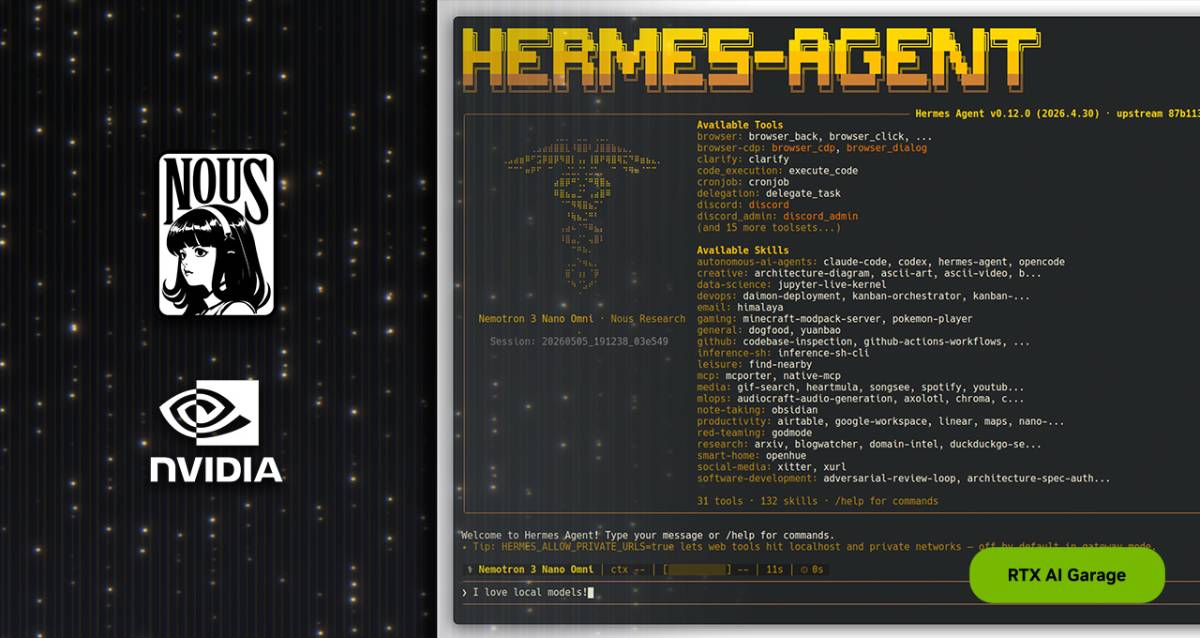
A major development in autonomous artificial intelligence emerged as NVIDIA highlighted Hermes, a new generation of self-improving AI agents powered by RTX AI PCs and DGX Spark systems. The initiative signals a broader shift toward continuously learning AI systems capable of adapting, optimizing, and operating with increasing independence across enterprise and consumer environments.
NVIDIA introduced Hermes as part of its expanding RTX AI Garage ecosystem, showcasing how AI agents can improve performance over time through iterative learning and memory-driven task execution. The system is designed to run on NVIDIA RTX AI PCs and DGX Spark infrastructure, combining local computing power with scalable AI acceleration capabilities.
The platform focuses on autonomous agent behavior, enabling AI systems to complete complex workflows, refine outputs, and optimize decision-making with reduced human intervention. NVIDIA positioned the development as a step toward practical agentic AI capable of supporting enterprise productivity, software development, research, and digital operations.
The launch also reinforces NVIDIA’s strategy of extending AI beyond cloud-based large language models into edge computing and personal AI systems. Analysts view the move as strategically important because it broadens the company’s role from AI chip supplier to ecosystem orchestrator for next-generation intelligent computing environments.
The announcement arrives amid intensifying global competition in autonomous AI systems involving major players including Microsoft, Google, OpenAI, and emerging AI infrastructure startups.
The Hermes initiative reflects a broader transition underway in artificial intelligence, where the industry is moving beyond static chatbots toward “agentic AI” systems capable of reasoning, planning, adapting, and independently executing tasks. This next phase of AI development is increasingly viewed as one of the most commercially significant transformations since the emergence of cloud computing.
Over the past two years, global AI investment has concentrated heavily on foundation models and generative AI interfaces. However, technology companies are now racing to commercialize autonomous agents that can interact with software environments, manage workflows, and continuously learn from operational feedback.
NVIDIA has emerged as one of the central beneficiaries of the AI boom due to soaring demand for GPUs powering model training and inference. Yet the company is also seeking to expand influence beyond hardware by building integrated AI ecosystems spanning software frameworks, developer tools, edge AI devices, and enterprise platforms.
The development also aligns with growing demand for localized AI processing. Businesses and governments increasingly want AI systems capable of operating securely on-premises or on edge devices rather than relying exclusively on centralized cloud infrastructure. This trend is driven by concerns surrounding data sovereignty, cybersecurity, latency, and regulatory compliance.
At the same time, autonomous AI agents raise important governance questions related to transparency, accountability, reliability, and workforce impact as systems gain greater operational independence.
NVIDIA executives framed Hermes as a major advancement in practical AI autonomy, emphasizing the importance of combining accelerated computing with adaptive learning architectures. The company suggested that self-improving agents could significantly increase productivity across industries ranging from software engineering to digital content management and enterprise analytics.
Industry analysts believe the initiative represents a critical evolution in the AI arms race. Experts argue that the future competitive battleground will not center solely on the largest language models, but on ecosystems capable of enabling persistent, autonomous AI behavior across real-world operational environments.
Technology strategists note that self-improving AI agents could fundamentally alter enterprise software markets by reducing the need for repetitive manual processes and enabling more dynamic decision automation. Analysts also see strong commercial potential for AI agents operating directly on personal computers and edge devices, especially in regulated industries where cloud dependence creates compliance concerns.
Cybersecurity experts, however, warn that increasingly autonomous AI systems may introduce new operational and security risks. Self-improving agents could create challenges around oversight, unintended behavior, and vulnerability management if governance frameworks fail to evolve alongside technological capabilities.
Meanwhile, investors continue viewing NVIDIA as one of the dominant beneficiaries of the global AI infrastructure boom, particularly as demand expands from data centers into distributed AI computing ecosystems.
For enterprise leaders, Hermes signals the accelerating arrival of AI systems capable of operating as digital co-workers rather than passive software assistants. Businesses may increasingly adopt autonomous agents to handle research, workflow orchestration, customer engagement, cybersecurity monitoring, and operational optimization.
The shift could redefine enterprise computing strategies by increasing demand for high-performance local AI infrastructure, edge computing devices, and advanced AI accelerators. Organizations may need to reassess cybersecurity models, workforce training, and governance policies as AI systems gain greater autonomy.
Investors are likely to interpret NVIDIA’s strategy as an effort to capture long-term value across the full AI stack from chips and infrastructure to software ecosystems and agentic computing frameworks.
From a regulatory perspective, policymakers may face growing pressure to establish standards governing autonomous AI decision-making, accountability, and system transparency. As self-improving AI becomes more commercially viable, governments and enterprises alike will need stronger oversight frameworks to manage operational and ethical risks.
Hermes represents another milestone in the rapid evolution of agentic AI systems capable of learning and operating with increasing independence. Decision-makers across industries will now watch whether autonomous agents can deliver measurable productivity gains without introducing unacceptable governance or security risks.
The next phase of AI competition is expected to focus on autonomy, adaptability, and real-world execution capabilities. For NVIDIA and the broader technology industry, the challenge will be transforming experimental agentic AI into scalable, trusted infrastructure for the global digital economy.
Source: NVIDIA Blog
Date: May 14, 2026


