
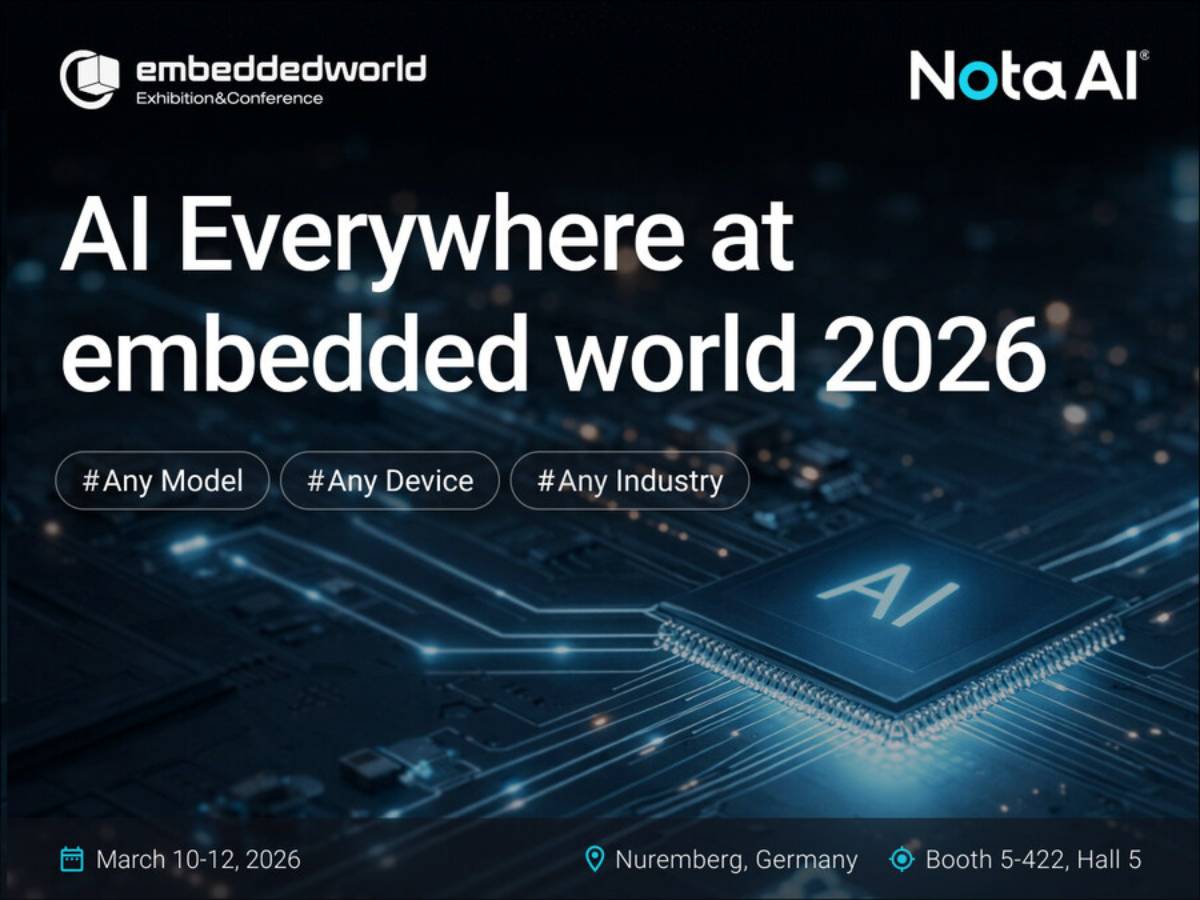
Nota AI Demonstrates On Device AI at Embedded World

Nota AI plans to showcase a fully integrated AI solution spanning device-level optimization, real-time analytics, and industrial deployment. The demonstration at Embedded World 2026.

March 30, 2026
|
Nota AI to Showcase End-to-End On-Device AI-from Edge Optimization to Real-World Industrial Deployment-at Embedded World 2026

A major development unfolded today as Nota AI announced it will demonstrate its end-to-end on-device AI capabilities at Embedded World 2026. From edge optimization to real-world industrial deployment, the initiative signals a strategic push to accelerate AI adoption in manufacturing, logistics, and industrial IoT, with potential global implications for enterprise efficiency, operational scalability, and technology-driven productivity.

Nota AI plans to showcase a fully integrated AI solution spanning device-level optimization, real-time analytics, and industrial deployment. The demonstration at Embedded World 2026, scheduled for March, will highlight AI model compression, energy-efficient inference, and on-device edge intelligence tailored for industrial environments.

Executives emphasized collaborations with hardware partners, including semiconductor and IoT vendors, to deliver scalable and cost-efficient solutions. The rollout targets global manufacturing and logistics firms seeking low-latency AI capabilities for predictive maintenance, process automation, and quality assurance. Analysts suggest that this positions Nota AI competitively against other industrial AI providers, signaling a potential acceleration in enterprise adoption of edge AI solutions.

The development aligns with a broader trend where on-device AI is becoming central to industrial digital transformation. By processing data locally, organizations reduce latency, lower bandwidth costs, and improve operational resilience a crucial advantage in sectors like manufacturing, energy, and logistics.

Nota AI’s end-to-end platform reflects growing demand for AI solutions that bridge the gap between research models and real-world deployment, enabling firms to implement AI without heavy reliance on cloud infrastructure.

This move comes amid heightened global competition in edge AI and industrial IoT, with companies such as NVIDIA, Intel, and Siemens investing heavily in hardware-accelerated AI for factories and supply chains.

For executives, understanding the operational, economic, and strategic benefits of on-device AI is critical, as edge intelligence increasingly shapes industrial efficiency, risk mitigation, and enterprise competitiveness in a rapidly evolving technology landscape.

Industry experts note that Nota AI’s platform demonstrates the practical application of AI at the edge, combining model optimization, energy efficiency, and real-time analytics. Analysts highlight that such solutions can accelerate predictive maintenance, reduce downtime, and optimize production workflows.

Company representatives stated that partnerships with semiconductor and IoT hardware providers are central to scaling deployments globally. Officials also emphasized the platform’s adaptability across multiple industrial domains, from automotive manufacturing to smart logistics.

Competitors are closely watching as edge AI adoption intensifies, potentially reshaping the industrial AI market. Investors and industry analysts are assessing the strategic implications of on-device AI solutions, including faster ROI, reduced operational risk, and enhanced scalability.

Regulatory and cybersecurity considerations remain critical, particularly regarding data privacy, industrial safety, and cross-border deployments.

For businesses, Nota AI’s demonstration underscores the strategic value of edge AI in improving productivity, operational efficiency, and predictive decision-making. Companies adopting on-device AI can reduce dependence on cloud infrastructure, lower latency, and enhance real-time responsiveness in critical industrial processes.

Investors may view the initiative as a signal of growth in industrial AI markets, influencing strategic partnerships and funding decisions.

Policy implications include potential regulation of AI deployment in critical industries, cybersecurity standards, and industrial data governance.

Executives and operations leaders should evaluate on-device AI adoption as part of broader digital transformation strategies to maintain competitive advantage and meet evolving performance, safety, and compliance expectations in global industrial ecosystems.

Looking ahead, Nota AI will refine its edge AI deployment capabilities and expand collaborations with industrial and semiconductor partners. Decision-makers should monitor pilot projects, deployment outcomes, and regulatory developments impacting industrial AI adoption. As edge AI gains traction, the platform could set benchmarks for operational efficiency, technology scalability, and real-time analytics, positioning companies to capitalize on the next wave of AI-driven industrial innovation.

Source: PR Newswire
Date: March 9, 2026

  • Featured tools
Writesonic AI
Free

Writesonic AI is a versatile AI writing platform designed for marketers, entrepreneurs, and content creators. It helps users create blog posts, ad copies, product descriptions, social media posts, and more with ease. With advanced AI models and user-friendly tools, Writesonic streamlines content production and saves time for busy professionals.

#
Copywriting
Learn more
Wonder AI
Free

Wonder AI is a versatile AI-powered creative platform that generates text, images, and audio with minimal input, designed for fast storytelling, visual creation, and audio content generation

#
Art Generator
Learn more

Learn more about future of AI

Join 80,000+ Ai enthusiast getting weekly updates on exciting AI tools.
Thank you! Your submission has been received!
Oops! Something went wrong while submitting the form.

Nota AI Demonstrates On Device AI at Embedded World

March 30, 2026

Nota AI plans to showcase a fully integrated AI solution spanning device-level optimization, real-time analytics, and industrial deployment. The demonstration at Embedded World 2026.

Nota AI to Showcase End-to-End On-Device AI-from Edge Optimization to Real-World Industrial Deployment-at Embedded World 2026

A major development unfolded today as Nota AI announced it will demonstrate its end-to-end on-device AI capabilities at Embedded World 2026. From edge optimization to real-world industrial deployment, the initiative signals a strategic push to accelerate AI adoption in manufacturing, logistics, and industrial IoT, with potential global implications for enterprise efficiency, operational scalability, and technology-driven productivity.

Nota AI plans to showcase a fully integrated AI solution spanning device-level optimization, real-time analytics, and industrial deployment. The demonstration at Embedded World 2026, scheduled for March, will highlight AI model compression, energy-efficient inference, and on-device edge intelligence tailored for industrial environments.

Executives emphasized collaborations with hardware partners, including semiconductor and IoT vendors, to deliver scalable and cost-efficient solutions. The rollout targets global manufacturing and logistics firms seeking low-latency AI capabilities for predictive maintenance, process automation, and quality assurance. Analysts suggest that this positions Nota AI competitively against other industrial AI providers, signaling a potential acceleration in enterprise adoption of edge AI solutions.

The development aligns with a broader trend where on-device AI is becoming central to industrial digital transformation. By processing data locally, organizations reduce latency, lower bandwidth costs, and improve operational resilience a crucial advantage in sectors like manufacturing, energy, and logistics.

Nota AI’s end-to-end platform reflects growing demand for AI solutions that bridge the gap between research models and real-world deployment, enabling firms to implement AI without heavy reliance on cloud infrastructure.

This move comes amid heightened global competition in edge AI and industrial IoT, with companies such as NVIDIA, Intel, and Siemens investing heavily in hardware-accelerated AI for factories and supply chains.

For executives, understanding the operational, economic, and strategic benefits of on-device AI is critical, as edge intelligence increasingly shapes industrial efficiency, risk mitigation, and enterprise competitiveness in a rapidly evolving technology landscape.

Industry experts note that Nota AI’s platform demonstrates the practical application of AI at the edge, combining model optimization, energy efficiency, and real-time analytics. Analysts highlight that such solutions can accelerate predictive maintenance, reduce downtime, and optimize production workflows.

Company representatives stated that partnerships with semiconductor and IoT hardware providers are central to scaling deployments globally. Officials also emphasized the platform’s adaptability across multiple industrial domains, from automotive manufacturing to smart logistics.

Competitors are closely watching as edge AI adoption intensifies, potentially reshaping the industrial AI market. Investors and industry analysts are assessing the strategic implications of on-device AI solutions, including faster ROI, reduced operational risk, and enhanced scalability.

Regulatory and cybersecurity considerations remain critical, particularly regarding data privacy, industrial safety, and cross-border deployments.

For businesses, Nota AI’s demonstration underscores the strategic value of edge AI in improving productivity, operational efficiency, and predictive decision-making. Companies adopting on-device AI can reduce dependence on cloud infrastructure, lower latency, and enhance real-time responsiveness in critical industrial processes.

Investors may view the initiative as a signal of growth in industrial AI markets, influencing strategic partnerships and funding decisions.

Policy implications include potential regulation of AI deployment in critical industries, cybersecurity standards, and industrial data governance.

Executives and operations leaders should evaluate on-device AI adoption as part of broader digital transformation strategies to maintain competitive advantage and meet evolving performance, safety, and compliance expectations in global industrial ecosystems.

Looking ahead, Nota AI will refine its edge AI deployment capabilities and expand collaborations with industrial and semiconductor partners. Decision-makers should monitor pilot projects, deployment outcomes, and regulatory developments impacting industrial AI adoption. As edge AI gains traction, the platform could set benchmarks for operational efficiency, technology scalability, and real-time analytics, positioning companies to capitalize on the next wave of AI-driven industrial innovation.

Source: PR Newswire
Date: March 9, 2026

Promote Your Tool

Copy Embed Code

Similar Blogs

July 22, 2026
|

VSCO Downloader Expands Media Access Solutions

VSCO Downloader is a tool designed around accessing and managing publicly available visual content from the VSCO platform.
Read more
July 22, 2026
|

BFLIX Expands Digital Viewing Platforms

BFLIX is associated with an online entertainment platform focused on providing users with access to digital video content.
Read more
July 22, 2026
|

Hoodmaps Improves Urban Navigation Tools

Hoodmaps is a collaborative mapping platform that allows users to add local perspectives and cultural observations to city maps.
Read more
July 22, 2026
|

Linkello Supports Digital Team Connectivity

Linkello is an online communication platform designed to enable secure voice, video, and messaging interactions through internet-based technology.
Read more
July 22, 2026
|

MovieHub Evolves Modern Streaming Experiences

MovieHub is a digital entertainment platform associated with online movie discovery and viewing experiences.
Read more
July 22, 2026
|

EasyChair Powers Global Academic Collaboration

EasyChair is an online conference management system designed to streamline academic event organization, including paper submissions, peer reviews, scheduling, and communication between researchers and conference organizers.
Read more