



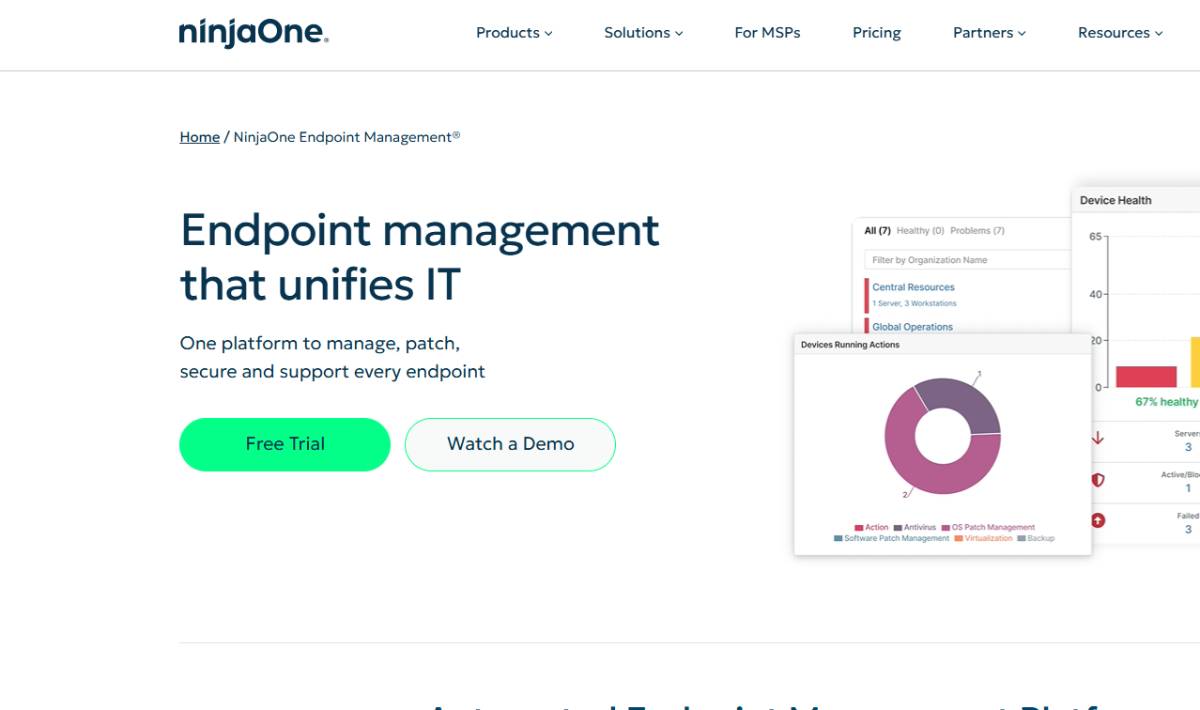
A significant development in enterprise IT management underscores the growing importance of unified endpoint management as organizations expand hybrid work environments and digital infrastructure. NinjaOne is strengthening its cloud-native platform to simplify endpoint monitoring, patch management, remote support, and device security, helping IT teams improve operational resilience and cybersecurity across distributed workforces.
NinjaOne continues advancing its endpoint management capabilities by providing organizations with centralized visibility across desktops, laptops, servers, and mobile devices. The cloud-based platform combines remote monitoring and management (RMM), automated patch deployment, endpoint backup, remote access, and IT asset management into a unified interface.
The solution enables IT administrators and managed service providers (MSPs) to automate routine maintenance, detect performance issues, enforce security policies, and reduce system downtime. As enterprises increasingly adopt hybrid work models, centralized endpoint administration supports business continuity while minimizing manual intervention and improving operational efficiency across geographically distributed environments.
Enterprise endpoint management has become a strategic priority as organizations manage increasingly complex technology environments spanning offices, remote employees, cloud services, and mobile devices. The rapid expansion of hybrid work has significantly increased the number of endpoints requiring continuous monitoring, security updates, and compliance management.
This evolution aligns with broader digital transformation initiatives where automation, cloud-native infrastructure, artificial intelligence, and cybersecurity are converging to modernize enterprise IT operations. Organizations are replacing fragmented legacy management tools with integrated platforms capable of delivering real-time visibility, automated remediation, and centralized governance.
Growing ransomware threats, expanding regulatory requirements, and increasing operational complexity have further accelerated investment in endpoint management platforms that combine operational efficiency with proactive cybersecurity capabilities, making unified IT management an executive-level priority across multiple industries.
Industry analysts increasingly view unified endpoint management as foundational to enterprise cyber resilience and operational efficiency. Technology consultants note that organizations managing thousands of endpoints benefit from automation that reduces manual workloads while improving patch compliance and infrastructure reliability.
Experts also emphasize that cloud-native management platforms enable IT teams to monitor distributed environments without maintaining complex on-premises infrastructure. Integration between endpoint management, backup, remote support, and security tools allows enterprises to streamline incident response and improve service delivery.
Although no specific executive statement accompanies this development, market observers believe continued investment in automation, artificial intelligence, predictive analytics, and cloud management reflects growing enterprise demand for scalable IT operations capable of supporting digital-first business models.
For enterprise executives, modern endpoint management platforms can reduce operational costs while strengthening cybersecurity, compliance, and employee productivity. Organizations benefit from faster issue resolution, improved infrastructure visibility, and automated software maintenance that minimizes business disruption.
Managed service providers gain scalable tools to support multiple client environments efficiently, while investors continue monitoring sustained demand for enterprise IT automation and cybersecurity solutions. Governments and regulators are also placing greater emphasis on endpoint security standards, cyber resilience, and data protection frameworks as digital infrastructure becomes increasingly critical to economic and public-sector operations.
The endpoint management market is expected to evolve alongside advances in artificial intelligence, predictive automation, zero-trust security, and autonomous IT operations. Decision-makers should monitor innovations that integrate endpoint management with cybersecurity, analytics, and cloud infrastructure. As organizations continue modernizing digital workplaces, unified management platforms are likely to become central components of enterprise technology strategies and long-term operational resilience.
Source: Crozdesk
Date: August 4, 2026


