
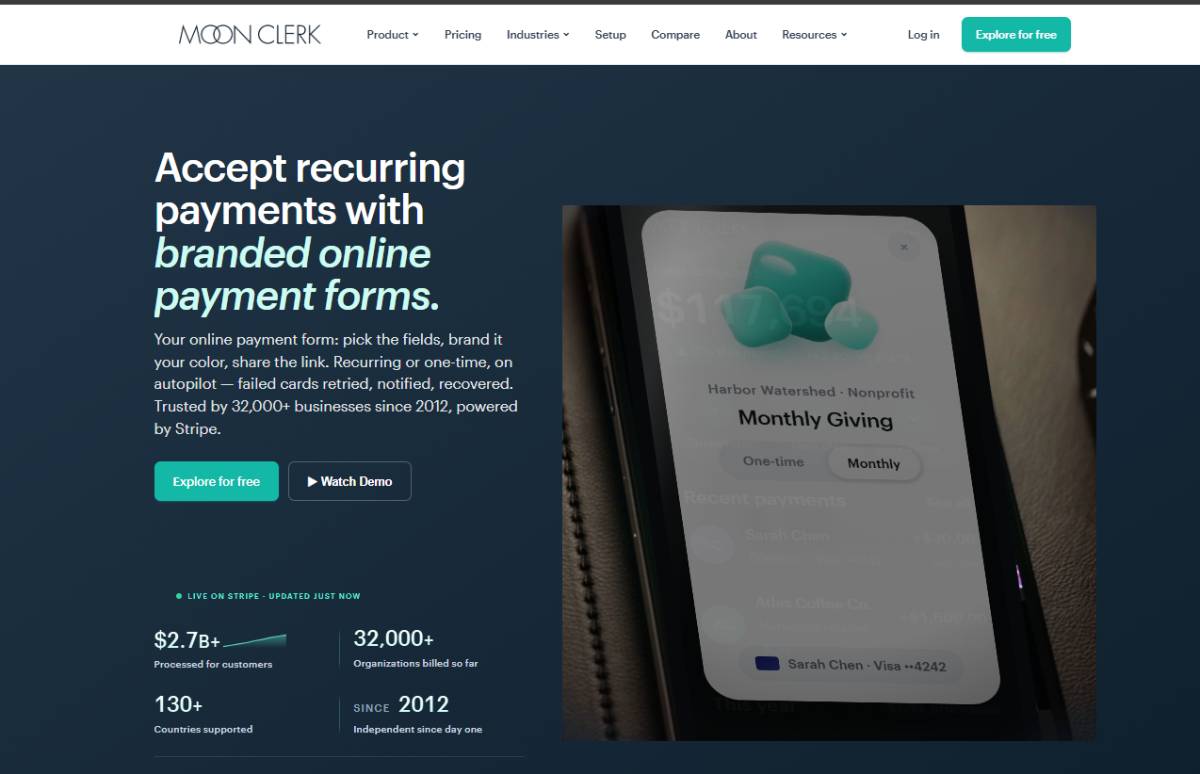
MoonClerk Advances Digital Payment Management

MoonClerk operates within the digital payments and online billing ecosystem, addressing business needs around collecting payments and managing recurring transactions.

August 12, 2026
|

MoonClerk highlights the continued evolution of digital payment infrastructure as businesses seek simpler ways to manage recurring payments and online transactions. Its focus on payment collection reflects a wider shift toward automated financial workflows, particularly among small businesses and organizations looking to reduce administrative friction while delivering more convenient payment experiences.

MoonClerk operates within the digital payments and online billing ecosystem, addressing business needs around collecting payments and managing recurring transactions. Its relevance comes as companies increasingly move financial processes away from manual invoicing and toward automated digital workflows.

For smaller organizations, payment administration can consume significant operational resources. Platforms that simplify payment collection can help businesses establish recurring billing processes, organize transactions, and reduce the complexity associated with traditional payment management.

The broader development also reflects changing expectations among customers, who increasingly prefer digital and flexible payment experiences. As businesses expand online operations, payment technology is becoming an increasingly important component of day-to-day financial management and customer engagement.

The development aligns with a broader global trend toward digitalizing business finance. Cloud-based payment platforms, online invoicing, recurring billing, and automated financial workflows have transformed how businesses interact with customers and manage revenue collection.

This shift has been particularly significant for small and growing businesses, which often need enterprise-like payment capabilities without the cost and complexity of maintaining sophisticated financial infrastructure. Digital payment tools can reduce manual administration while helping organizations establish more consistent collection processes.

The rise of subscription-based services and recurring commercial relationships has further increased demand for automated payment capabilities. At the same time, customers increasingly expect businesses to provide convenient, secure, and frictionless digital payment options.

MoonClerk sits within this broader transformation, where payment technology is increasingly becoming an operational foundation rather than simply a transactional function. Financial technology analysts generally view payment automation as an important component of modern business operations. For executives, the value of platforms such as MoonClerk ultimately depends on their ability to simplify payment workflows while maintaining reliability, security, and a strong customer experience.

Industry observers would likely assess payment platforms across several dimensions, including transaction management, recurring billing capabilities, integration options, usability, and scalability. Businesses must also consider how payment systems fit into accounting, customer management, and broader financial workflows.

The wider fintech market is also moving toward greater automation, with businesses increasingly seeking technology that connects payment collection with other operational systems. As this convergence continues, platforms that can minimize administrative work while providing dependable payment infrastructure could become increasingly valuable to organizations seeking leaner financial operations.

\For global executives, digital payment platforms can help simplify revenue collection, reduce administrative workloads, and support recurring business models. Small businesses may particularly benefit from tools that allow them to establish professional payment processes without building complex infrastructure internally.

For investors and market analysts, the continued growth of digital payment technology signals sustained demand for financial software that improves business efficiency. Consumers can benefit from faster and more convenient payment experiences.

However, payment technology also creates important governance considerations. Businesses must pay close attention to transaction security, fraud prevention, privacy, regulatory compliance, and financial-data protection. As digital payments become more deeply integrated into commercial operations, maintaining trust will remain central to long-term adoption.

The digital payments market is likely to continue moving toward greater automation, integration, and flexibility. Decision-makers should watch how payment platforms evolve alongside subscription commerce, embedded finance, and increasingly connected financial systems. For businesses, the strategic priority will be balancing convenience with security and compliance. Payment technology that can simplify collections while supporting scalable digital operations is positioned to remain an important part of the modern business ecosystem.

Source: Crozdesk
Date: August 12, 2026

  • Featured tools
Alli AI
Free

Alli AI is an all-in-one, AI-powered SEO automation platform that streamlines on-page optimization, site auditing, speed improvements, schema generation, internal linking, and ranking insights.

#
SEO
Learn more
Figstack AI
Free

Figstack AI is an intelligent assistant for developers that explains code, generates docstrings, converts code between languages, and analyzes time complexity helping you work smarter, not harder.

#
Coding
Learn more

Learn more about future of AI

Join 80,000+ Ai enthusiast getting weekly updates on exciting AI tools.
Thank you! Your submission has been received!
Oops! Something went wrong while submitting the form.

MoonClerk Advances Digital Payment Management

August 12, 2026

MoonClerk operates within the digital payments and online billing ecosystem, addressing business needs around collecting payments and managing recurring transactions.

MoonClerk highlights the continued evolution of digital payment infrastructure as businesses seek simpler ways to manage recurring payments and online transactions. Its focus on payment collection reflects a wider shift toward automated financial workflows, particularly among small businesses and organizations looking to reduce administrative friction while delivering more convenient payment experiences.

MoonClerk operates within the digital payments and online billing ecosystem, addressing business needs around collecting payments and managing recurring transactions. Its relevance comes as companies increasingly move financial processes away from manual invoicing and toward automated digital workflows.

For smaller organizations, payment administration can consume significant operational resources. Platforms that simplify payment collection can help businesses establish recurring billing processes, organize transactions, and reduce the complexity associated with traditional payment management.

The broader development also reflects changing expectations among customers, who increasingly prefer digital and flexible payment experiences. As businesses expand online operations, payment technology is becoming an increasingly important component of day-to-day financial management and customer engagement.

The development aligns with a broader global trend toward digitalizing business finance. Cloud-based payment platforms, online invoicing, recurring billing, and automated financial workflows have transformed how businesses interact with customers and manage revenue collection.

This shift has been particularly significant for small and growing businesses, which often need enterprise-like payment capabilities without the cost and complexity of maintaining sophisticated financial infrastructure. Digital payment tools can reduce manual administration while helping organizations establish more consistent collection processes.

The rise of subscription-based services and recurring commercial relationships has further increased demand for automated payment capabilities. At the same time, customers increasingly expect businesses to provide convenient, secure, and frictionless digital payment options.

MoonClerk sits within this broader transformation, where payment technology is increasingly becoming an operational foundation rather than simply a transactional function. Financial technology analysts generally view payment automation as an important component of modern business operations. For executives, the value of platforms such as MoonClerk ultimately depends on their ability to simplify payment workflows while maintaining reliability, security, and a strong customer experience.

Industry observers would likely assess payment platforms across several dimensions, including transaction management, recurring billing capabilities, integration options, usability, and scalability. Businesses must also consider how payment systems fit into accounting, customer management, and broader financial workflows.

The wider fintech market is also moving toward greater automation, with businesses increasingly seeking technology that connects payment collection with other operational systems. As this convergence continues, platforms that can minimize administrative work while providing dependable payment infrastructure could become increasingly valuable to organizations seeking leaner financial operations.

\For global executives, digital payment platforms can help simplify revenue collection, reduce administrative workloads, and support recurring business models. Small businesses may particularly benefit from tools that allow them to establish professional payment processes without building complex infrastructure internally.

For investors and market analysts, the continued growth of digital payment technology signals sustained demand for financial software that improves business efficiency. Consumers can benefit from faster and more convenient payment experiences.

However, payment technology also creates important governance considerations. Businesses must pay close attention to transaction security, fraud prevention, privacy, regulatory compliance, and financial-data protection. As digital payments become more deeply integrated into commercial operations, maintaining trust will remain central to long-term adoption.

The digital payments market is likely to continue moving toward greater automation, integration, and flexibility. Decision-makers should watch how payment platforms evolve alongside subscription commerce, embedded finance, and increasingly connected financial systems. For businesses, the strategic priority will be balancing convenience with security and compliance. Payment technology that can simplify collections while supporting scalable digital operations is positioned to remain an important part of the modern business ecosystem.

Source: Crozdesk
Date: August 12, 2026

Promote Your Tool

Copy Embed Code

Similar Blogs

August 12, 2026
|

Arting AI Advances Generative Visual Creation

Arting AI brings several creative capabilities into a unified environment, including text-to-image and image-to-image generation, image enhancement.
Read more
August 12, 2026
|

Loomly Strengthens Social Media Management Tools

Loomly brings core social media activities into a unified workspace, covering content calendars, post creation, scheduling, collaboration and publishing.
Read more
August 12, 2026
|

Omada Health Expands Digital Care Solutions

Omada reported first-quarter 2026 revenue of $78 million, representing 42% year-over-year growth. Total members reached 1.02 million, up 51%, while its net loss narrowed to $3 million from $9 million a year earlier. Adjusted EBITDA improved to $1 million from a $4 million loss.
Read more
August 12, 2026
|

SentinelOne Strengthens AI Enterprise Cybersecurity

SentinelOne's Singularity Platform brings together endpoint security, cloud security, identity protection, security operations and AI security within a unified architecture.
Read more
August 12, 2026
|

Easelly Strengthens Visual Team Communication

Easelly provides a drag-and-drop editor supported by templates, icons, illustrations, images, charts and other visual assets. Users can create infographics, presentations, reports, timelines, posters and educational materials through a browser-based workflow.
Read more
August 12, 2026
|

ManageEngine Strengthens Enterprise IT Management

ManageEngine Endpoint Central operates within the unified endpoint management and enterprise IT operations market, supporting organizations responsible for managing computers, mobile devices, applications, and other endpoints.
Read more