
Monica Launches Unified AI Assistant with GPT-5.2, Claude, Gemini

Monica’s new platform unifies three leading AI models into a single interface, allowing users to leverage generative text, contextual reasoning, and multi-modal insights.

March 4, 2026
|

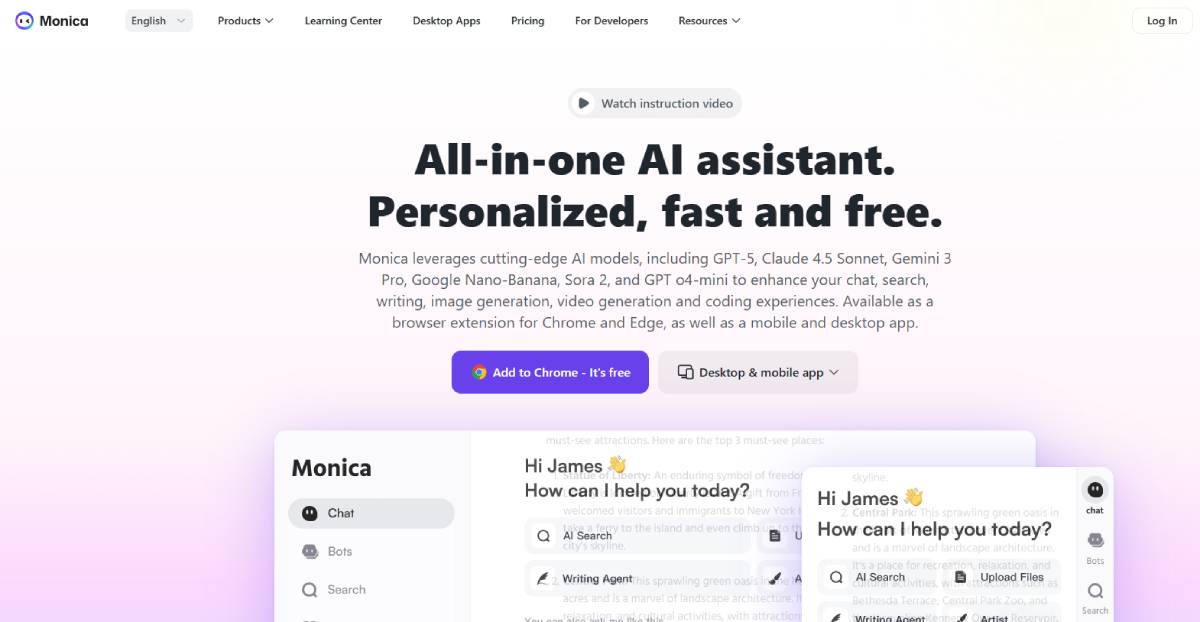
A major development unfolded today as Monica AI unveiled its all-in-one AI assistant, combining capabilities from GPT-5.2, Claude 4.5, and Gemini. The platform promises seamless multi-model integration for enterprises and individuals, signaling a strategic shift in AI adoption that could reshape workflows, productivity, and competitive positioning across global markets.

Monica’s new platform unifies three leading AI models into a single interface, allowing users to leverage generative text, contextual reasoning, and multi-modal insights. The launch includes enterprise-focused tools for collaboration, research, and automation, as well as consumer-oriented functionalities for personal productivity.

Key stakeholders include global technology partners, AI model providers, and early enterprise adopters in North America, Europe, and Asia-Pacific. The platform is positioned to accelerate adoption of AI in corporate workflows, providing businesses with integrated solutions rather than siloed tools. Analysts note that Monica’s approach could set a new benchmark for multi-model AI deployment and operational efficiency.

The development aligns with a broader trend across global markets where multi-model AI platforms are becoming critical for productivity, decision-making, and enterprise competitiveness. Companies are increasingly seeking unified solutions that combine natural language processing, contextual reasoning, and creative generative capabilities.

Historically, AI adoption has been fragmented, with organizations relying on multiple single-purpose tools. Monica’s all-in-one approach reflects growing demand for seamless integration, reducing friction in workflows and data management. The launch coincides with heightened investment in AI infrastructure, cloud computing, and enterprise automation, highlighting how multi-model assistants are rapidly moving from experimental use cases to strategic business applications.

For CXOs and investors, platforms like Monica illustrate how AI is shifting from support functions to strategic enablers of efficiency, innovation, and competitive differentiation. Monica executives emphasized that integrating GPT-5.2, Claude 4.5, and Gemini provides enterprises with unparalleled flexibility, allowing teams to select the best model for each task without leaving a single ecosystem. Analysts observe that this interoperability could accelerate AI adoption by reducing integration costs and operational complexity.

Industry experts also note potential challenges, including model governance, bias mitigation, and secure data handling. Regulatory scrutiny on AI applications, particularly around data privacy and ethical use, remains high in key markets such as the U.S., EU, and Asia-Pacific.

Market strategists suggest that Monica’s platform could drive consolidation among AI tools and spur competitive innovation, as rivals seek to match multi-model integration capabilities. Investor attention is likely to focus on subscription growth, enterprise adoption, and cross-platform interoperability metrics.

For businesses, Monica’s launch represents an opportunity to streamline AI deployment across departments, enhancing productivity, decision-making, and innovation. Investors may view the platform as a leading indicator of enterprise AI adoption trends, influencing capital flows toward integrated AI solutions.

Markets could experience increased pressure on standalone AI providers to consolidate or partner to remain competitive. Policy implications include the need for robust AI governance, compliance with data protection regulations, and accountability frameworks for multi-model deployments. Executives must balance rapid integration with risk management to ensure regulatory adherence, operational security, and ethical AI use while leveraging the strategic benefits of a unified AI ecosystem.

Decision-makers should monitor Monica’s enterprise adoption rates, user engagement, and cross-model performance metrics in the coming quarters. Competitive response from other AI platform providers and regulatory developments will shape market dynamics. While unified AI platforms offer significant efficiency gains, uncertainties remain around governance, model interoperability, and long-term scalability. Companies that strategically integrate multi-model AI assistants are positioned to gain early competitive advantage in productivity and innovation.

Source: Monica
Date: March 2026

  • Featured tools
WellSaid Ai
Free

WellSaid AI is an advanced text-to-speech platform that transforms written text into lifelike, human-quality voiceovers.

#
Text to Speech
Learn more
Ai Fiesta
Paid

AI Fiesta is an all-in-one productivity platform that gives users access to multiple leading AI models through a single interface. It includes features like prompt enhancement, image generation, audio transcription and side-by-side model comparison.

#
Copywriting
#
Art Generator
Learn more

Learn more about future of AI

Join 80,000+ Ai enthusiast getting weekly updates on exciting AI tools.
Thank you! Your submission has been received!
Oops! Something went wrong while submitting the form.

Monica Launches Unified AI Assistant with GPT-5.2, Claude, Gemini

March 4, 2026

Monica’s new platform unifies three leading AI models into a single interface, allowing users to leverage generative text, contextual reasoning, and multi-modal insights.

A major development unfolded today as Monica AI unveiled its all-in-one AI assistant, combining capabilities from GPT-5.2, Claude 4.5, and Gemini. The platform promises seamless multi-model integration for enterprises and individuals, signaling a strategic shift in AI adoption that could reshape workflows, productivity, and competitive positioning across global markets.

Monica’s new platform unifies three leading AI models into a single interface, allowing users to leverage generative text, contextual reasoning, and multi-modal insights. The launch includes enterprise-focused tools for collaboration, research, and automation, as well as consumer-oriented functionalities for personal productivity.

Key stakeholders include global technology partners, AI model providers, and early enterprise adopters in North America, Europe, and Asia-Pacific. The platform is positioned to accelerate adoption of AI in corporate workflows, providing businesses with integrated solutions rather than siloed tools. Analysts note that Monica’s approach could set a new benchmark for multi-model AI deployment and operational efficiency.

The development aligns with a broader trend across global markets where multi-model AI platforms are becoming critical for productivity, decision-making, and enterprise competitiveness. Companies are increasingly seeking unified solutions that combine natural language processing, contextual reasoning, and creative generative capabilities.

Historically, AI adoption has been fragmented, with organizations relying on multiple single-purpose tools. Monica’s all-in-one approach reflects growing demand for seamless integration, reducing friction in workflows and data management. The launch coincides with heightened investment in AI infrastructure, cloud computing, and enterprise automation, highlighting how multi-model assistants are rapidly moving from experimental use cases to strategic business applications.

For CXOs and investors, platforms like Monica illustrate how AI is shifting from support functions to strategic enablers of efficiency, innovation, and competitive differentiation. Monica executives emphasized that integrating GPT-5.2, Claude 4.5, and Gemini provides enterprises with unparalleled flexibility, allowing teams to select the best model for each task without leaving a single ecosystem. Analysts observe that this interoperability could accelerate AI adoption by reducing integration costs and operational complexity.

Industry experts also note potential challenges, including model governance, bias mitigation, and secure data handling. Regulatory scrutiny on AI applications, particularly around data privacy and ethical use, remains high in key markets such as the U.S., EU, and Asia-Pacific.

Market strategists suggest that Monica’s platform could drive consolidation among AI tools and spur competitive innovation, as rivals seek to match multi-model integration capabilities. Investor attention is likely to focus on subscription growth, enterprise adoption, and cross-platform interoperability metrics.

For businesses, Monica’s launch represents an opportunity to streamline AI deployment across departments, enhancing productivity, decision-making, and innovation. Investors may view the platform as a leading indicator of enterprise AI adoption trends, influencing capital flows toward integrated AI solutions.

Markets could experience increased pressure on standalone AI providers to consolidate or partner to remain competitive. Policy implications include the need for robust AI governance, compliance with data protection regulations, and accountability frameworks for multi-model deployments. Executives must balance rapid integration with risk management to ensure regulatory adherence, operational security, and ethical AI use while leveraging the strategic benefits of a unified AI ecosystem.

Decision-makers should monitor Monica’s enterprise adoption rates, user engagement, and cross-model performance metrics in the coming quarters. Competitive response from other AI platform providers and regulatory developments will shape market dynamics. While unified AI platforms offer significant efficiency gains, uncertainties remain around governance, model interoperability, and long-term scalability. Companies that strategically integrate multi-model AI assistants are positioned to gain early competitive advantage in productivity and innovation.

Source: Monica
Date: March 2026

Promote Your Tool

Copy Embed Code

Similar Blogs

March 4, 2026
|

Monica Launches Unified AI Assistant with GPT-5.2, Claude, Gemini

Monica’s new platform unifies three leading AI models into a single interface, allowing users to leverage generative text, contextual reasoning, and multi-modal insights.
Read more
March 4, 2026
|

CrowdStrike Boosts Earnings Outlook Amid AI Cybersecurity Surge

CrowdStrike reported stronger-than-expected guidance for the upcoming fiscal year, reflecting accelerated adoption of AI-powered threat detection and response tools.
Read more
March 4, 2026
|

Gemini AI Targets Grocery, Ride-Hailing, Challenges Instacart Uber

Gemini AI is preparing to launch features allowing users to order groceries and schedule rides through conversational AI interfaces.
Read more
March 4, 2026
|

Meta Forms Dedicated AI Unit to Accelerate Model Development

Meta has created a dedicated artificial intelligence division aimed at speeding up research, productization, and deployment of advanced AI models.
Read more
March 4, 2026
|

Digital Realty Eyes $10 Billion Revenue Amid AI Boom

Digital Realty, one of the world’s largest data center real estate investment trusts (REITs), has projected it will surpass $10 billion in annual revenue for the first time.
Read more
March 4, 2026
|

Google Ties Pixel Customization to AI, Reinforcing Platform Control Strategy

Google is rolling out AI-generated custom app icons for Pixel users, but the functionality is tied exclusively to its proprietary AI tools rather than open customization frameworks.
Read more