
Modi AI Summit Optics Spotlight US Rivalries, Balancing

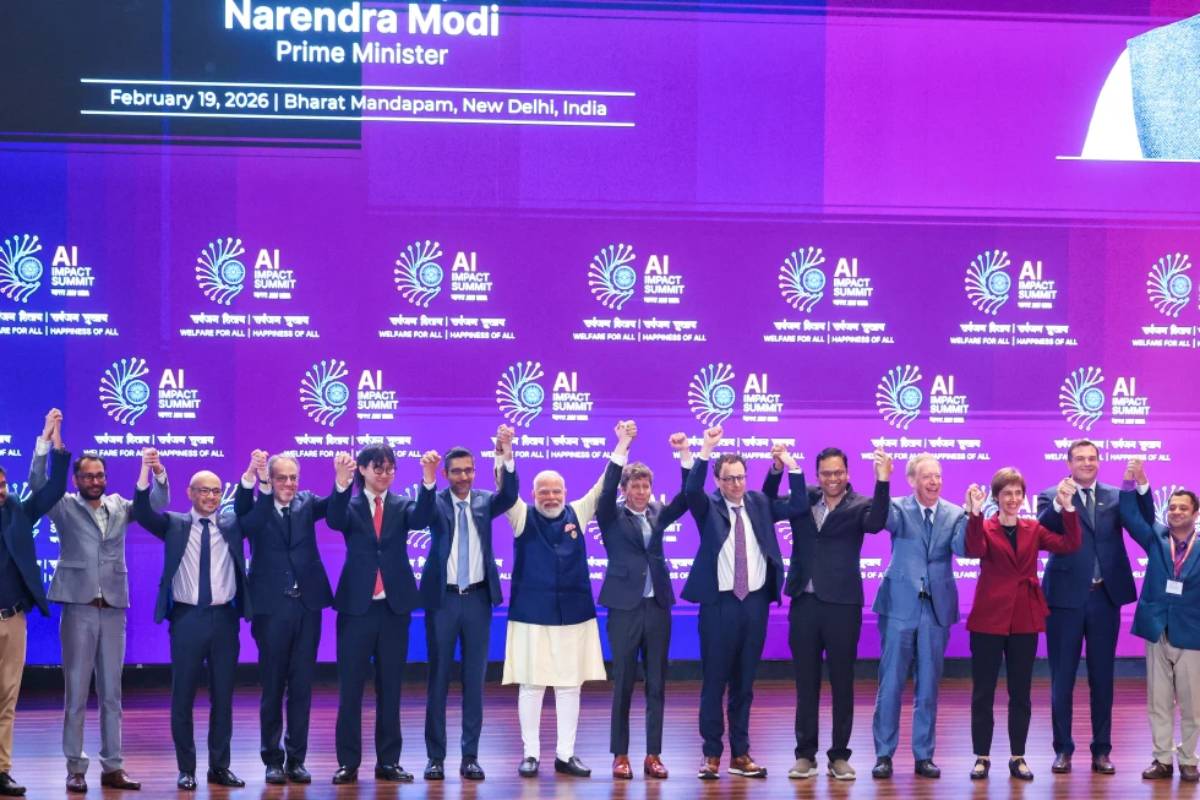
The awkward optics emerged during a high profile AI summit hosted by Narendra Modi, where Sam Altman and Dario Amodei were both present. Reports indicated that the two AI executives avoided direct interaction during a public photo opportunity.

February 24, 2026
|

A moment of visible tension unfolded at India’s flagship AI summit as top US tech leaders appeared to avoid interaction, casting an unexpected shadow over Prime Minister Narendra Modi’s global technology push. The episode underscores intensifying competition within the AI sector and highlights India’s growing role as a strategic AI battleground.

The awkward optics emerged during a high profile AI summit hosted by Narendra Modi, where Sam Altman and Dario Amodei were both present. Reports indicated that the two AI executives avoided direct interaction during a public photo opportunity, drawing attention to the competitive tensions between their respective companies, OpenAI and Anthropic.

The summit itself was designed to position India as a central hub in global AI governance, innovation, and infrastructure development. The moment quickly became symbolic of broader rivalries shaping the next phase of frontier AI competition.

The development aligns with a broader trend across global markets where AI leadership is increasingly defined by both technological capability and geopolitical alignment. OpenAI and Anthropic represent two of the most influential US based AI firms competing to build advanced large language models and enterprise platforms.

India, meanwhile, is seeking to establish itself as a neutral yet powerful AI player. With its vast digital population, expanding data infrastructure, and growing startup ecosystem, the country is positioning itself as a testing ground for AI deployment at scale.

The summit reflects India’s ambition to shape global AI governance frameworks while attracting foreign investment and partnerships. However, the visible friction between major US AI leaders highlights how corporate competition is intersecting with national strategy, diplomacy, and global regulatory debates.

While no formal dispute was announced, analysts suggest the optics reflect intensifying rivalry within the frontier AI sector. Competition for enterprise clients, model performance leadership, and government contracts has heightened tensions among top AI firms.

Industry observers note that public appearances at high profile geopolitical events often carry symbolic weight. In this case, the absence of visible engagement between executives may signal strategic distancing amid competitive positioning.

Indian officials have framed the summit as a platform for collaboration and global cooperation. Corporate representatives have largely avoided public comment on the optics, instead reiterating commitments to AI safety, innovation, and partnerships in emerging markets. Market analysts say such moments illustrate how AI competition now extends beyond product launches into diplomatic theatre and influence building.

For global executives, the episode underscores how AI competition is reshaping corporate diplomacy. Companies must navigate not only technological advancement but also geopolitical alignment and public perception.

Investors are closely watching how AI leaders expand in high growth markets such as India, where government backing, infrastructure policy, and regulatory frameworks will influence long term profitability.

For policymakers, the summit highlights the challenge of fostering collaboration while managing strategic competition. Governments aiming to attract AI investment must balance neutrality with regulatory clarity and national security considerations.

Enterprises operating across jurisdictions may need to reassess partnership strategies in an increasingly fragmented AI ecosystem. As India deepens its AI ambitions, future summits will likely draw even greater global scrutiny. Decision makers should watch for concrete policy announcements, infrastructure investments, and cross border research partnerships emerging from the initiative.

The optics at this summit serve as a reminder that AI leadership is as much about influence and alignment as it is about code.

Source: Associated Press
Date: February 2026

  • Featured tools
Surfer AI
Free

Surfer AI is an AI-powered content creation assistant built into the Surfer SEO platform, designed to generate SEO-optimized articles from prompts, leveraging data from search results to inform tone, structure, and relevance.

#
SEO
Learn more
Scalenut AI
Free

Scalenut AI is an all-in-one SEO content platform that combines AI-driven writing, keyword research, competitor insights, and optimization tools to help you plan, create, and rank content.

#
SEO
Learn more

Learn more about future of AI

Join 80,000+ Ai enthusiast getting weekly updates on exciting AI tools.
Thank you! Your submission has been received!
Oops! Something went wrong while submitting the form.

Modi AI Summit Optics Spotlight US Rivalries, Balancing

February 24, 2026

The awkward optics emerged during a high profile AI summit hosted by Narendra Modi, where Sam Altman and Dario Amodei were both present. Reports indicated that the two AI executives avoided direct interaction during a public photo opportunity.

A moment of visible tension unfolded at India’s flagship AI summit as top US tech leaders appeared to avoid interaction, casting an unexpected shadow over Prime Minister Narendra Modi’s global technology push. The episode underscores intensifying competition within the AI sector and highlights India’s growing role as a strategic AI battleground.

The awkward optics emerged during a high profile AI summit hosted by Narendra Modi, where Sam Altman and Dario Amodei were both present. Reports indicated that the two AI executives avoided direct interaction during a public photo opportunity, drawing attention to the competitive tensions between their respective companies, OpenAI and Anthropic.

The summit itself was designed to position India as a central hub in global AI governance, innovation, and infrastructure development. The moment quickly became symbolic of broader rivalries shaping the next phase of frontier AI competition.

The development aligns with a broader trend across global markets where AI leadership is increasingly defined by both technological capability and geopolitical alignment. OpenAI and Anthropic represent two of the most influential US based AI firms competing to build advanced large language models and enterprise platforms.

India, meanwhile, is seeking to establish itself as a neutral yet powerful AI player. With its vast digital population, expanding data infrastructure, and growing startup ecosystem, the country is positioning itself as a testing ground for AI deployment at scale.

The summit reflects India’s ambition to shape global AI governance frameworks while attracting foreign investment and partnerships. However, the visible friction between major US AI leaders highlights how corporate competition is intersecting with national strategy, diplomacy, and global regulatory debates.

While no formal dispute was announced, analysts suggest the optics reflect intensifying rivalry within the frontier AI sector. Competition for enterprise clients, model performance leadership, and government contracts has heightened tensions among top AI firms.

Industry observers note that public appearances at high profile geopolitical events often carry symbolic weight. In this case, the absence of visible engagement between executives may signal strategic distancing amid competitive positioning.

Indian officials have framed the summit as a platform for collaboration and global cooperation. Corporate representatives have largely avoided public comment on the optics, instead reiterating commitments to AI safety, innovation, and partnerships in emerging markets. Market analysts say such moments illustrate how AI competition now extends beyond product launches into diplomatic theatre and influence building.

For global executives, the episode underscores how AI competition is reshaping corporate diplomacy. Companies must navigate not only technological advancement but also geopolitical alignment and public perception.

Investors are closely watching how AI leaders expand in high growth markets such as India, where government backing, infrastructure policy, and regulatory frameworks will influence long term profitability.

For policymakers, the summit highlights the challenge of fostering collaboration while managing strategic competition. Governments aiming to attract AI investment must balance neutrality with regulatory clarity and national security considerations.

Enterprises operating across jurisdictions may need to reassess partnership strategies in an increasingly fragmented AI ecosystem. As India deepens its AI ambitions, future summits will likely draw even greater global scrutiny. Decision makers should watch for concrete policy announcements, infrastructure investments, and cross border research partnerships emerging from the initiative.

The optics at this summit serve as a reminder that AI leadership is as much about influence and alignment as it is about code.

Source: Associated Press
Date: February 2026

Promote Your Tool

Copy Embed Code

Similar Blogs

April 3, 2026
|

AI Website Builder Accelerates Wix Platform Evolution

Wix’s AI website builder allows users to generate complete websites through conversational prompts, eliminating the need for traditional coding or design expertise.
Read more
April 3, 2026
|

Microsoft Warns of Rising AI Threat Abuse

Microsoft’s latest security analysis highlights how threat actors are increasingly exploiting AI systems not just as tools, but as targets and attack vectors.
Read more
April 3, 2026
|

OpenAI Signals Shift in Generative Media Strategy

OpenAI is reported to be discontinuing or limiting access to its AI video capabilities, particularly those associated with its Sora model.
Read more
April 3, 2026
|

Meta Advances Autonomous Infrastructure with AI Agent

KernelEvolve is an AI agent developed by Meta to automatically optimize system-level performance, particularly in ranking and infrastructure workloads.
Read more
April 3, 2026
|

Gemma 4 Boosts NVIDIA Edge AI Push

NVIDIA announced enhanced support for Gemma 4 through its RTX AI platform, allowing developers to run advanced AI models locally on GPUs.
Read more
April 3, 2026
|

Microsoft Expands AI Arsenal with New Models

Microsoft’s latest announcement includes three foundational AI models designed to enhance performance across reasoning, language processing, and multimodal capabilities.
Read more