



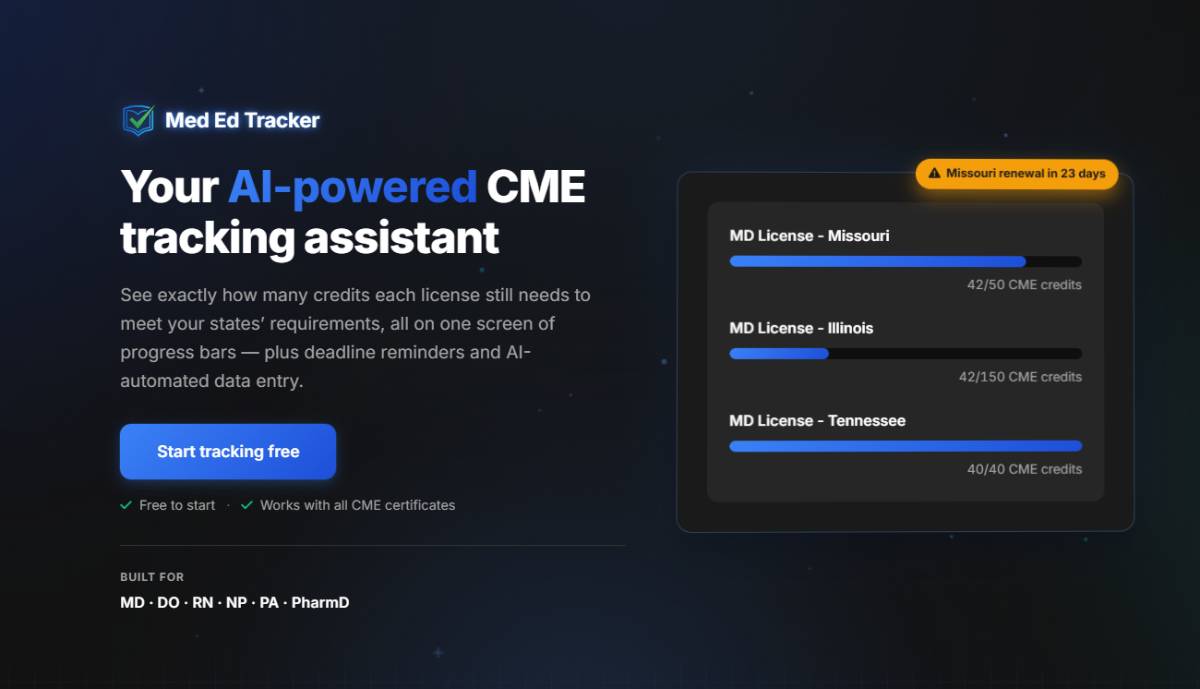
Med Ed Tracker is modernizing continuing medical education and professional license management through a centralized digital platform designed to help healthcare professionals monitor CME credits, renewal deadlines and compliance documentation. The solution targets physicians, nurses, advanced-practice providers and other licensed professionals facing increasingly complex requirements across U.S. jurisdictions.
Med Ed Tracker combines CME tracking, license management, renewal reminders and document organization within a single platform. Its capabilities are designed to reduce manual administration associated with maintaining professional credentials.
The platform supports multiple licenses and allows users to track progress toward applicable CME requirements. Automated reminders can help professionals monitor approaching renewal deadlines, while document-management functionality keeps certificates and related records organized.
Its offering also extends to healthcare organizations that need visibility across multiple providers. This creates potential value for practice administrators and compliance teams responsible for ensuring clinicians maintain current credentials.
The healthcare credentialing environment is becoming increasingly complicated as professionals work across state lines, maintain multiple licenses and encounter different CME requirements depending on their profession and jurisdiction.
For individual clinicians, compliance can involve tracking credit categories, completion dates, renewal periods and supporting documentation. For healthcare organizations, the challenge is amplified by the number of professionals and credentials that must be monitored simultaneously.
This environment is creating demand for specialized digital tools that replace spreadsheets, paper certificates and manually maintained calendars. Med Ed Tracker's positioning reflects the wider digitization of healthcare administration, where software increasingly handles repetitive recordkeeping and monitoring tasks.
The trend also aligns with broader enterprise interest in workflow automation. By centralizing compliance information, organizations can potentially gain earlier visibility into approaching deadlines and reduce the risk of administrative oversights.
No new independent analyst assessment or regulatory announcement specifically tied to Med Ed Tracker was identified in the supplied source. As a result, its published product capabilities provide the most relevant basis for evaluating its positioning.
Med Ed Tracker presents its platform as a centralized solution for managing CME and license obligations, helping users organize professional education records and monitor renewal requirements. Its digital-first approach reflects a broader healthcare technology trend: shifting administrative work from manual processes toward automated tracking and notifications.
For healthcare executives, the strategic issue extends beyond convenience. Credential compliance is directly connected with workforce readiness and operational continuity. A missed renewal can create administrative disruption, while incomplete documentation can increase the workload for credentialing personnel.
Industry observers would therefore likely focus on the accuracy of automated tracking, the speed at which regulatory changes are incorporated and the platform's ability to support increasingly complex organizational requirements.
Healthcare organizations could use automated CME and license tracking to reduce administrative workloads and improve visibility across their provider workforce. Practice managers may gain a centralized mechanism for monitoring upcoming renewals and missing documentation.
For clinicians, the value lies in reducing the time required to manually organize certificates and remember multiple deadlines. The approach could be particularly useful for professionals holding credentials across several jurisdictions.
For investors and healthcare technology buyers, specialized compliance platforms represent a growing opportunity as providers digitize administrative operations. However, accuracy, data security, interoperability and regulatory coverage remain critical purchasing considerations.
From a policy perspective, digital tracking tools can support better record management but cannot replace official licensing-board requirements or the responsibility of professionals and employers to verify current rules.
Med Ed Tracker's future growth will depend on its ability to keep pace with changing CME and licensing requirements while expanding automation and organizational capabilities. Buyers should watch for new integrations, profession coverage, enterprise functionality and regulatory updates. As healthcare organizations prioritize workforce compliance and administrative efficiency, specialized digital credential-management platforms are positioned to become increasingly important.
Source: Serchen
Date: August 14, 2026


