
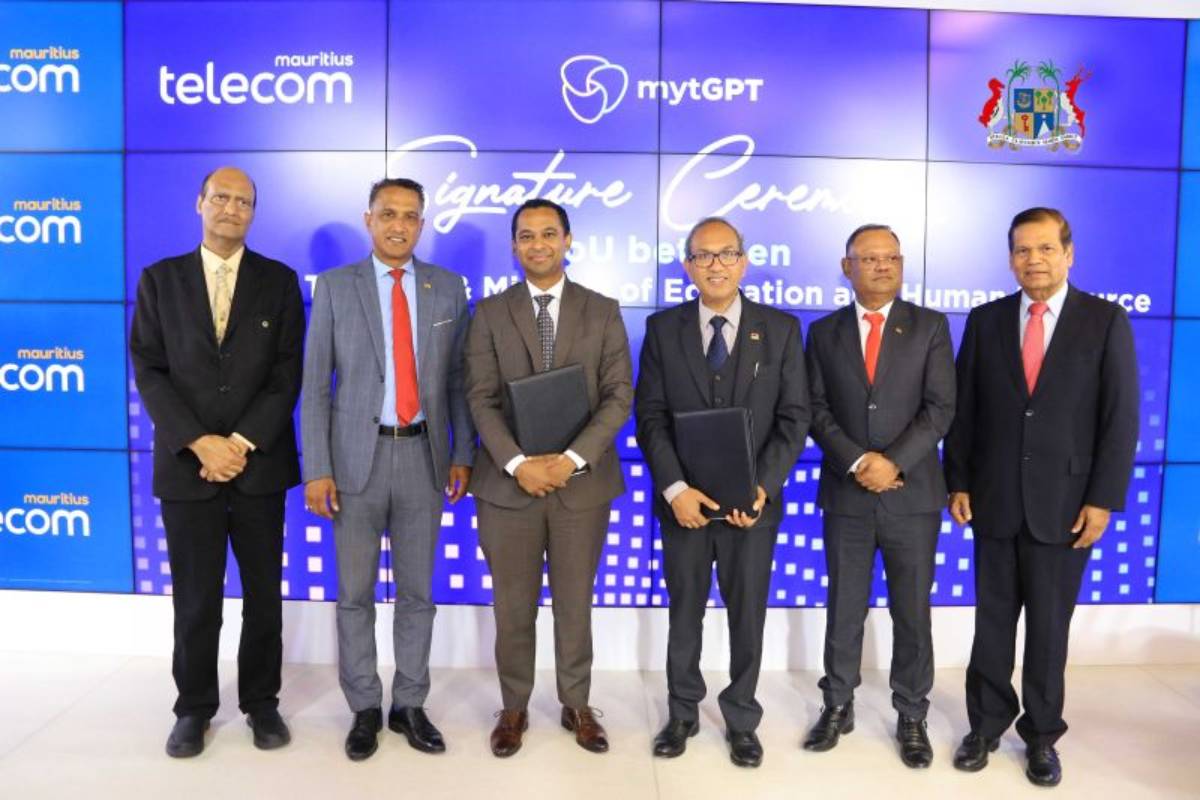
Mauritius Telecom Launches mytGPT Project to Bring AI Classrooms

Mauritius Telecom has introduced mytGPT as part of a broader effort to embed AI tools into the national education ecosystem. The project focuses on providing students and educators with access to generative AI.

February 24, 2026
|

A major development unfolded in Mauritius as the country’s leading telecom operator launched mytGPT, an AI-driven educational initiative aimed at integrating artificial intelligence into classrooms. The move signals a strategic push to modernise education, equip students with future-ready skills, and position the island nation within the global digital economy.

Mauritius Telecom has introduced mytGPT as part of a broader effort to embed AI tools into the national education ecosystem. The project focuses on providing students and educators with access to generative AI capabilities tailored for learning, research, and digital literacy. Initial deployments target schools and academic institutions, with structured content designed to align with curricula. The initiative involves collaboration with education authorities and technology partners to ensure responsible use. By leveraging its digital infrastructure and AI platforms, Mauritius Telecom aims to bridge skills gaps and prepare young learners for an increasingly AI-driven workforce.

The development aligns with a broader trend across global markets where governments and corporations are accelerating AI adoption in education. Countries across Africa, Asia, and Europe are experimenting with AI tutors, adaptive learning systems, and digital classrooms to address teacher shortages and uneven access to quality education. Mauritius, positioning itself as a regional technology and financial hub, has prioritised digital transformation as a pillar of economic policy. Past investments in broadband connectivity, e-government services, and ICT training laid the groundwork for initiatives such as mytGPT. As AI reshapes labour markets worldwide, education systems are under pressure to move beyond traditional curricula and incorporate computational thinking, data literacy, and ethical AI awareness from an early stage.

Education technology analysts view the launch as a notable example of a telecom operator expanding beyond connectivity into digital capability building. Experts argue that AI-powered learning tools can personalise education, improve engagement, and expose students to advanced technologies earlier in their academic journey. However, they also caution that safeguards are essential to prevent over-reliance on automated systems and to protect student data. Industry observers note that initiatives led by large infrastructure providers can scale faster than pilot projects run by schools alone. From a policy perspective, officials often emphasise that AI in classrooms must complement teachers rather than replace them, reinforcing critical thinking and creativity instead of rote automation.

For businesses, the initiative signals a growing pipeline of AI-literate talent emerging from non-traditional tech hubs. Companies operating in Mauritius and the wider region may benefit from a workforce better prepared for digital and data-driven roles. Investors are likely to see the project as reinforcing Mauritius’s ambition to attract technology and knowledge-based industries. For policymakers, mytGPT raises important questions around curriculum standards, teacher training, data governance, and equitable access. Clear frameworks will be required to ensure that AI-enhanced education reduces, rather than widens, digital divides.

Decision-makers will be watching how quickly mytGPT scales across schools and how effectively it integrates with existing teaching methods. Key uncertainties include long-term funding, educator readiness, and regulatory oversight of AI use in classrooms. If successful, the initiative could serve as a model for other emerging economies seeking to combine telecom infrastructure with national AI education strategies.

Source & Date

Source: TechAfrica News
Date: February 2026

  • Featured tools
WellSaid Ai
Free

WellSaid AI is an advanced text-to-speech platform that transforms written text into lifelike, human-quality voiceovers.

#
Text to Speech
Learn more
Wonder AI
Free

Wonder AI is a versatile AI-powered creative platform that generates text, images, and audio with minimal input, designed for fast storytelling, visual creation, and audio content generation

#
Art Generator
Learn more

Learn more about future of AI

Join 80,000+ Ai enthusiast getting weekly updates on exciting AI tools.
Thank you! Your submission has been received!
Oops! Something went wrong while submitting the form.

Mauritius Telecom Launches mytGPT Project to Bring AI Classrooms

February 24, 2026

Mauritius Telecom has introduced mytGPT as part of a broader effort to embed AI tools into the national education ecosystem. The project focuses on providing students and educators with access to generative AI.

A major development unfolded in Mauritius as the country’s leading telecom operator launched mytGPT, an AI-driven educational initiative aimed at integrating artificial intelligence into classrooms. The move signals a strategic push to modernise education, equip students with future-ready skills, and position the island nation within the global digital economy.

Mauritius Telecom has introduced mytGPT as part of a broader effort to embed AI tools into the national education ecosystem. The project focuses on providing students and educators with access to generative AI capabilities tailored for learning, research, and digital literacy. Initial deployments target schools and academic institutions, with structured content designed to align with curricula. The initiative involves collaboration with education authorities and technology partners to ensure responsible use. By leveraging its digital infrastructure and AI platforms, Mauritius Telecom aims to bridge skills gaps and prepare young learners for an increasingly AI-driven workforce.

The development aligns with a broader trend across global markets where governments and corporations are accelerating AI adoption in education. Countries across Africa, Asia, and Europe are experimenting with AI tutors, adaptive learning systems, and digital classrooms to address teacher shortages and uneven access to quality education. Mauritius, positioning itself as a regional technology and financial hub, has prioritised digital transformation as a pillar of economic policy. Past investments in broadband connectivity, e-government services, and ICT training laid the groundwork for initiatives such as mytGPT. As AI reshapes labour markets worldwide, education systems are under pressure to move beyond traditional curricula and incorporate computational thinking, data literacy, and ethical AI awareness from an early stage.

Education technology analysts view the launch as a notable example of a telecom operator expanding beyond connectivity into digital capability building. Experts argue that AI-powered learning tools can personalise education, improve engagement, and expose students to advanced technologies earlier in their academic journey. However, they also caution that safeguards are essential to prevent over-reliance on automated systems and to protect student data. Industry observers note that initiatives led by large infrastructure providers can scale faster than pilot projects run by schools alone. From a policy perspective, officials often emphasise that AI in classrooms must complement teachers rather than replace them, reinforcing critical thinking and creativity instead of rote automation.

For businesses, the initiative signals a growing pipeline of AI-literate talent emerging from non-traditional tech hubs. Companies operating in Mauritius and the wider region may benefit from a workforce better prepared for digital and data-driven roles. Investors are likely to see the project as reinforcing Mauritius’s ambition to attract technology and knowledge-based industries. For policymakers, mytGPT raises important questions around curriculum standards, teacher training, data governance, and equitable access. Clear frameworks will be required to ensure that AI-enhanced education reduces, rather than widens, digital divides.

Decision-makers will be watching how quickly mytGPT scales across schools and how effectively it integrates with existing teaching methods. Key uncertainties include long-term funding, educator readiness, and regulatory oversight of AI use in classrooms. If successful, the initiative could serve as a model for other emerging economies seeking to combine telecom infrastructure with national AI education strategies.

Source & Date

Source: TechAfrica News
Date: February 2026

Promote Your Tool

Copy Embed Code

Similar Blogs

April 24, 2026
|

Apple iPhone Feature Targets Rising Spam Calls

Apple is promoting a native iPhone setting “Silence Unknown Callers” that automatically filters calls from numbers not in a user’s contacts, recent calls, or Siri suggestions.
Read more
April 24, 2026
|

McAfee Pushes Tools for Growing Digital Footprints

McAfee has introduced features that allow users to identify, manage, and delete outdated online accounts, subscriptions, and stored personal data.
Read more
April 24, 2026
|

Mullvad Adds iOS Kill Switch to Boost Privacy

Mullvad VPN’s new feature acts as a kill switch, automatically blocking all internet traffic if the VPN disconnects, ensuring no data leaks occur during transitions between networks.
Read more
April 24, 2026
|

AI Tools Boost Cyber Threats From N Korean Hackers

Investigations reveal that threat actors associated with North Korea are increasingly leveraging AI-powered tools to improve phishing campaigns, automate coding tasks, and refine social engineering tactics.
Read more
April 24, 2026
|

Mozilla Uses AI Bug Hunting to Boost Firefox Security

Mozilla used Anthropic’s Mythos AI tool to uncover and fix 271 bugs within Firefox, significantly enhancing the browser’s security and performance.
Read more
April 24, 2026
|

Google Revives Persistent AI for Smart Homes

Google is reintroducing “continued conversations” in its Gemini for Home experience, allowing users to interact with devices without repeatedly triggering wake commands.
Read more