



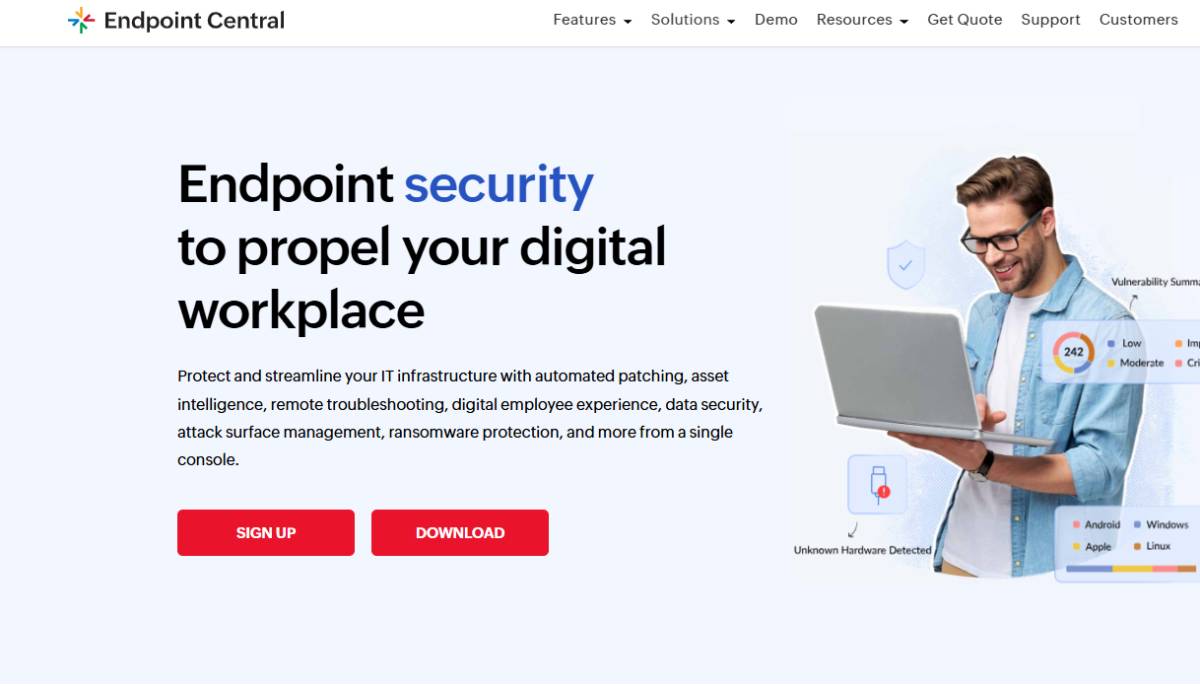
ManageEngine Endpoint Central reflects the growing enterprise focus on centralized endpoint management as organizations navigate increasingly distributed workforces and expanding device environments. By bringing endpoint administration, monitoring, security, and automation into a unified platform, it addresses a critical operational challenge: maintaining secure, reliable, and efficiently managed devices at enterprise scale.
ManageEngine Endpoint Central operates within the unified endpoint management and enterprise IT operations market, supporting organizations responsible for managing computers, mobile devices, applications, and other endpoints.
Its broader capabilities are designed to help IT teams automate routine administration, deploy software, monitor devices, manage configurations, and address endpoint security requirements from a centralized environment. This approach can reduce fragmented tooling and give technology teams greater visibility across distributed device fleets.
The platform is particularly relevant as organizations adopt hybrid work models and expand cloud-connected infrastructure. More endpoints mean greater management complexity, making centralized visibility and automated administration increasingly important for IT departments seeking to control operational costs while maintaining security and productivity.
The development aligns with a broader transformation in enterprise IT management. The traditional corporate network has expanded beyond office buildings, with employees accessing business systems through laptops, smartphones, tablets, and other connected devices from multiple locations.
This distributed environment has created new challenges for IT leaders. Organizations must maintain software updates, configuration standards, device compliance, and security controls while ensuring employees can access the resources required to remain productive.
Endpoint management has therefore become closely connected with cybersecurity and operational resilience. Unpatched or poorly configured devices can create vulnerabilities, while fragmented administration can increase costs and slow IT response times.
For enterprises, centralized endpoint management provides a potential way to standardize technology operations across large device fleets. ManageEngine Endpoint Central sits within this broader shift toward integrated IT administration, automation, and security.
Technology analysts increasingly view endpoint management as a foundational component of modern enterprise IT strategy. From a C-suite perspective, the value of platforms such as Endpoint Central lies in their ability to connect routine device administration with broader security, compliance, and productivity objectives.
IT leaders are likely to evaluate such platforms based on automation capabilities, scalability, reporting, integration, device visibility, and the ability to support different operating environments. Centralized management can also help organizations establish consistent policies across geographically dispersed teams.
Industry experts emphasize that endpoint management cannot operate independently of cybersecurity. Device inventory, patching, configuration management, and access controls increasingly overlap with an organization's broader security posture.
As enterprises continue modernizing their infrastructure, the convergence of endpoint management and security is likely to become increasingly important for technology executives responsible for reducing operational risk.
For global businesses, centralized endpoint management can help reduce administrative overhead while improving visibility across corporate devices. Automated software deployment, patch management, configuration controls, and monitoring can enable IT teams to manage larger environments without relying entirely on manual processes.
For investors, the category reflects sustained enterprise demand for technologies that improve IT efficiency while strengthening cybersecurity. Employees can benefit from more reliable device support and faster resolution of common technical issues.
Policy considerations include data privacy, device monitoring, cybersecurity standards, and regulatory compliance. Organizations must establish appropriate governance around employee-device data and ensure endpoint-management practices do not conflict with privacy obligations. As device fleets expand, executives will increasingly need to balance operational visibility with responsible data governance.
Endpoint management is likely to become increasingly automated and closely integrated with cybersecurity, artificial intelligence, and cloud infrastructure. Decision-makers should watch how platforms improve predictive maintenance, automated remediation, and cross-platform management. The strategic priority for enterprises will be to create a secure and manageable endpoint environment without adding unnecessary complexity. As workforces remain distributed, centralized endpoint intelligence will remain an important component of modern IT strategy.
Source: Crozdesk
Date: August 12, 2026


