



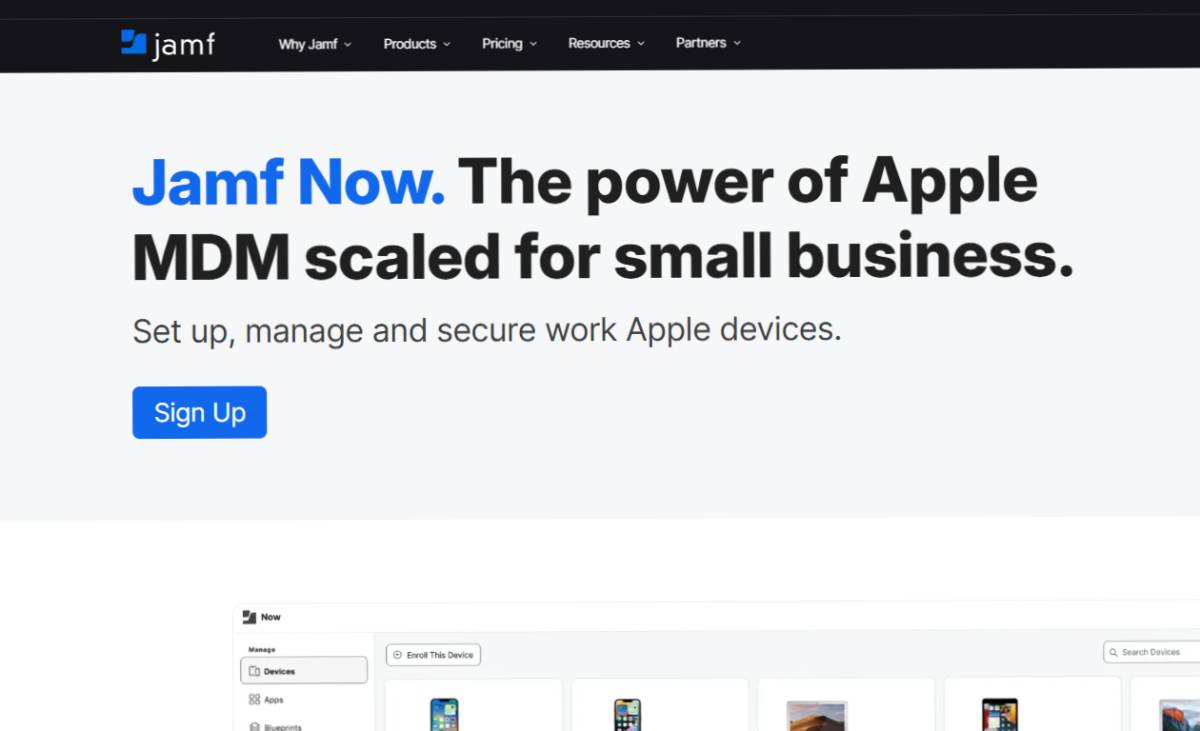
Jamf Now is strengthening the device-management landscape for organizations seeking simpler ways to deploy and secure Apple devices. Its cloud-based approach addresses the growing challenge of managing distributed Mac, iPhone and iPad fleets, giving businesses a more centralized way to configure devices, enforce controls and support employees without extensive IT infrastructure.
Jamf Now is designed to simplify mobile device management for organizations using Apple hardware. The platform enables businesses to enroll devices, configure settings, deploy applications and establish security controls through centralized cloud-based administration.
Its approach is particularly suited to small and growing businesses that may not have large IT teams or extensive device-management infrastructure. Centralized administration can reduce the need for manual configuration when organizations deploy multiple Apple devices.
The technology also supports remote management, an increasingly important capability as employees work across offices, homes and other locations. For business leaders, simplified device administration can reduce operational overhead while helping maintain consistent security and configuration standards across corporate hardware.
The development aligns with the rapid growth of cloud-based IT management and distributed workforces. Organizations increasingly provide employees with laptops, smartphones and tablets that must remain secure regardless of where those devices are used.
Managing devices individually can become inefficient as employee numbers increase. IT teams may need to configure settings, install applications, enforce security policies and respond to device issues across geographically dispersed users.
Mobile device management platforms address these challenges by centralizing administration. Cloud-based systems can allow IT teams to manage devices remotely while reducing dependence on physical access to corporate hardware.
Apple's strong presence in business environments has also increased demand for specialized management capabilities. While large enterprises may operate sophisticated endpoint-management infrastructures, smaller organizations often require simpler tools that can be deployed quickly.
For executives, the strategic issue is balancing ease of management with security. As more business activity moves onto employee devices, effective endpoint management becomes increasingly important to operational continuity and cybersecurity.
IT management specialists increasingly emphasize that device security must extend beyond traditional office networks. Employees can access business applications and sensitive information from multiple locations, making centralized endpoint controls increasingly important.
Jamf Now reflects this shift by providing cloud-based management capabilities focused on Apple devices. Its simplified approach can help organizations establish standardized configurations without requiring highly complex IT administration.
For technology leaders, however, ease of deployment must be matched by appropriate security controls. Device enrollment, access management, application policies and configuration standards need to be consistently maintained as organizations grow.
Remote management also introduces important governance considerations. Organizations must establish clear policies around device ownership, employee privacy, access permissions and the handling of corporate information.
Industry observers are also watching how device-management platforms integrate with identity management, endpoint security and automated compliance tools. Greater integration could allow smaller IT teams to manage increasingly complex device environments more efficiently.
For businesses, centralized Apple device management can reduce manual setup and administration while improving consistency across corporate devices. This can be particularly valuable for small and medium-sized organizations with limited IT resources.
For executives, the technology can support faster device deployment and stronger operational control while reducing the administrative burden associated with growing hardware fleets.
Employees may benefit from more consistent device configurations and faster access to required applications and services. From a policy perspective, organizations must balance device management with employee privacy and data-protection requirements. Clear policies are particularly important where corporate and personal devices are used together.
For investors and technology leaders, endpoint management is increasingly connected to broader cybersecurity strategy. Effective device administration can become an important layer in protecting corporate applications and data.
Apple device management is likely to become increasingly automated as artificial intelligence, identity controls and endpoint-security technologies converge. Future platforms may automate configuration, identify security risks and provide more proactive compliance monitoring.
Decision-makers should watch how device-management providers address increasingly distributed workforces while maintaining security and privacy. The strongest solutions will combine simplicity with robust controls, allowing organizations to scale Apple device fleets without proportionally increasing IT complexity.
Source: Crozdesk; Jamf Now
Date: August 11, 2026


