



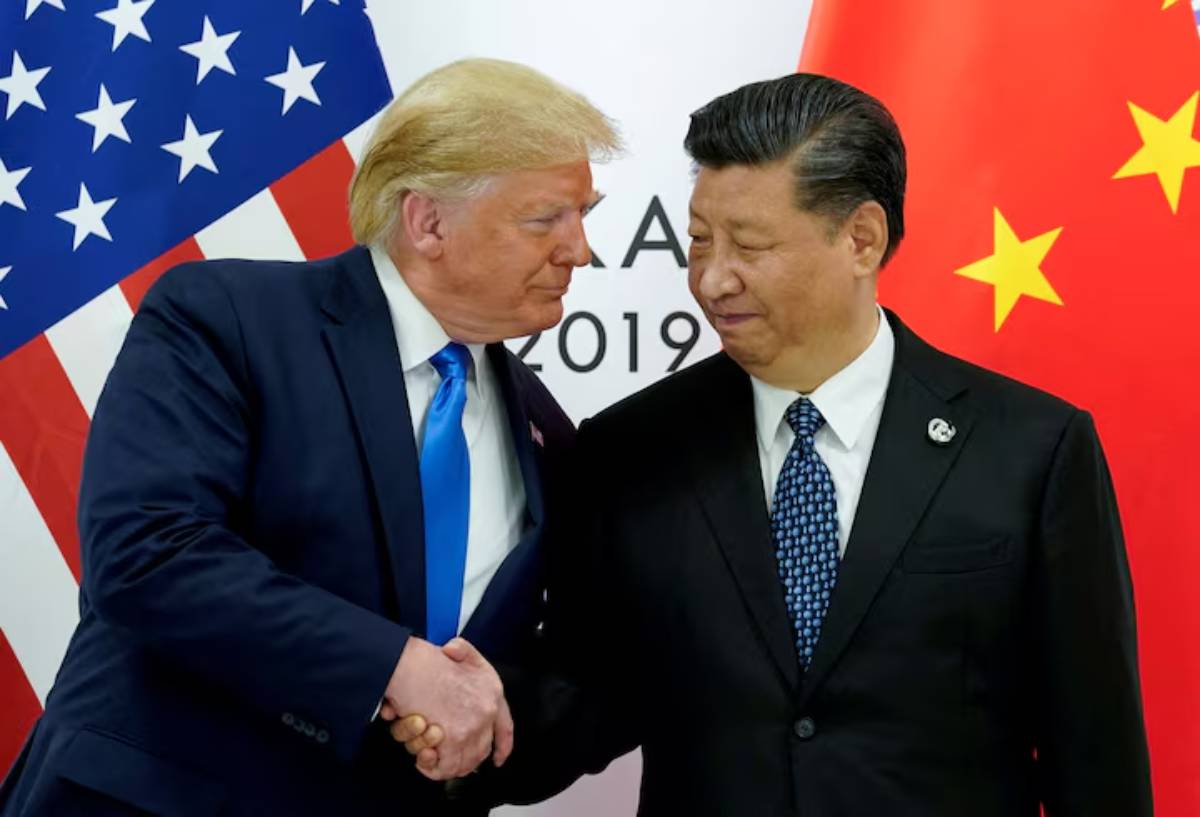
A growing number of global investors are calling on leaders in the United States and China to avoid escalating political interference in the artificial intelligence sector, warning that geopolitical tensions could disrupt one of the world’s fastest-growing technology markets. The debate highlights mounting concern across financial markets over regulation, export controls, and strategic fragmentation in the global AI economy.
Investors and market participants told Reuters they want both Donald Trump and Xi Jinping to minimize political disruption to AI development and global technology investment flows.
The concerns emerge as the United States and China intensify competition over semiconductors, AI infrastructure, cloud computing, and advanced manufacturing capabilities. Investors fear additional trade restrictions, technology bans, and regulatory interventions could destabilize supply chains and slow commercial AI deployment.
Market participants emphasized that AI remains one of the strongest global growth sectors, attracting significant capital into chipmakers, cloud providers, software firms, and data-center infrastructure operators.
The discussion also reflects wider anxiety over whether geopolitical rivalry may fragment the global AI ecosystem into competing regional technology blocs with differing standards, regulations, and infrastructure access.
The development aligns with a broader geopolitical shift in which artificial intelligence has become a central pillar of strategic competition between the United States and China. Over the past several years, Washington has expanded export controls targeting advanced semiconductor technologies, while Beijing has accelerated domestic AI and chip self-sufficiency initiatives.
The AI sector has simultaneously become one of the most significant drivers of global equity markets, fueling massive valuations across companies including Nvidia, Microsoft, Alphabet, and major Chinese technology firms.
Historically, global technology ecosystems benefited from deeply interconnected supply chains spanning U.S. software, Taiwanese semiconductor manufacturing, Chinese hardware production, and international cloud infrastructure. However, rising geopolitical tensions are increasingly challenging that interconnected model.
Governments worldwide are now treating AI not only as a commercial technology, but also as a national-security asset tied to economic competitiveness, military modernization, and digital sovereignty. This has intensified concerns among investors who fear excessive political intervention could undermine innovation efficiency and global capital flows.
The debate also reflects broader uncertainty surrounding how governments should regulate AI without slowing technological progress or creating market fragmentation. Market analysts argue that investors are seeking predictability rather than complete deregulation. Financial institutions and technology investors broadly support responsible AI oversight, but many remain concerned that geopolitical escalation could create long-term instability across supply chains and technology markets.
Industry strategists note that AI development depends heavily on globally integrated ecosystems involving semiconductor manufacturing, cloud infrastructure, data flows, and research collaboration. Disruptions to any major component of that ecosystem could raise costs, delay deployment timelines, and reduce investment efficiency.
Economic analysts also warn that intensified U.S.-China technology decoupling may create duplicative infrastructure systems, forcing corporations to maintain separate compliance, manufacturing, and cloud environments for different geopolitical regions.
Technology executives increasingly emphasize that innovation leadership depends on maintaining access to talent, capital, and international markets. Analysts suggest that excessive export controls or retaliatory restrictions could weaken competitiveness even for companies operating within protected domestic markets.
Policy experts, however, argue that governments are unlikely to fully step back from AI oversight given the technology’s strategic implications for cybersecurity, military systems, surveillance capabilities, and critical infrastructure resilience.
The tension between national-security priorities and market efficiency is therefore expected to remain a defining feature of the global AI economy. For businesses, growing geopolitical pressure surrounding AI could complicate long-term planning, particularly for multinational corporations reliant on cross-border supply chains and international market access. Technology firms may increasingly need region-specific infrastructure, compliance strategies, and data-governance frameworks.
Investors are likely to continue favoring AI-related assets but may also become more sensitive to geopolitical risk exposure, especially in semiconductors, cloud infrastructure, and advanced manufacturing sectors.
For policymakers, the challenge lies in balancing national-security concerns with economic competitiveness. Governments face rising pressure to protect strategic technologies without disrupting innovation ecosystems or discouraging investment.
Consumers could also be indirectly affected through higher technology costs, reduced platform interoperability, and slower rollout of AI-enabled products if geopolitical fragmentation accelerates.
The broader AI market may increasingly depend on diplomatic stability as much as technological advancement. Global investors will closely watch future trade negotiations, semiconductor export policies, and AI regulatory initiatives emerging from both Washington and Beijing. The direction of U.S.-China relations may significantly shape the pace and structure of global AI development over the coming decade.
The central question now is whether the AI economy evolves as a globally interconnected ecosystem or fractures into competing geopolitical technology spheres with separate rules, infrastructure, and innovation pathways.
Source: Reuters
Date: May 12, 2026


